

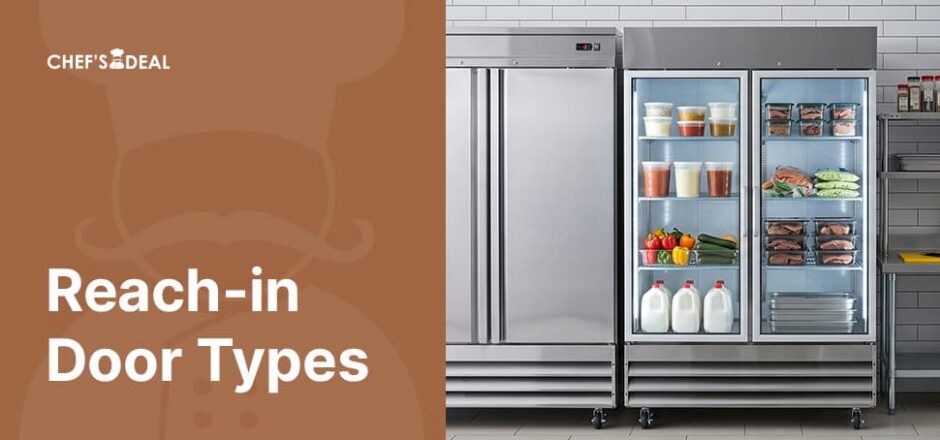
Reach-in refrigerator door types play a critical role in balancing temperature control, energy efficiency, and operational speed. Each design directly affects how much cold air escapes during use, how quickly staff can locate items, and how hard the system must work to maintain safe storage temperatures. Over time, even small differences in insulation and access efficiency can significantly impact energy costs and overall kitchen performance.
Reach-in refrigerators are available in four main door configurations: solid doors, glass doors, half doors (also called split doors), and pass-through doors. Each is engineered for a different operational priority, and choosing the wrong type for your setting can quietly inflate your utility bills, slow down service, or create cross-traffic hazards in your kitchen.
Selecting the right door type depends on your specific workflow and business environment. Solid doors maximize insulation and reduce operating costs, while glass doors improve visibility and merchandising potential. Half doors offer a smart compromise by minimizing air loss during frequent access, and pass-through designs streamline kitchen workflows in high-volume operations.
What are Reach-in Refrigerator Door Types?
Reach-in refrigerator door types include solid, glass, half, and pass-through doors, each offering distinct benefits for specific conditions and use cases. A reach-in refrigerator is a freestanding or built-in commercial cooling unit that holds chilled foods at optimal preservation temperatures, typically between 32° and 41°F (0°C and 5°C), below the Danger Zone.
You can access the stored items in these commercial refrigeration coolers by opening one or more front-facing doors, resulting in loss of chill, more frequent operation, and higher energy consumption.
To minimize chill loss and prevent temperature fluctuations, commercial reach-in refrigerators feature powerful compressors to compensate for the loss and reach-in cooler door types to increase insulation, prevent air escape, and facilitate locating the products.
Door type is a primary factor that determines how much cold air escapes during access, how quickly staff can locate and retrieve items, and how much energy the compressor must consume to maintain the set temperature after each opening. Since commercial reach-in refrigerators run uninterrupted, even small differences in door efficiency add up significantly over a year.
Solid Door Reach-In Refrigerators
Solid-door reach-ins are opaque door types mostly manufactured from high-quality stainless steel to ensure durability and rust resistance. Solid reach-in refrigerator doors feature high-density polyurethane foam insulation between the inner and outer skins, which provides maximum thermal separation between the cabinet interior and the ambient kitchen environment.
- Insulation Advantage: Solid reach-in refrigeration doors feature 2” (5.08 cm) thick high-density polyurethane insulation and create a barrier against the ambient temperature. The insulated construction of a solid door eliminates thermal conductivity, a significant disadvantage of glass panels. Hence, in commercial kitchen conditions, where ambient temperatures near cooking equipment frequently reach 85°F to 100°F (29.4°C to 37.7°C), the low conductivity of solid doors directly improves air retention in the cabinet.
- Lower Energy Costs: Solid doors reduce passive heat gain and allow less cold air to escape through openings. Hence, solid-door refrigerators offer up to 20% energy savings over comparable glass-door models under equivalent usage conditions. Over the course of a year in a commercial kitchen, this translates into measurable utility savings.
- Best for Prep Kitchens: Solid doors are the most common choice for ingredient storage and for temporarily storing prepared pans, especially in back-of-house operations. Hence, they are perfect for prep kitchens where kitchen staff know the unit’s contents and layout.

Glass Door Reach-In Refrigerators
Glass door reach-in refrigerators have single- or double-pane tempered glass panels that allow staff and customers to see the refrigerator’s interior without opening the door. Some glass-door reach-in refrigerators feature “Low-E” (Low Emissivity) glass doors that reduce heat transfer and increase light transmission for better visibility and lower chill loss.
- Product Visibility: The defining advantage of glass door refrigerators is unobstructed visibility into the cabinet interior. In restaurants, bars, and cafés, this allows waiters, bartenders, and baristas to locate specific bottles, cans, or products at a glance before opening the door, reducing access time and opening duration. In retail and grab-and-go environments, glass doors allow customers to browse products without opening the unit.
- Faster Access Decisions: Enhanced product visibility through glass doors helps your staff or your customers to confirm the location of a specific product before opening the door. This significantly reduces the opening time and the duration the door remains open, improving energy efficiency.
- Merchandising Advantage: Glass-door reach-in refrigerators are versatile units that are used as both storage units and display cases. For bars, cafés, and retail convenience setups, the revenue impact of a glass door display can offset the unit’s higher energy costs over time.

Half Door (Split Door) Reach-In Refrigerators
Half-door reach-in refrigerators, also referred to as Dutch half doors, split-door or divided-door units, feature two independently operable panels stacked vertically within a single door opening.
These commercial reach-in-door types enable the creation of organized sections of items rather than keeping everything in one cabinet. So, your staff opens only the upper or lower half of the door, depending on where the needed item is stored, accessing only the relevant section of the cabinet interior.
- Reduced Cold Air Loss: Each time you open the refrigerator door, cold air mixes with warm ambient air, causing the compressor to cycle more frequently to restore the set temperature. A full-height door opening creates a vertical column through which cold air escapes and hot air enters. A Dutch half-door limits this exchange to 50% of the door height, substantially reducing the volume of cold air lost per access event.
- Ergonomic Benefits: Half doors reduce unnecessary bending by allowing staff to store frequently used items in the upper half of the cabinet. This is particularly useful in fast-paced prep environments where staff have to go back and forth many times over the course of a long shift.
- Energy vs. Access Balance: Half-door reach on refrigerator doors offers a smart solution that balances solid-door efficiency and glass-door accessibility. Full-glass half doors enable high visibility while reducing energy consumption by improving energy retention. Additionally, Full solid Dutch half doors offer enhanced energy efficiency while enabling better storage organization to facilitate product finding. There are also combo reach-in refrigerators with glass and solid half-door options to address small-scale needs.
Pass-Through (Dual Access) Refrigerators
Pass-through reach-in refrigerators feature doors on both the front and rear of the unit, allowing staff positioned on either side of the cabinet to access the same refrigerated storage space independently.
- Kitchen Workflow Optimization: A pass-through reach-in refrigerator allows prep staff to load items from the back and line cooks to retrieve them from the front. This streamlines kitchen workflow through a seamless transfer without requiring either team to cross the other’s work zone.
- Reduces Cross-Traffic: In a conventional kitchen layout, a single-access refrigerator forces prep staff and line cooks to use the same side of the unit. This creates cross-traffic and congestion, which results in delays during peak service. Pass-through reach-in refrigerators reduce cross-zone movement by creating a dedicated point of transfer between prep and service, allowing each team to operate within their designated area with fewer interruptions.
- Ideal for High-Volume Kitchens: Reducing cross-zone movement, congestion, and facilitating transfers between the prep kitchen and cook line improves workflow in large commercial kitchens. Hence, hotels, large restaurants, catering operations, hospital kitchens, and institutional foodservice facilities benefit most from pass-through configurations.
Solid vs. Glass vs. Half Doors vs. Pass-Through: Side-by-Side Comparison
The following table summarizes the performance characteristics of each reach-in refrigerator door type across the four most operationally significant dimensions.
| Feature | Solid Door | Glass Door | Half Door | Pass-Through |
| Energy Efficiency | Excellent up 20% lower energy vs. glass | Moderate: Higher heat gain through glass | Good Reduced opening frequency | Good Workflow-dependent |
| Visibility | None Contents not visible | Excellent Full product view | Partial Half-section view per door | Moderate Front staff only |
| Cold Air Retention | Excellent Minimal air loss per opening | Moderate Full-height opening per access | Very Good Half-height opening minimizes loss | Good Two-door system limits full exposure |
| Best Use Case | Prep kitchens, back-of-house storage | Bars, cafés, retail display | High-frequency prep lines, bakeries | High-volume pass/receive workflows |
The right door type depends on which of these four dimensions is most critical to your operation’s daily performance. In most commercial kitchens, energy efficiency and cold air retention are the highest-priority factors. In customer-facing environments, visibility and access speed take precedence.
Which Reach-in Door Type is Best by Business Type?
Commercial reach-in door types address different foodservice and retail needs, and the optimal door type varies significantly across business categories:
- Restaurants (Back-of-House Kitchens): In full-service restaurants, solid doors are the most common type of reach-in doors in back-of-the-house operations. The solid door’s insulation advantage directly reduces energy costs use of solid doors reaches ins to store almost the same type of foods in these settings reduces the time for locating the items. Half-door reach-in refrigerators are a significant alternative for high-traffic restaurants, hotels, and caterers, providing divided storage sections with individual access.
- Bars & Cafés: Glass-door reach-in refrigerators are the standard in bars and cafés for both operational and commercial reasons. Bartenders need to identify bottle locations at a glance, and baristas need to quickly locate milk, cream, and cold brew options to keep up with the peak-hour rush. In addition, glass-door reach-in coolers offer merchandising benefits for bars and cafes. A well-organized, backlit glass-door refrigerator showcases craft beers, specialty beverages, and cold-brew options to encourage customers to make more purchases.
- Supermarkets & Retail: Glass doors are the clear choice for retail environments where reach-in refrigerators store products sold directly to customers. Supermarkets, convenience stores, and delis use glass-door reach-in refrigerators to drive impulse purchases by displaying beverages, cold drinks, and specialties.
- High-Volume & Institutional Kitchens: Large institutional kitchens in hotels, hospitals, university dining facilities, catering operations, and restaurants use pass-through configurations at key transfer points between the food prep and cook line sections. When the kitchen processes 300 or more plates per service, pass-through reach-in refrigerators prevent congestion and increase service speed by eliminating cross-traffic. Furthermore, these high-traffic foodservice operations use solid-door reach-in units for general cold storage throughout the kitchen.
Which Door Type Saves the Most Energy?
The door type that saves the most energy depends primarily on the use cases and conditions:
- Solid vs. Glass Energy Comparison: Solid-door reach-in refrigerators consume approximately 10-20% less energy than equivalent glass-door models under the same working conditions. Despite providing high visibility, glass-door reach-in refrigerators consume more energy to compensate for the loss of chill, and anti-sweat heater systems on glass-door frames add to energy consumption.
- Impact of Door Openings per Hour: The main reason for lost chill in reach-in refrigerators is constant door openings. Glass-door reach-in refrigerators reduce the time the door remains open, while solid-door coolers require a longer period to find what your staff looks for. So, glass-door coolers are ideal for front-of-house applications, while a half-solid door can reduce energy consumption by exposing only 50% of the cabinet’s vertical cross-section in back-of- house use.
- Insulation vs. Visibility Trade-Off: The trade-off between insulation performance and visibility is the principal purchasing factor when selecting reach-in doors. Solid doors offer the best insulation and the lowest passive heat gain. Glass doors offer the best visibility and the fastest access decisions, but with higher energy consumption. Half doors reduce the thermal impact with a smaller profile. Pass-through reach-in refrigerators improve workflow efficiency and prevent total exposure to higher temperatures.
How Kitchen Layout Affects Your Door Choice
Your commercial kitchen layout directly affects your choice of reach-in refrigerator door type. Therefore, you should consider physical dimensions, traffic intensity, and operational patterns of your kitchen to find the right door type:
- Choose sliding doors and avoid full swing doors in narrow kitchens. Standard reach-in refrigerator doors swing outward at 90 to 120 degrees and have a door length of around 20 to 30 inches when open. So, if the aisle in front of the commercial refrigerator is below 36 inches (91.44 cm), a full-width door swing can block the aisle entirely when open, preventing comfortable loading and unloading.
- Include Pass-Through reach-in refrigerator doors in high-traffic kitchens to manage traffic flows between prep and service zones. Pass-through refrigerators eliminate the need for crossing between zones.
- Half Doors provide flexibility for prep lines, such as sandwich stations and food and bakery prep lines, that require frequent openings. The half-door configuration reduces cold air loss per opening, and the ergonomic benefit is not having to crouch to access lower shelves.
What are the Common Mistakes When Choosing Reach-In Refrigerator Doors?
Common mistakes when choosing reach-in refrigerator doors directly affect operational efficiency, energy costs, and staff comfort. The most frequent mistakes are:
- Choosing Glass Doors for Back-of-House Storage: Glass door refrigerators are designed for display applications. Installing them in a back-of-house prep kitchen adds unnecessary energy costs without providing any operational benefit, while creating possible renewal costs due to broken doors.
- Ignoring Energy Costs: The constant running of refrigerators in commercial settings. Hence, you should consider the annual energy cost in addition to the initial purchase price. A glass-door unit that costs $300 less than a solid-door equivalent at the time of purchase may consume $100 to $400 more in electricity annually in a hot kitchen environment, compounding to $1000 to $4000 over 10 years of use.
- Wrong Door Swing Direction: Reach-in refrigerators are available with left-hinged and right-hinged door configurations. So, you should select the right direction to enable efficient operation. The door should swing open in the direction that aligns with the natural movement of staff during access.
- Underestimating Opening Frequency: A reach-in refrigerator at a busy sandwich station may be opened 60 to 80 times per hour during lunch rush, even if the daily average is only 30 times per hour. So, you should select your reach-in refrigerator doors based on peak times rather than the daily average.
- Not Considering Workflow: The reach-in door configuration should be selected based on your kitchen layout and workflow. The right door type is the one that best fits the specific workflow context of the position where it will be installed.
Recommended Reach-in Configurations
Reach-in refrigerators are available in various door configurations that offer maximum benefits in common commercial foodservice and retail scenarios. As a starting point for your consideration, we present a recommendation list:
- Small Restaurants: A single 1-solid-door reach-in refrigerator in the prep area provides sufficient cold storage for daily ingredient prep at minimal energy cost.
- Medium Kitchens: A 2-door half-door reach-in refrigerator offers a balance of energy efficiency and access speed for kitchens with moderate-to-high door-opening frequency.
- Bar: Glass door reach-in refrigerators behind the bar provide full product visibility, merchandising display capacity, and rapid access during service.
High-Volume Kitchen: A pass-through reach-in refrigerator in the prep-to-cook line eliminates cross-traffic in high-traffic kitchens.

FAQs About Reach-in Refrigerator Door Types?
What is the most energy-efficient refrigerator door type?
Solid door reach-in refrigerators are the most energy-efficient configuration. Their insulated panels eliminate passive heat gain and minimize cold air loss, offering 10 to 20% less energy use than glass-door models.
What is a half-door refrigerator?
A half-door refrigerator, also called a split-door or half-Dutch-door cooler, features two independently operable panels stacked vertically within a single door opening. Staff open only the upper or lower half of the door, depending on where the needed item is stored, and access only the relevant section of the cabinet.
What is a pass-through refrigerator used for?
A pass-through refrigerator is used to create a smooth, refrigerated transfer point between food preparation areas and cook or service lines, eliminating the need for prep staff and line cooks to cross each other’s work zones.
Do glass door refrigerators increase electricity costs?
Yes. Glass-door reach-in refrigerators consume more electricity than solid-door units under equivalent usage conditions, primarily because glass transmits heat from the ambient kitchen environment into the refrigerated cabinet at a higher rate than solid doors do.
Are glass door refrigerators worth it for restaurants?
Yes, glass-door refrigerators are worth the investment for restaurants, especially in front-of-house or high-visibility applications where display benefits outweigh the energy costs.
Final Verdict: Which Reach-In Refrigerator Door Type Is Right for You?
The right reach-in refrigeration door type is the one that aligns with your kitchen’s specific combination of operational priorities, access frequency, layout constraints, and budget requirements. So:
- If energy efficiency is your primary concern, solid doors deliver the lowest operating cost and the longest compressor service life.
- If product visibility and access speed are your priority, glass doors provide measurable operational and commercial benefits that justify the higher energy cost in those specific contexts.
- If you need to balance high-frequency access with energy efficiency, half-doors reduce cold-air loss per access event without sacrificing access speed.
- If kitchen workflow and cross-traffic reduction are the critical factors, pass-through refrigerators eliminate the most costly bottleneck in the prep-to-service handoff.
Chef’s Deal offers a comprehensive selection of solid-door, glass-door, half-door, and pass-through reach-in refrigerators from industry-leading brands, including True, Turbo Air, Beverage-Air, Continental, Hoshizaki, and more.
Door type is just one piece of the buying decision. Once you’ve settled on it, our reach-in refrigeration buying guide walks through sizing for peak service, choosing a compressor position, and estimating 10-year operating costs.

