

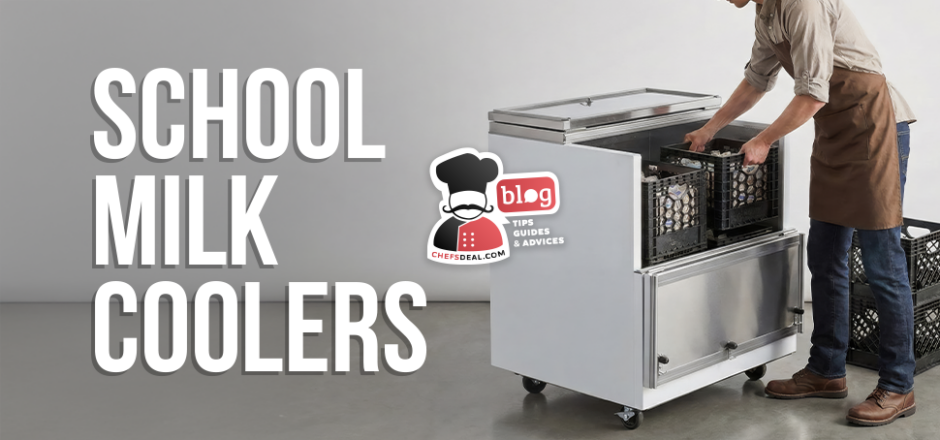
School milk coolers sit at the center of safe, efficient beverage service in today’s cafeterias. Unlike standard refrigerators, these specialized units are designed to store and serve large quantities of milk cartons at precise temperatures, even as hundreds of students pass through the lunch line within a short window.
Operating between 33°F and 38°F (0.556°C and 3.333°C), they support USDA Child Nutrition Program requirements, which mandate specific milk types and portions for every student. By keeping milk consistently cold and readily accessible, school milk coolers help nutrition directors meet both menu standards and food safety expectations.
Because school environments are demanding, school milk coolers are engineered to withstand high capacity, heavy use, and high traffic. They hold far more cartons than a household refrigerator, recover temperature quickly during peak service, and are designed at student-friendly heights with wide-access openings.
Schools can choose from single-side, dual-access, compact, and bulk milk systems depending on enrollment, layout, and service style. At the same time, decision-makers must pay close attention to temperature control, crate configuration, electrical requirements, and regulatory standards like NSF/ANSI 7 and FDA Food Code limits to avoid costly spoilage and health code violations.
Key Takeaways
- School milk coolers maintain safe milk temperatures (36–38°F) even during heavy lunch rushes.
- Dedicated milk coolers outperform regular refrigerators in capacity, durability, and temperature stability.
- Different cooler types serve various needs: single-sided, dual-access, compact, mobile, bulk, and reach-in.
- Proper capacity planning should include a buffer for peak demand and restocking delays.
- NSF/ANSI Standard 7 certification and compliance with the FDA Food Code are essential for schools.
- ENERGY STAR models reduce energy use by 30–40% and lower long-term operating costs.
- Correct placement, ventilation, and airflow prevent compressor failure and temperature drift.
- Regular cleaning, temperature logging, and preventive maintenance extend equipment life to 10–20 years.
- Bulk milk systems reduce packaging waste and can save thousands of dollars annually.
- Grants and assistance programs help schools offset purchase and upgrade costs.
What are School Milk Coolers?
A school milk cooler is a specialized commercial refrigeration unit designed to store and dispense large quantities of milk and juice cartons in school cafeterias, canteens, and dining halls at universities and other educational settings. They operate between 33°F and 38°F (0.556°C and 3.333°C) for optimal preservation and feature a special design that enables quick loading and easy service, even by small children.
Milk is a primary component of school meal programs, and the USDA Food and Nutrition Service requires at least 2 types of milk (unflavored and flavored) for breakfast and lunch. Additionally, each child must receive 8 fluid ounces (oz) of half a pint of fluid milk daily, in accordance with Child Nutrition Program standards. Therefore, schools need dedicated coolers to hold large quantities of milk cartons for students until and during service.

Why Schools Use Milk Coolers Instead of Regular Refrigerators
Schools need higher-capacity, smaller-footprint refrigeration systems that maintain interior chill during service and provide long-term durability in crowded settings. When 300 students grab milk cartons in 30 minutes, temperatures spike. Hence, milk crates must be stored in reliable systems to maintain their safety.
School milk coolers use heavy-duty compressors, reinforced insulation, and rapid air circulation to recover quickly. They’re built at student-friendly heights with wide-access doors that keep lunch lines moving. A standard refrigerator might hold 50 cartons; a school milk cooler stores 200-500 cartons in organized crates. Regular refrigerators fluctuate by 8-12°F (-13.333°C to -11.111°C) when opened frequently, while milk coolers stay within 2-3°F (-16.6667°C to -16.1111°C) of the set temperature even during rush periods, reducing milk spoilage.
How School Milk Coolers Work
School milk coolers use either forced-air or cold-wall systems to efficiently and quickly cool milk cartons to 33°F to 38°F (0.556°C to 3.333°C). Forced-air cooling models typically place the compressors and condensers on top of the unit to increase available storage space and facilitate service. Cold-wall cooling models allow tight stacking and ensure all cartons remain at optimal temperatures.
In addition, school milk coolers are typically top- or side-opening to facilitate loading and streamline service by allowing easier reach. Their construction provides a space that accommodates standard milk crates (13″x 13″x11″ or 19″x13″x 11″) stacked in configurations that maximize airflow.
What are The Key Features to Look For in a School Milk Cooler Before Buying?
The key features to look for in a school milk cooler before buying are:
- Temperature range and precision: Look for units that hold 33-38°F with ±1°F accuracy and a digital display.
- Capacity and crate configuration: Standard crates contain 64 milk cartons, and standard cases contain 50 milk cartons. A 100-student serving capacity requires 4 cases or crates per day for breakfast and lunch service. You can calculate your needs depending on your meals and student capacity.
- Opening style: You can choose flip-doors for elementary access, sliding doors for speed, or a drop-front for ergonomic restocking.
- Service type: Choose double-sided units to accelerate service in crowded settings; single-sided options are ideal for small-scale applications.
- Heavy-duty hinges and reinforced doors: Stainless steel hinges with 100,000-cycle rating, minimum 20-gauge steel doors.
- Locking mechanisms: Keyed locks for after-hours storage prevent tampering and unauthorized access
- Energy efficiency: ENERGY STAR models use 30-40% less power; look for variable-speed compressors.
- Casters: Locking 4” or 5″ (10.16 to 12.7 cm) casters enable easier equipment relocation.

Temperature Requirements for Milk in Schools
The American Dairy Association recommends storing milk at 40°F (4.444°C)or lower, and most school authorities, such as the Los Angeles Unified School District, target 36-40°F (2.222°C-4.444°C) for milk crates and cases.
Because milk shelf life decreases remarkably for every 5-degree rise above 40°F (4.444°C), as explained by the Dairy Alliance of Dairy Producers and Suppliers. Additionally, this temperature must be maintained from the very beginning through service to ensure milk safety and prevent foodborne illness.
Types of School Milk Coolers
Single-sided, dual-access, compact/small, and bulk milk coolers are the main types of school milk coolers.
1. Single-Side Milk Coolers
Single-sided milk coolers are the most common style found in school cafeterias. These units open from the top and one side, allowing placement against a wall or along the edge of a serving line. They work best in cafeterias where student traffic moves in a single direction.
Single-sided school milk coolers typically hold 8–16 crates, depending on size. They are more affordable than dual-access models and easier to install, making them a practical choice for small to mid-size schools that do not require multiple serving lines. Proper side and rear clearance is still important to maintain airflow and cooling performance.
2. Dual-Access Milk Coolers
Dual-access milk coolers (double-sided milk coolers), are designed for high-traffic cafeterias serving large student populations. These units open on both sides and at the top, allowing two lunch lines to move simultaneously when the cooler is placed centrally.
Schools serving 500 or more students per lunch period often use dual-access milk coolers to reduce congestion and shorten wait times. These models require more floor space and a higher initial investment, but they significantly improve service speed in large cafeterias with multiple meal waves.
3. Compact or Small-Capacity Units
Compact milk coolers are ideal for small schools, daycares, and after-school programs. These units typically hold 5–10 crates, or approximately 80–160 cartons, and fit easily into tight spaces.
Most compact school milk coolers operate on standard 110V outlets and do not require dedicated electrical circuits. This simplifies installation and keeps costs lower. These units work well for limited meal volumes but may struggle during peak lunch periods in larger schools.
4. Mobile Milk Coolers
Mobile milk coolers are equipped with heavy-duty casters, allowing staff to move them between serving areas. Schools often use mobile units for breakfast programs, flexible lunch layouts, or summer meal service.
Locking wheels provide stability during service. Mobile school milk coolers offer flexibility but still require careful placement to maintain proper ventilation and temperature consistency.
5. Bulk Milk Coolers
Bulk milk coolers are designed for schools using bag-in-box milk systems instead of individual cartons. These units store large milk bags inside insulated tanks and connect to dispensers or cafeteria serving equipment, allowing students to fill their cups directly.
Schools choose bulk milk coolers to reduce packaging waste, lower daily stocking labor, and simplify milk service. Bulk systems can reduce long-term costs. Research from King County, Washington, shows that bulk school milk coolers and dispensers can save schools up to USD 3,000 annually.
Bulk milk systems require consistent cleaning and staff training to maintain sanitation standards. They work best in schools with established procedures and high milk consumption.
6. Reach-In and Drop-Front Milk Coolers
Some schools use reach-in or drop-front milk coolers instead of top-opening models. These units provide front-only access and are often used in staff-served cafeterias or areas with limited overhead clearance.
Reach-in milk coolers can improve accessibility but may lose cold air more quickly due to frequent door openings. Proper loading and monitoring are important to maintain safe milk temperatures.
Capacity Guide: How Big Should Your School Milk Cooler Be?
To determine the capacity you need for your school milk cooler, start with the number of students per meal period. If 400 students eat lunch and 75% choose milk, you need 300 cartons available. Add a 20% buffer for restocking delays and popular-flavor shortages. That’s 360 half-pint cartons, or roughly 6 crates.
Half-pint cartons (8 oz) pack 64 per (13”x13” (33.02×33.02 cm)) standard crates, and some dairy producers use cases to hold 50 milk cartons.
Small schools (under 200 students) typically need 6-8 crate capacity, mid-size schools (200-500 students) require 8-24 crates.
Large schools and universities (500+ students) should plan for 25-40 crate capacity or multiple units.
Regulations, Compliance & Certifications for School Milk Coolers
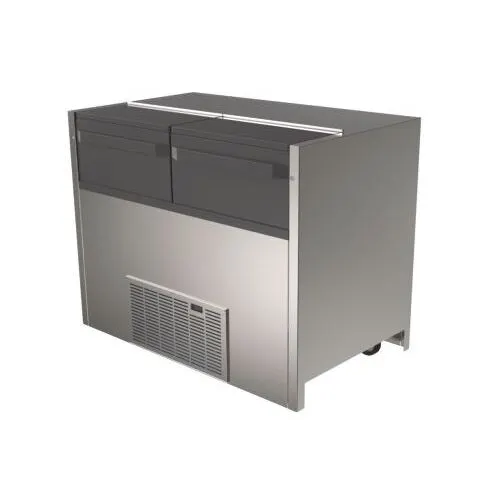
NSF/ANSI Standard 7 covers commercial refrigerators and freezers, including milk coolers. This certification verifies that materials don’t contaminate food, surfaces clean easily, and temperature control meets safety requirements. Health inspectors check for NSF marks during routine visits.
Local health codes typically follow FDA Food Code requirements, which require storing milk at 41°F (5°C) or below, monitoring temperatures every 4 hours, and documenting corrective actions when temperatures drift. Schools participating in federal meal programs must meet additional USDA Equipment Standards and Documentation requirements.
How to Choose the Right Milk Cooler for Your School
Before you buy a school milk cooler for your school consider the steps below:
- Assess your cafeteria layout during peak lunchtime and map the traffic flow to determine the best location for the milk cooler. There must be 5” (12.7 cm) of clearance on all sides for ventilation.
- Locate nearby electrical outlets to verify they meet the milk cooler’s power requirements. Most commercial school milk coolers require 5-15P NEMA plugs and 115V/15A or 115V/20A circuits. Verify your electrical panel can handle the load before ordering.
- Plan for the restocking if demand exceeds capacity. Most milk coolers have top and side doors to facilitate loading and service, making it easy for your staff to place new crates. For schools with more than 200 students and a double-service line, dual-access models prevent delays and shorten wait times by streamlining service with dual-sided reach.
- Consider Energy-Star Equipment. Energy consumption directly affects operating costs. A standard milk cooler uses 3-8 kWh per day, depending on size and efficiency. At $0.12 per kWh, that’s $130- $ 350 annually. ENERGY STAR models reduce consumption by 30%, saving $40-105 per year. Over a 10-year lifespan, efficiency upgrades pay for themselves and often qualify for utility rebates.
- Get the best warranty option. Warranty coverage varies dramatically. Basic warranties cover 1 year of parts and labor. Some manufacturers offer a 6-year warranty on parts/labor and a 7-year warranty on the compressor. Check if the warranty requires professional installation and annual maintenance.
- Choose a stainless steel model to maximize your school milk cooler’s performance. Stainless steel exteriors last 15-20 years in cafeteria environments. Additionally, welded frames last longer than bolted assemblies. Units with easily replaceable gaskets, door catches, and casters reduce maintenance costs over time.
Common Mistakes Schools Make When Buying School Milk Coolers
- Choosing a capacity that is too small: calculating the exact capacity and ignoring the buffer capacity to handle unexpected demand.
- Using household refrigerators: Residential refrigerators cannot maintain an optimal temperature level when left open for service. Additionally, their hinges are not sturdy enough to withstand frequent opening.
- Ignoring airflow and placement: Pushing coolers against walls restricts airflow to the condenser coils, leading to overheating and compressor failure.
- Overfilling the cooler: Cramming extra crates prevents proper ventilation and creates warm zones where milk spoils.
- Not planning for summer programs: School cafeterias also operate year-round, and school milk coolers enable year-round operation, including during the summer heat.
Placement Tips for Maximum Efficiency
- Location in the cafeteria: The best place to install the school milk cooler is in areas with good ventilation and away from direct sunlight.
- Ventilation requirements: Maintain 5″ (12.7 cm) clearance on the sides and 12″ (30.48 cm) on the back for condenser airflow. Avoid blocking coils to save up to 25% more energy.
- Accessibility considerations: Place at 32-36″ (81.28-91.44 cm) height for elementary students; 36-42″ (91.44-106.68 cm) for middle/high school; dual-height units serve all ages. You should not place it on a high platform to facilitate reach for small students.
- Lunch line flow: Angle cooler 30-45° to the serving line so students don’t block traffic while selecting milk flavors. Furthermore, you can place it at the end of the line to prevent congestion.
Installation & Setup Guidelines for School Milk Coolers
Schol milk coolers perform optimally when properly installed and started. Therefore, we recommend professional installation to ensure warranty compliance, long-term service life, and reliable performance and safety.
Professional installers help you verify that electrical connections meet local code, test temperature calibration, and level units to ensure proper door operation and drainage.
Train all cafeteria staff on proper operation, including efficient loading, stock rotation, avoiding blocking vents, and never stacking crates above the marked lines.
Maintenance Checklist for School Milk Coolers
To maximize the service life of your school milk cooler and minimize downtime, create a maintenance checklist to regularly clean the critical components and inspect them for condition. This will help you maintain peak performance and replace malfunctioning parts before a more serious problem occurs. So, we recommend:
- Creating a daily cleaning routine: Daily cleaning helps prevent bacterial or mold growth and odors. You should wipe interior surfaces with a food-safe sanitizer after each meal service and check door seals for milk residue that could prevent proper closure.
- Having a weekly sanitation schedule: Remove all crates and thoroughly clean the interior cabin with hot water and sanitizers. Inspect door hinges for looseness and tighten mounting bolts. Clean exterior surfaces, including handles, where bacteria accumulate. Wipe condenser coils with a soft brush to remove dust that reduces cooling efficiency.
- Logging and monitoring temperature: Follow the data closely and log temperature readings. Check logs for fluctuations that indicate a malfunction or potential spoilage.
Cost Overview: What Schools Can Expect to Pay
- Milk Cooler price ranges: Compact units (5-10 crates) cost $1,200-2,000; mid-size (15-25 crates) run $2,500-4,500; large capacity (30-40 crates) range $5,000-8,000; and dual-access models add $800-1,500.
- Warranty considerations: Extended warranties cost 10-15% of the purchase price but cover expensive compressor repairs averaging $600-1,200.
- Freight and installation: Shipping adds $200-500, depending on distance; professional installation runs $300-800, including electrical work.
- Long-term operating costs: Factor $130-350 annual electricity, $100-200 yearly maintenance, and $150-300 repairs over a 10-year lifespan.
Funding & Grants for School Milk Coolers
USDA Equipment Assistance Grants provide funding for school food authorities to purchase or upgrade food service equipment to improve food safety and meal quality. Additionally, governmental and industrial authorities and associations, such as the United Dairy Industry of Michigan, offer special grants for school milk coolers and related equipment.
Energy Efficiency & Sustainability Benefits
Energy-efficient milk coolers reduce operating costs by 25-35% compared to standard models. A school operating two milk coolers can save $80-210 per unit annually with ENERGY STAR equipment. District-wide upgrades in a 15-school system save $1,200- $ 3,150 per year. LED interior lighting uses 75% less power than fluorescent lighting while improving visibility. High-density insulation (2.5-3″ thick) maintains temperature with less compressor runtime.
Environmentally, efficient coolers reduce carbon emissions equivalent to taking 0.2-0.4 cars off the road per unit. Over a 12-year equipment lifecycle, an efficient milk cooler can prevent 3-7 tons of CO2 emissions.

School Milk Coolers vs. Beverage Coolers: Key Differences
- Storage design: Milk coolers use crate-based organization; beverage coolers have shelves that don’t accommodate standard milk crates efficiently.
- Temperature control: Milk coolers maintain 36-38°F (2.222°C-3.333°C); beverage coolers range from 38-45°F (3.333°C-7.222°C), which is too warm for safe dairy storage.
- Door type and usage volume: Milk coolers feature reinforced doors for 200+ daily openings; beverage cooler doors fail under cafeteria traffic due to a family-based design.
- Safety and compliance: School milk coolers meet NSF/ANSI Standard 7 for food service; beverage coolers follow retail display standards
- Why beverage coolers fail: They lack temperature precision, can’t handle traffic volume, don’t accommodate milk crates, and violate school meal program requirements.
Alternatives to School Milk Coolers
There are alternative milk merchandising and serving equipment designed for commercial settings. Dairy display coolers let students see milk options and grab the ones they want, reducing decision time and temperature loss. However, these units cost 15-25% more than standard milk coolers but offer better visual merchandising.
Milk merchandisers can hold 2 crates of milk and feature an enticing exterior milk branding. They feature caster wheels for mobility and relocation. However, they can only have a limited number of milk cartons. Mobile milk coolers feature a cart-type design that can hold up to 2 milk crates or 140 half-pint cartons.
What are the temperature requirements for school milk coolers?
Milk must be stored at 41°F (5°C) or below, per the FDA Food Code. Most school nutrition programs target 36-38°F (2.222°C-3.333°C) as the optimal safety range. Temperature should not fluctuate more than 3-4°F (-16.1111°C) during peak service times.
What types of milk coolers are used in schools?
Schools use top-loading single or dual-access milk coolers. Single units offer optimal space use while dual-access coolers serve high-volume cafeterias.
What does it cost to buy a school milk cooler?
Compact units: $1,200- $ 2,000. Mid-size: $2,500-4,500. Large capacity: $5,000- $ 8,000. Dual-access models add $800- $ 1,500. Budget an additional 20-30% for shipping, installation, and warranty coverage.
What are the daily and weekly cleaning procedures?
The daily cleaning procedure includes wiping interior surfaces with sanitizer, checking door seals for residue, and logging temperature readings. The weekly cleaning schedule includes removing all crates, thoroughly cleaning with hot water and an approved sanitizer, inspecting hinges and gaskets, cleaning the exterior, including handles, and brushing the condenser coils.
What is the difference between a dairy cooler and a school milk cooler?
Dairy coolers feature glass doors for visual merchandising and operate at slightly warmer temperatures suitable for multiple dairy products. School milk coolers prioritize temperature precision, crate-based storage, durability for student traffic, and compliance with specific meal program standards.
Where can schools buy commercial milk coolers?
You can purchase commercial milk coolers from foodservice equipment dealers, such as Chef’s Deal. These national dealers often provide better service and after-sales support.
What are common repair issues with school milk coolers?
Common problems include worn door gaskets (most common), dirty condenser coils causing temperature drift, failed door hinges from heavy use, broken thermostats, and compressor failure in older units (typically after 8-10 years).
How much milk can a school milk cooler hold?
Capacity ranges from 80 cartons (2 crates) for compact models to 1,024 cartons (16 containers) for large units.
How often should school milk coolers be cleaned?
School milk coolers should be wiped daily after meal service to remove food residues, and weekly for deep cleaning, with all crates removed. Furthermore, you can schedule monthly cleaning of the condenser coil and a gasket inspection.
How do you install a school milk cooler safely?
To install a school milk cooler safely, you should hire licensed commercial refrigeration technicians to ensure code compliance and warranty coverage.
How energy efficient are school milk coolers?
ENERGY STAR models use 30-40% less energy than standard units, consuming 3-5 kWh daily versus 6-8 kWh.
Can schools use a regular refrigerator for milk?
No, schools must use specially designed milk coolers to streamline service and ensure milk safety since using residential refrigerators risks health code violations and foodborne illness.
Are school milk coolers required to meet NSF certification standards?
Schools participating in USDA Child Nutrition Programs must use NSF-certified equipment.
Are grants available for purchasing school milk coolers?
USDA Equipment Assistance Grants cover some costs for eligible schools. Companies, associations, and local education foundations provide funding.
Are refrigerated milk dispensers a good alternative for cafeterias?
Yes, because milk dispensers reduce packaging waste and long-term costs but require a higher upfront investment ($3,000-6,000), daily cleaning (15-20 minutes), and changes in student behavior.

Conclusion: Why the Right Milk Cooler Improves Safety & Efficiency
School milk coolers play an essential role in maintaining safe, efficient, and compliant beverage service in school cafeterias. Unlike standard refrigerators, these specialized units are engineered to maintain stable temperatures for large quantities of milk, even during the busiest lunch periods.
Their design, construction, and cooling performance reduce safety risks, streamline student access, and support the strict temperature and handling requirements set by federal school meal programs. Without dedicated milk coolers, cafeterias face a higher risk of spoilage, slow service lines, and health code violations.
Choosing the right school milk cooler requires understanding how capacity, service style, and cooling technology match your cafeteria’s needs. Schools must calculate their daily milk demand based on student count, peak serving times, and buffer capacity for unexpected increases.
Equally important are the door style, crate configuration, cooling method, and energy efficiency. Dual-access units excel in high-volume cafeterias, while compact models serve small schools and early-education environments. Energy-efficient models reduce long-term operating costs and qualify for rebates, making them a smarter long-term investment for districts of all sizes.
Once installed, proper placement, ventilation, and maintenance determine how well the unit performs over its lifespan. Schools must train staff to load crates correctly, avoid blocking airflow, sanitize the interiors regularly, and monitor temperature logs to ensure compliance.
Routine upkeep, such as cleaning condenser coils, inspecting door gaskets, and following daily and weekly sanitation schedules, extends equipment life and prevents costly repairs. With proper care, a high-quality milk cooler can operate reliably for 10–20 years.
Ultimately, a school milk cooler is more than a piece of equipment; it’s a food safety tool that supports student health, cafeteria efficiency, and regulatory compliance. When schools evaluate capacity needs, energy use, installation requirements, and warranty coverage, they ensure their investment pays off for years to come.
With available grants, sustainable options, and a wide range of models on the market, schools can confidently choose a milk cooler that keeps service running smoothly and meets the high standards required for today’s nutrition programs.

