

Beer requires proper conditions during brewing, transportation, storage, or aging to preserve flavor, freshness, and quality. Therefore, companies and residential consumers build specialized cellars or sections to ensure the beer is produced or aged at consistently optimal temperature levels and proper conditions. Bar refrigeration equipment such as back bar coolers, bottle coolers, and kegerators are indispensable for any beer-serving business as a central component in achieving consistent, optimal storage conditions that enhance the beer’s taste and longevity, especially in commercial settings.
Although most beer types are prescribed/brewed for immediate consumption, some businesses or consumers prefer aging beer to develop new flavors or enrich its taste. However, unlike wine, only certain beer types like stouts, porters, and high-alcohol beers are suitable for aging, making proper storage even more critical in preserving quality.
Besides, beer fermentation is a vital process of brewing; all types of beer are matured to turn the first green liquid into a drinkable beer type. Some beer types are left to aging for several years for rich flavor and taste. Nevertheless, maturation and aging entail consistent temperature, dark ambient, and proper positioning to not stale or spoil.
Proper beer storage and aging are essential for preserving beer’s flavor, freshness, and quality throughout its lifecycle, from brewing to consumption. In commercial settings like bars, specialized refrigeration equipment, such as back bar coolers, bottle coolers, and kegerators, is critical in maintaining optimal storage conditions. While most beers are brewed for immediate consumption, some, like stouts, porters, and high-alcohol brews, benefit from aging under controlled conditions, which can enhance their flavor profiles. Proper beer storage and aging conditions and how specially designed bar refrigeration equipment can help you ensure the best taste of beer.
How Proper Storage Affects Beer Quality?
Proper storage greatly affects beer quality by preventing unwanted chemical changes in the beer, fermenting at the desired pace, and preventing oxidization. Properly storing beer bottles or cans allows businesses and consumers to protect the initial beer flavor, ensure consistent quality, and prevent exposure to light.
Flavor Preservation
Many beers have different flavors ranging from fruity and sour to hop, malt, and smoke, although beer is a simple formula of combining yeast, malt, and hop. However, beer contains yeast, it gradually ferments and develops new flavors, mostly going skunk. Hence, beer must be stored at a safe temperature interval (between 38°F and 55°F (3°C and 13°C) to ensure a proper fermentation speed.
Quality Consistency
Consumers look for the same taste they are accustomed to while drinking beer. Proper beer storage is the key to consistently serving the same beer type with the same taste. Even though you buy the same beer bottle from the same brewery, it will have different flavors, acidity, and bitterness unless stored under proper conditions.
Light and Oxygen Protection
Hop in the beer formula is very responsive to light effects. When exposed to direct sunlight or UV lights, hops break down and produce a compound MBT (3-methyl-2-butene-1-thiol). This has a strong smell and causes a skunky smell and flavor.
Oxidization is a deteriorating factor in the beer quality. Like apples, potatoes, and pears, beer is darkened or develops a brown color if oxidized during brewing or filling. Suppose beer is safely brought to you without oxidization. In that case, the storage conditions can spoil its appearance and taste, especially when the storage area is hotter than the optimal storage level.
Cellar or ambient temperature directly influences shelf life since oxidization doubles every 15°F (8°C) increase in storage conditions. Mass-produced bottled beer can be stored at room temperature for about 6 months, and this duration can be extended to 1 year with pasteurization. However, craft beer does not contain preservatives and lasts for a certain time for the best taste. Back bar coolers, kegerators, and bottle coolers are engineered to preserve beer cans and bottles between 38°F and 55°F (3°C and 13°C) for the best service.
Beer Types and Their Storage Needs
Beer is one of the oldest drinks in human history, and it is widely brewed and consumed worldwide with different formulas and ingredients. Naturally, different beer types necessitate different storage conditions and requirements to ensure the tastiest service to the customers, guests, and all customers.
Storage by Beer Type
Beers are primarily classified into Ales, which are top-fermenting and warm-fermented (60°F-70°F (16°C-21°C)) beer types, as well as lagers, which refer to the bottom-fermenting beer types that use yeast for low-temperature (around 45°F-55°F ( 7°C-13°C)) fermenting.
- Lagers and Pilsners: These beer types feature a crisp and refreshing taste and are ideal for quenching thirst and drinking in summer. Lagers and pilsners contain higher hop volume in their formula and require lower storage temperature levels between 40°F and 45°F (4°C and 7°C) to preserve their taste and not go stale.
- Ales and IPAs: Ales are warm-fermented beer types, which makes them ideal for aging. Due to the higher brewing temperature, they have a faster fermentation process and are used to make stronger brews with higher alcohol content. Hence, they can be stored at higher temperature levels from 50°F to 55°F (10°C-13°C).
- Porters and Stouts: Relying on ale bases and fermentation methods, Porters and stouts feature a deep, roast, and sweeter taste. These brews are the best when stored at 45°F – 55°F (7°C-13°C).
- Wheat Beers: Featuring a soft flavor and silky texture, wheat beers are refreshing drinks. They should be stored at lower temperatıres, like 40°F-50°F (4°C-10°C), to ensure the best taste.
- Sours and Bocks: These two brews are strong, high-alcohol beer types with an acidic taste. They can be stored at 50°F-55°F (10°C-13°C).
- Barleywines and Strong Ales: Among the finest brews, barleywines have high alcohol content (7-15% ABV) and are one of the best options for cellaring. They can gradually enrich their taste by developing new flavors when stored at 50°F-55°F (10°C-13°C).
Specialty Beers and Aging
Beer is mostly consumed fresh, and aging is a significant factor that spoils the beer’s quality, taste, and flavor. However, beer with higher ABV and more complex flavors like barleywines, imperial stouts, and lambics can be aged under controlled conditions to enrich the taste and mellowing flavors. Therefore, bars, restaurants, breweries, and even individuals create dark and controlled settings for an efficient and controlled aging process that improves the beer taste with new flavors and aromas.
When the aging process is complete, and the aged beer is moved to the beer station for service, it must be preserved in a specially designed cabinet which can prevent temperature fluctuations. Bar refrigeration systems with adjustable temperature settings accommodate these variations, allowing bars to maintain multiple types of beer at their ideal temperatures.
What are The Best Storage Practices for Maintaining Beer Quality?
Best storage practices for maintaining beer quality include commercial bar refrigeration equipment designed and manufactured for temperature consistency, organized storage, humidity controls, and enhanced air circulation.
Optimal Temperature Settings
Bar coolers and kegerators have digital temperature controls, powerful compressors, and high-sensitivity thermostats to ensure a stable temperature. Designed to operate between 32°F and 55°F (0°C to 12.8°C), they provide an optimal ambient temperature for storing all beer types at the desired chill and humidity.
Proper Positioning for Beer Bottles and Cans
Beer bottles and cans must be stored properly to prevent sediment formation and reduce oxidization. Hence, sealed beer bottles and cans must be stored vertically or upright. Corked beer bottles must be stored horizontally to prevent the drying and cracking of the cork. Otherwise, it can lead to oxidization, the primary reason for a spoiled appearance.
Humidity and Air Circulation Control
Bar refrigeration equipment provides a stable chilling performance with enhanced air circulation, ensuring all cabinet parts are chilled equally. The back bar and bottle coolers feature forced air circulation and reversible compressor fans. They retain the humidity between 60-75% to keep the corks moist and prevent mold formation.
Aging Beer: Which Beers Age Well and How to Store Them?
Higher alcohol content, acidity, and strong malt profiles make beers suitable for aging. Alcohol by volume or ABV ratio is the first consideration when choosing a beer for aging. Brews with higher alcohol than 8% ABV are generally the types you should choose for aging. Darker beer color and higher malt content are significant for a perfect aging process.
Barleywines, stouts, Belgian ales, lambics and gueuzes, old ales, and dark ales are frequently used for cellaring since they develop complex tastes with gradual fermentation, and their bitterness mellow in time. Aged beer introduces new aromas and flavors due to the chemical processes during fermentation.
Beer does not reach its chemical equilibrium when bottled or canned, even after maturation, as explained in detail in the Food Chemistry journal. The compounds and ingredients such as yeast, hop, and malt are highly reactive to chemical reactions, which gradually increase over time. Therefore, high-alcohol beers develop richer flavors over time when stored under consistent, cool conditions (generally around 50°F-55°F (10°C-12.8°C) with chemical reactions.
Specialized Refrigeration Options for Aging
Specialized refrigeration units for aging beer provide the ideal environment for long-term storage, ensuring that temperature, humidity, and air circulation are perfectly controlled. Cellar coolers or refrigeration systems are designed for easier installation so that your existing room, basement, or pantry can be converted into an efficient and secure beer-aging cellar.
You can use commercial wine coolers to store and age beer at optimal temperatures since these units present a stable operation between 40°F-68°F (4.4°C to 20°C). They offer a consistent level of humidity around 60-70%.
Monitoring and Handling Aged Beer
Beer aging promises a better taste only when aging is carried out under the proper conditions and finished when the desired aroma, color, and taste are achieved. Therefore, regardless of whether you are aging beer for your consumption or retailing or selling in your bar, you must constantly monitor and check the process. First, cellar or cabinet conditions such as temperature, humidity, light, and time must be under strict control. So, you can use a wine and beer monitoring system that provides detailed data about fermentation levels, microbiological risks, and key parameters through smart sensors.
Furthermore, an expert must inspect the sediment formation, cloudiness, and cork/cap condition to obtain information about faster or slower fermentation, over-aging, or oxidization. More importantly, the aging beer requires regular tasting (every 6 months or 1 year) to see if there is any change in the flavor and check for an unwanted flavor formation.
The first thing you should do before serving or drinking an aged beer is to keep it upright for at least 24 hours. Furthermore, they should be stored in bar refrigeration equipment to keep them at optimal serving temperatures while reducing their fermentation speed to retain the flavor and taste. Besides, aged beer should be kept from light and poured carefully and in an angled position to prevent an over-foamy texture.
Types of Bar Refrigeration Equipment for Beer Storage
Back bar coolers, bottle coolers, kegerators, beer dispensers, tap towers, glycol power pack beer chillers and glass frosters are bar equipment for efficient beer storage.
Back Bar Coolers
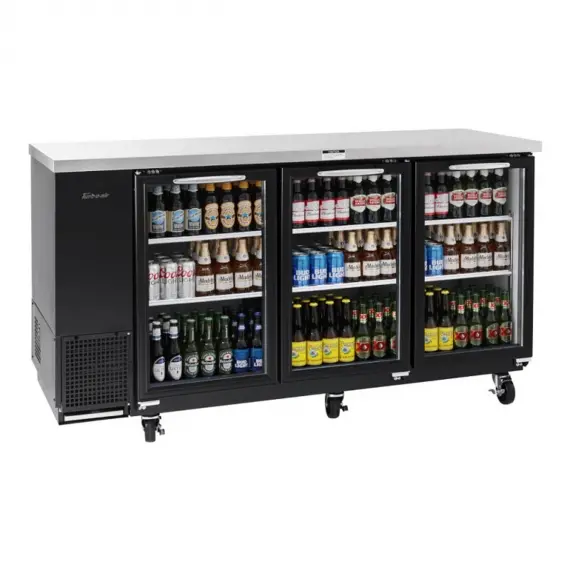
Back bar coolers are compact commercial refrigerators engineered for storing bottled and canned beer behind the bar. They operate at 33°F to 41°F (0.5°C to 5°C), which is ideal for serving and short-term storage of beer types. Their capacities range from 12 to 40 cubic feet (340 to 1133 L) to hold 90 to 300 bottles. Equipped with smartly thought features such as adjustable shelves, glass doors, LED lighting, and forced-air cooling for even temperature distribution, back bar coolers from True, Beverage-Air, and Perlick preserve beer quality.
Bottle Coolers
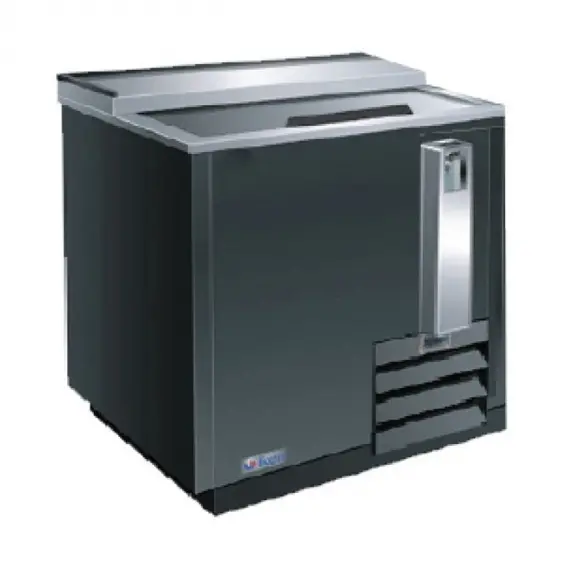
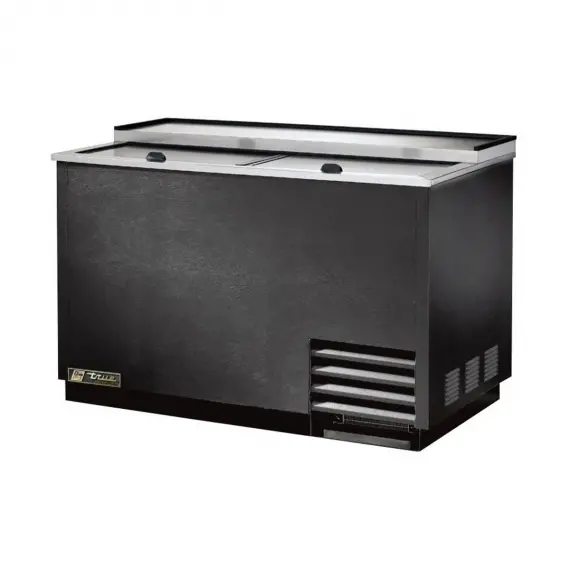
Bottle coolers are horizontal, chest-like units that store large quantities of bottled and canned beer. They operate between 32°F and 38°F 0°C to 3.3°C), with capacities ranging from 150 to 500 bottles. True, Glastender, Turbo Air, Continental Refrigerator, and Beverage-Air are leading brands offering sliding lids, rapid and stable cooling, foamed-in insulation, and stainless steel interiors. Bottle coolers are ideal for bars and restaurants with high turnover, offering rapid chilling and secure beer storage within easy access.
Kegerators and Beer Dispensers
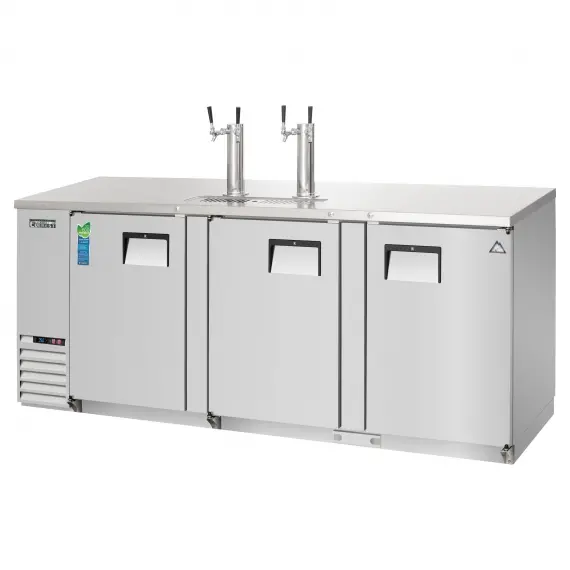
Kegerators or keg coolers are designed to store and dispense draft beer kegs, maintaining optimal serving temperature at 34°F to 42°F (1°C to 5.5°C). Depending on the model, they can hold single to multiple kegs (up to 5 half kegs). Brands like Perlick, Beverage-Air, Everest, Fagor, Hoshizaki, and Summit are leading suppliers of kegerators with digital temperature controls, CO2 regulators, dual/triple tap towers, up to 12 taps, and forced-air cooling for even keg temperature. Kegerators are perfect for draft beer service and can support keg aging for beers like IPAs or stouts, ensuring freshness and carbonation retention.
Tap Towers
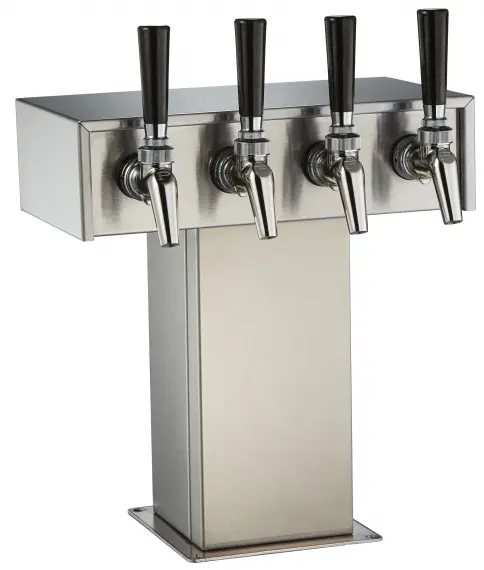
Tap towers serve draft beer from kegerators or dispensing systems. They don’t control temperature but cooperate with glycol systems to maintain beer at serving temperatures. Brands like Glastender, Talos, Krowne, and Perlick offer durable stainless steel or chrome finishes and elegant gold and wooden finished tap tower models. Towers are available with 1 to 3-column options and up to 40 faucets to provide an efficient and diverse beer service. They feature integrated insulation and glycol cooling to maintain beer temperature from keg to glass.
Glycol Power Pack Draft Beer Chillers
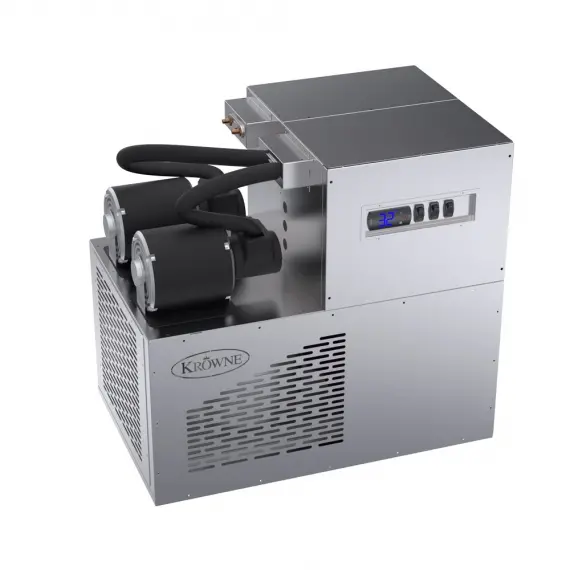
Glycol beer chillers maintain consistent temperature in long-draw draft beer systems, keeping beer lines between 36°F and 38°F (2.2°C to 3.3°C). Offer by leading vendors like Perlick, Glastender, and Krowne, glycol beer chillers circulate a glycol-water mixture around beer lines to ensure beer stays cold from keg to tap, even over long distances. Glycol chillers ensure aged draft beer remains fresh and at optimal serving temperatures, preserving carbonation and flavor integrity.
Glass Frosters & Chillers
Glass frosters and chillers pre-chill the glasses for beer service by cooling them, extending the beer chill for a longer period, enhancing the beer-drinking experience. Operating between -10°F and 0°F (-23°C to -18°C), glass frosters by Everes, Beverage-Air, Glastender, Turbo Air, and True Refrigeration offer various capacities from 50 to 400 glasses. This bar refrigeration equipment features rapid cooling, compact designs, stainless steel, and black exterior options.
Implementing Beer Storage and Aging in a Bar Setting
Efficiently organizing bar refrigeration equipment for beer storage and aging is crucial in a busy bar, beer cellar, and restaurant. Arrange bar refrigerators to ensure easy access during peak hours, placing frequently served beers in inaccessible areas. Creating records and monitoring the aged beer stocks present a reliable way of maintaining a healthy and secure aging process. In addition, keeping aged beers in a dedicated space helps you find the correct option when needed. Additionally, this prevents disruption to the aging process by enabling you or your bartenders to follow a standard pattern for preventing over-aging and staling.
Training staff on storage best practices is essential, and bartenders should understand the ideal conditions for different beer types and know how to handle beers intended for aging. So, you should provide orientation for your bartenders and servers to explain your beer aging operation’s stock keeping and service system.
Follow a routine for monitoring refrigeration temperatures and humidity levels to prevent unexpected fluctuations and spoilage. Schedule regular quality checks to ensure aged beers maintain their intended flavor profile and follow the desired aging path.
Conclusion
Proper beer storage and aging are crucial for preserving beer’s freshness, quality, and flavor, whether for immediate consumption or aging. Bars and businesses rely on specialized bar refrigeration equipment like back bar coolers, bottle coolers, and kegerators to maintain the ideal conditions for service, short-term storage, and long-term aging. With precise temperature controls and humidity regulation, these systems prevent oxidation, light exposure, and spoilage, ensuring that beer retains its intended taste. Aging beers such as stouts, porters, and high-alcohol brews benefit from these controlled environments, developing new flavors and enriching their profiles over time.
Implementing effective beer storage and aging practices involves efficiently organizing refrigeration equipment, training staff on best storage practices, and establishing a quality control routine. By dedicating specific areas to aging beers and maintaining optimal temperatures, bars can minimize handling during peak hours, ensuring that stored and aged beers are served at their best. With the right refrigeration systems, staff education, and regular monitoring, bars can offer consistently high-quality beer, from fresh pours to carefully aged brews, enhancing the overall drinking experience for customers.

