


Draft beer towers are storage and dispensing systems designed to serve beer without exposing it to oxygen or contamination, while maintaining proper carbonation. They are typically composed of kegs, pressurized beer lines, CO2 tanks, coolers, glycol systems, and faucets, enabling bartenders to pour smooth, foamy glasses of beer at the perfect temperature.
The concept of draft beer dates back centuries, but pressurized draft beer towers are a 20th-century innovation. While bars used to use gravity-fed or hand-pumped systems to dispense beer previously, with the invention of cooled, pressurized beer towers, almost all establishments abandoned the old ways for this new method to reap the rewards of serving cool, deliciously carbonated beer at a fast pace with no waste of inventory, time, or energy.
In recent years, the draft beer tower market has experienced significant growth, driven by the increasing demand for craft beer and the ongoing expansion of the hospitality industry. The commercial beer tap system market is expected to reach a value of USD 3.4 billion by 2032, growing at a compound annual growth rate (CAGR) of 5.48% between 2024 and 2032, according to the Market Research Future report.
Draft beer towers are available in various styles and configurations to accommodate different bar layouts, beverage types, and service volumes. From classic single-tap towers to advanced multi-keg systems, each type offers unique benefits in terms of function, aesthetics, and space efficiency. Selecting the right draft beer tower enhances pour quality, streamlines workflow, and improves the overall customer experience.
Each draft beer tower type has its pros and cons, and the best choice depends on factors like faucet count, space and layout, budget, beverage type, design fit, and ease of maintenance. Installation steps, cleaning routines, and long-term maintenance are crucial in ensuring optimal performance and durability.
In addition to necessities and business needs, consider emerging trends in draft beer towers, including technological advancements, design innovations, customization options, and custom tap handle options for beer towers. This can help you innovate your operations and elevate your beer service.
Types of Draft Beer Towers
12 types of draft beer towers based on function, design, or configuration are listed below:
- Standard towers
- T-towers
- Double-pedestal towers
- Underbar-mounted towers
5. Specialty towers
6. Countertop draft beer towers
7. Multi-keg beer tower systems
8. Battery-powered draft beer towers
9. Draft Beer Towers for Outdoor Bars
10. Self-pour draft beer towers
11. LED-lit draft beer towers
12. DIY tap tower
1. Standard Towers
Standard towers are the most common type of draft beer tower found in commercial bars and home setups, typically featuring a single column with one to three taps, which is sufficient to support small to medium-sized businesses. These towers are highly popular due to several advantages they offer, such as being easy to install, cost-effective, and compatible with most kegerators or countertop systems available on the market.
In essence, their most significant advantage is simplicity and affordability compared to other units. However, standard towers have certain disadvantages, such as lacking aesthetic flair or volume capacity compared to more advanced or customizable models, which makes them less ideal for high-traffic or high-end establishments such as hotel bars or beer-focused pubs.
2. T-Towers
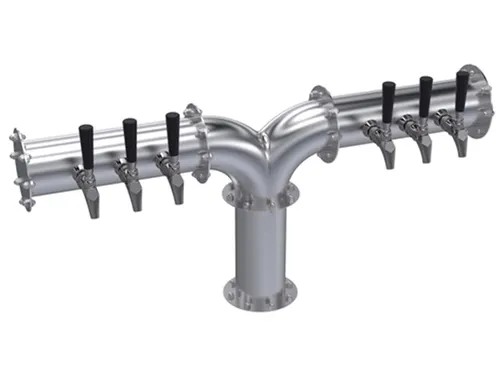
T-Towers are draft beer towers that feature a horizontal arm at the top of a vertical column, offering more than four taps for service in a compact design. They’re more popular in mid-size bars aiming for both volume and aesthetics. The main advantage of t-towers is efficient utilization of space and increased pour capacity. Thanks to four or more taps, multiple bartenders can serve simultaneously, significantly reducing wait time for customers.
However, the cons of t-towers are that their upfront costs can be higher than standard model,s and the installation may require more professional help as it is more complex. Temperature consistency varies if the lines aren’t well insulated or glycol-cooled like standard models.
3. Double-Pedestal Towers
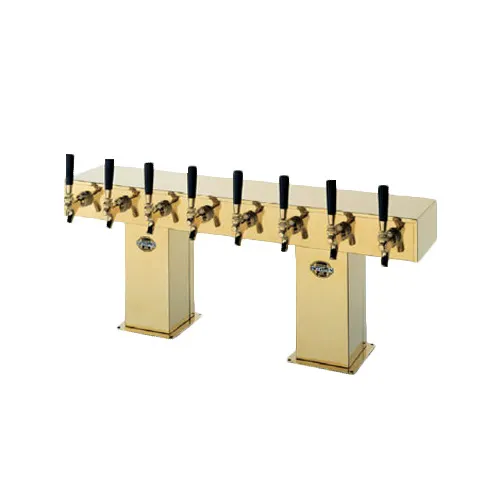
Double-pedestal towers are draft beer towers that have two support columns for extra stability and capacity. They are typically used in larger establishments and possess 6 to 12 taps or more, which is great for rush hour service or serving a broad range of different beers. The most significant advantages of double-pedestal towers are their performance and durability; however, these advantages give rise to two main disadvantages: the need for more space and a more complex installation process.
You need to restructure the pipes from your storage to your service area and do some reconstruction in the meantime. Space is a valuable commodity for a business, and every piece of bar equipment should be carefully measured and purchased in the required size and capacity to avoid wasting any space.
4. Underbar Mounted Towers
Underbar-mounted towers are draft beer towers installed below the bar to keep the surface area clutter-free while utilizing the space underneath the counter. They’re ideal for sleek, modern designs and or customer-facing setups where aesthetics matter.
The main benefits of these units are their visual appeal and space-saving features. However, it is worth noting that access for maintenance and line cleaning is more difficult in underbar units, as the majority of components are located under the bar, facing the wall. Underbar-mounted towers may be less intuitive for bartenders used to standard upright systems.
5. Specialty Towers
Specialty towers are draft beer tower systems that come in custom shapes, finishes (such as ceramic or copper), and branded designs for high-end establishments seeking to enhance their beer service with a distinctive, branded touch. They enhance the look of a bar and improve customer experience by blending in with the interior design or featuring unique properties to maintain the taste and temperature of the beer.
The benefits of owning a specialty tower include a unique design and brand differentiation, as well as the ability to add custom features tailored to your needs. However, specialty towers have cons too, such as they are typically more expensive, and because they are custom-made, they may require non-standard fittings or lines, which makes maintenance and parts replacements way more complicated compared to a standard unit.
6. Countertop Draft Beer Towers
Countertop draft beer towers are self-contained, portable units designed to sit on countertops in smaller establishments with limited beer service needs. They’re easy to install and move, but typically support fewer taps and smaller kegs. Their simplicity and low cost are substantial advantages, but they don’t offer the volume or cooling capabilities of larger systems, which are must-haves in larger bars.
7. Multi-Keg Beer Tower Systems
Multi-keg beer tower systems are draft beer towers designed to serve multiple types of beer simultaneously by combining several kegs in a single structure and dispensing them through separate taps. They’re must-haves for beer bars or restaurants offering different types of beers.
The most obvious advantage of owning a multi-keg beer tower system is its versatility, as it allows bars to experiment with different menu offerings. However, this benefit comes at the cost of a significant downside: the need for a complex keg room setup with greater installation and cleaning demands. Considering that the downside is mostly a one-time issue, the investment is worthwhile for large establishments; it’s typically overkill for home use or small venues.
8. Battery-Powered Draft Beer Towers
Battery-powered draft beer towers use battery-operated pumps instead of CO2 or nitrogen systems to maintain pressure. The battery system makes them portable and practical for outdoor events or temporary installations for caterers. The independence from gas lines, in particular, is a huge pro, making installation, clean-up, and mobility easier.
On the other hand, the poor consistency and pressure control offered by the battery system tend to be inferior to traditional systems, which utilize CO2 or nitrogen. Battery life and pump reliability can be concerns in the long run, and the unit may require more frequent maintenance to ensure longevity.
9. Draft Beer Towers for Outdoor Bars
Draft beer towers for outdoor bars are similar to standard models but are specially designed for outside use, featuring extra durability, weather resistance, and added insulation or built-in refrigeration. There is a wide variety of outdoor units to choose from, suitable for use on patios, backyard bars, or more commercial settings, such as hotel gardens.
Thanks to weatherproofing and added durability, these units can handle environmental exposure. On the other hand, these units tend to be more expensive and require specialized maintenance to prevent corrosion or sun damage.
10. Self-Pour Draft Beer Towers
Self-pour draft beer towers are designed for self-service operations, featuring integrated POS technology that allows customers to serve themselves without needing a bartender. These systems increase customer engagement and reduce labor costs, which makes them ideal for modern, high-tech establishments, open buffet settings, or large pubs with crowded happy hours. The cons of self-pour draft beer towers include high initial costs, software integration, and the need for more frequent and stricter sanitation controls due to customer contact.
11. LED-Lit Draft Beer Towers
LED-lit draft beer towers are equipped with LED lighting to draw attention to the unit and enhance ambiance in customer-facing areas of the bar. They are often used to highlight premium beer products or in themed bars to show off the beer collection. Their visual impact is a clear pro, but they typically require additional wiring and may need repairs if the lighting system malfunctions. They offer style over practical utility, which may cause issues in high-capacity establishments.
12. DIY Tap Towers
DIY tap towers are custom-built by beer lovers at home or budget-conscious business owners using kits or upcycled materials. The biggest pros of these units are that they allow full customization and cost control to the buyer.
However, the quality varies widely depending on the builder’s skill. DIY towers may lack the durability, cooling efficiency, or pressure regulation of commercial-grade towers and may endanger your inventory if not built correctly. It is safer to opt for a commercial-grade unit to protect your inventory from spoilage in the long run.

Comparative Considerations for Draft Beer Towers
Choosing between CO₂ and nitrogen, selecting nitro or standard towers, or determining the ideal tap setup helps align your draft system with your bar’s drink selection and service flow.
Factors like gas type, beverage compatibility, and intended use can significantly impact performance and quality. Whether you’re deciding between CO₂ and nitrogen, nitro vs. standard towers, or selecting the optimal tap setup for your space, these comparisons help tailor your draft system to match your operational goals and beverage menu.
CO2 vs. Nitrogen for Draft Beer Towers
CO2 and nitrogen are the top two gases used to maintain carbonation and pressure in draft beer towers. CO2 is the standard gas for most beer types, and it is commonly used in standard units to create carbonation and consistent pours. Nitrogen is a more exclusive option, as it is preferred for nitro beers to give the beer a creamier texture and smaller bubbles, enhancing the drinking experience.
CO2 is cheaper and easier to manage, while nitrogen requires special tanks, faucets, and restrictor plates. Choosing the wrong gas can ruin the pour or flavor of a beer, so the choice must align with the style of the beverage. If you are not offering niche beers, a CO2 unit is your best bet for standard use.
Nitro Beer Towers vs. Standard Towers
Nitro beer towers utilize specialized faucets and nitrogen gas to deliver a smooth, creamy pour, creating stouts and some porters, as well as more nitro-based niche drinks. The primary benefit of using a nitro beer tower over a standard tower is the texture and visual appeal achieved through the use of nitrogen instead of CO2.
However, most beers are better off with CO2, and the use of nitrogen is limited. Nitro beer towers are more expensive than standard towers and are less versatile. If you are keen on serving nitro beers, though, a CO2 standard unit cannot create the desired results, and you need a nitro tower.
Single-Tap vs. Multi-Tap Towers for Home Use
Single-tap vs. multi-tap towers for home use raises the question of whether you need a compact, affordable unit for daily use or a dedicated space to entertain guests or enjoy different types of beer simultaneously. Single-tap beer towers can be easily fitted on counters, are affordable, and easier to manage. Their sole function is to maintain and serve high-quality beer.
Multi-tap towers offer more variety and are ideal for home enthusiasts who frequently entertain guests or enjoy a wide range of brews. However, they take up more space, cost more, and require more cleaning and gas management. The choice entirely depends on your drinking habits and the available space.
What are The Key Considerations for Draft Beer Tower Selection?
7 Key considerations for buying draft beer towers are listed below:
1. Number of faucets needed
2. Space availability and Bar layout
3. Budget constraints
4. Type of beverages served
5. Aesthetic alignment with bar design
6. Maintenance requirements
7. Installation guidelines
Buying a draft beer tower requires careful consideration to ensure the investment’s profitability. You can find great units, such as smart beer towers with temperature control; however, the quality of the investment hinges on how well the unit meets your needs.
1. Number of Faucets Needed
The number of faucets you need on a draft beer tower directly depends on the variety of beverages you plan to serve and the service volume of your business. For example, a single-faucet tower may be sufficient for a home bar or a small café with limited and scarce offerings, while a busy bar or brewery may require 4 to 12 faucets to serve multiple beer styles simultaneously during rush hours, when there are numerous customers waiting for a cold beer.
They demand more space, upkeep, and gas line management, which can be costly and time-consuming for small businesses. However, more faucets are generally better, as they allow for greater variety.
Consider your menu and service volume, as well as the amount of space you can dedicate to kegs, to determine the number of faucets you need. Your guidelines on how to clean a draft beer tower may vary based on the number of faucets, as each faucet opens up new areas of contamination and requires special care.
2. Space Availability and Bar Layout
Space availability and bar layout for a draft beer tower determine how smoothly the unit can integrate into your operations and whether your bar’s physical layout may need to be adjusted. While measuring the space you can spare, consider the space for countertop, underbar clearance, and keg storage areas.
T-Towers and double-pedestal towers may be ideal for spacious bars, while underbar-mounted or compact single-tap towers are better suited for tighter environments. The best beer tower cooling solutions will seamlessly integrate into your space, keeping your beer cool and delicious.
3. Budget Constraints
Budget constraints when purchasing a draft beer tower can significantly narrow down your choices and help you prioritize your top needs. Basic stainless-steel single-tap towers are budget-friendly and ideal for straightforward setups. On the other hand, custom-built or glycol-cooled towers with advanced features can be a significant investment.
Your budget should account for accessories, installation, long-term maintenance, and the tower itself. Consider units that offer substantial price-to-performance value, and be open to higher initial investments when supported by energy certifications and positive reviews, as they often lead to reduced utility and maintenance costs over time.
4. Type of Beverages Served
The types of beverages you plan to serve will inevitably affect your draft beer tower choice. Standard CO2-powered towers are ideal for lagers, IPAs, and most beers, making them the best option for regular pubs with small to medium serving capacities, thanks to their versatility.
Nitro beers require specialized faucets and nitrogen gas, while towers serving kombucha, cold brew coffee, or cocktails may need specific fittings and temperature control. Matching your tower to your beverage ensures proper carbonation, texture, and taste. Be sure to regularly replace draft beer tower seals and lines to maintain the desired level of carbonation and quality over time.
5. Aesthetic Alignment with Bar Design
Aesthetic alignment with bar design for a draft beer tower is possible through customizations, finish choices, and branding. These can enhance the visual identity of your bar and make it more memorable.
Consult a designer and choose a design that complements your overall interior aesthetic. For instance, you can pick polished surfaces and materials or LED-lit towers for modern venues, or vintage brass or ceramic taps for traditional pubs.
Taking the time to build a striking tower helps you create a centerpiece out of commercial bar equipment and a focal point for customer attention and appreciation. The best draft beer tower for outdoor bar use is a unit such as a battery-powered draft beer tower that can withstand the weather and aesthetically complement your outdoor space.
6. Maintenance Requirements
Maintenance requirements for draft beer towers are a crucial consideration in determining the amount of upkeep your unit will need compared to others. Features like glycol cooling, multiple faucets, or specialty finishes can increase cleaning frequency and parts replacement.
Consider how much time and labor you can dedicate to routine maintenance, as well as whether you have the necessary staff and expertise to manage it effectively, and choose a unit accordingly. Portable beer towers for events have special maintenance requirements. They require more frequent maintenance due to outdoor exposure, while they are more accessible and easier to disassemble and reassemble.
7. Installation Guidelines
Installation guidelines for the draft beer tower you choose define how much professional help and restructuring you’ll need, and requirements vary by tower type. Basic single-tap towers may only require a simple mounting and line connection. At the same time, double-pedestal or multi-keg systems necessitate more complex installation, including refrigeration and gas line coordination, or even a reconfiguration of your space to facilitate connections from the keg room to the service area.
Battery-powered draft beer towers are the easiest units to install as they require no electrical connections and are portable. Always follow manufacturer guidelines to ensure optimal performance and safety.
Step-by-Step Installation Process
A step-by-step installation process for draft beer towers typically includes mounting the tower, connecting the beverage and gas lines, securing insulation or glycol tubes, and sealing the base to prevent leaks. Once these steps are completed, ensure that you test the flow and carbonation.
Ensure that beer towers for patio use are weatherproof to protect your investment from the elements if the unit is intended for outdoor use. For more advanced towers, such as nitro or multi-keg systems, professional installation is often recommended to ensure insulation is not broken.
Maintenance and Upkeep
Maintenance and upkeep of draft beer towers are crucial to ensure proper insulation, consistent texture, foam, and taste, as well as to prevent potential problems. Regular maintenance includes inspecting seals, lubricating faucet parts, checking for leaks, and ensuring consistent temperature and pressure. Creating a weekly or monthly maintenance schedule can help you prevent unexpected failures and extend the lifespan of your bar equipment.
Regular Cleaning Protocols
Regular cleaning protocols for draft beer towers typically dictate that beer lines should be flushed every 1-2 weeks with a commercial, food-grade line cleaner, followed by a thorough rinse with water. Faucets, couplers, and drip trays need scrubbing once every few days to prevent buildup.
Wipe around the tap after each use to prevent bacterial growth. Failure to clean these crucial components regularly can lead to bacterial growth, off-flavors, inventory waste, and customer complaints. The same goes for home use. Draft beer tower for homebrew kegs requires the same care and a regular cleaning protocol to keep the household safe and free from germs.
Preventative Maintenance to Ensure Longevity
Preventative maintenance to ensure the longevity of a draft beer tower includes activities such as replacing worn seals, cleaning coils, inspecting fittings, and recalibrating regulators, thereby preventing costlier and more time-consuming repairs in the long run. Preventive maintenance is particularly important for high-volume establishments and complex systems, such as glycol-cooled or self-pour towers.
Common Challenges and Troubleshooting Tips About Draft Beer Towers
Common challenges and troubleshooting tips associated with each type of draft beer tower provide valuable guidelines to help you understand how your chosen unit might perform in the future.
The most common issues include foamy pours, inconsistent temperature, or flat beer, and all three often stem from incorrect pressure, dirty lines, or inadequate insulation. Troubleshooting typically involves checking regulator settings, cleaning lines, inspecting connections, and ensuring your keg is stored at the correct temperature.
Having a basic troubleshooting checklist that can be applied to all situations can minimize downtime in case of a problem and save you money. The best beer tower for craft beer is considered to be standard multi-tap units from reputable brands such as Perlick and Krowne. These big brands have extensive support networks to help with emergency troubleshooting.
Emerging Trends in Draft Beer Towers
Emerging trends in draft beer towers include technological advancements like smart dispensing systems, integrated POS, and digital monitoring of keg levels and waste. Design innovations and customization options enable greater branding opportunities and a more impactful visual presence. Affordable models with these features are becoming increasingly accessible, helping to boost efficiency and profitability.
Technological Advancements: Smart Dispensing Systems
Technological advancements in draft beer towers are designed to reduce energy consumption and expedite service while enhancing beer quality. These systems use digital flow meters, integrated POS, and IoT connectivity to monitor pour volume, temperature, keg levels, and waste in real time.
They’re ideal for high-traffic venues looking to improve inventory control and service consistency. Some even offer mobile app integration for remote monitoring and alerts. Though they require a higher upfront investment, the long-term savings and performance benefits can be significant for large-scale operations.
Design Innovations and Customization Options
Modern draft beer towers now serve as both branding and design elements, rather than just functional bar equipment. You can choose towers that match your bar’s theme or act as a visual centerpiece. Modular configurations support scalable tap setups, integrated cooling, and customized line layouts, providing flexibility for various applications. For businesses with multiple locations, these flexible options help maintain a consistent brand image while elevating the overall customer experience.
Custom Tap Handle Options for Beer Towers
Custom tap handles have evolved into tools for brand storytelling and visual differentiation. Bars and breweries use them to display logos, mascots, or seasonal themes, even through 3D-printed designs that catch the eye. These handles help bartenders quickly identify different products on multi-tap towers, making service more efficient while adding a polished, professional look to the setup.
FAQs About Draft Beer Towers
What are popular draft beer tower brands?
The popular draft beer tower brands are Perlick, Micro Matic, Krowne, Taprite, and Glastender. These manufacturers are known for their durable construction, temperature retention, extensive support systems, visually appealing designs, and a wide range of configurations to choose from.
What are the draft tower lengths?
The draft towers lengths vary based on the number of faucets and overall design, however standard single-column towers typically range from 3 to 5 inches (7.62 to 12.7) in diameter and can be around 12 to 18 inches (30.48 – 45.72) in height, while multi-tap or T-towers may span 10 to 36 inches (25.4 to 91.44 cm) or more in length, depending on how many taps they support. Double-pedestal towers and long T-bar configurations can even exceed 48 inches (121.92 cm), especially in high-volume or multi-keg systems.
Are all keg tower mounting configurations pretty much standard?
Yes, all keg tower mounting configurations are pretty standard; however, they are not all the same or universally compatible. Some towers may require different bolt patterns, shank lengths, or drip tray alignments. Specialty towers, underbar mounts, and double-pedestal designs often need custom mounting or reinforcement. Always check the manufacturer’s specifications and compatibility with your existing kegerator or bar structure before purchasing a new tower.
Can You Use a Draft Beer Tower for Cider?
Yes, you can use a draft beer tower for cider, as long as the lines, connectors, and dispensing components are properly cleaned and maintained. Cider can be dispensed using the same CO₂ systems as beer. However, it’s essential to dedicate a line to cider if you’re rotating beverages, as residual sugar in the lines can affect the taste of your other offerings. DIY draft beer tower setups are often used to store and dispense beer, as well as cider and coffee.
Conclusion
Draft beer towers have evolved from simple gravity-fed systems into advanced solutions that blend precision engineering with visual appeal. Whether for a busy bar or a home setup, selecting the right tower has a direct impact on drink quality, service speed, and customer satisfaction.
Different tower types support various operational setups, while emerging features, such as smart technology and custom branding, add both performance and visual appeal to modern draft systems. With proper setup, regular maintenance, and a touch of personalization, your draft tower becomes the centerpiece of your beverage service.
For home kegerators on a budget, multi-faucet units from dependable brands like Glastender or Krowne are solid choices. Consider used options from premium manufacturers, such as Perlick, to strike a balance between quality and cost.

