

Evaporator plate separation on Hoshizaki ice machines is a documented and real failure. But if you ask two refrigeration technicians how often they run into it, you will get two very different answers. One technician may say he has seen it twice in roughly 30 years; another may say he saw it twice in two weeks. Rather than focusing on frequency estimates, focus on what is happening mechanically, why different ice machine brands fail differently, and why frequency estimates from individual technicians vary so widely.
TL;DR: Evaporator Plate Separation on Hoshizaki Ice Machines
- It is a documented failure, not a myth: Evaporator plate and grid separation is a recognized commercial ice machine failure, documented in the trade press by ACHR News, treated as a replacement trigger by commercial ice service providers such as EasyIce, and included in the Hoshizaki Freeze-Up checklist.
- The exact mechanism differs by brand: On Hoshizaki machines, the stainless-steel evaporator plate disconnects from the coils. On Manitowoc machines, the nickel-plated cube grid detaches from the back of the plate. These are related but mechanically distinct problems.
- Frequency Differs by Machine: Water quality, maintenance history, and machine age all affect the frequency. So one technician may say it is a very low-frequency problem, while another says it’s common.
- Indicative signs include harvest time and cube shape: Longer-than-normal harvest cycles and non-standard ice shapes, like small “fingers” or “shark teeth” on the ends of the cubes, can result from partial melting during an extended harvest.
- There is no safe way to reattach a separated plate or grid: Nothing can be glued or epoxied back together in a food-contact area. So the real fix is a new evaporator, and often a new machine, unless the evaporator is still covered under warranty.
What Evaporator Plate Separation Actually Is
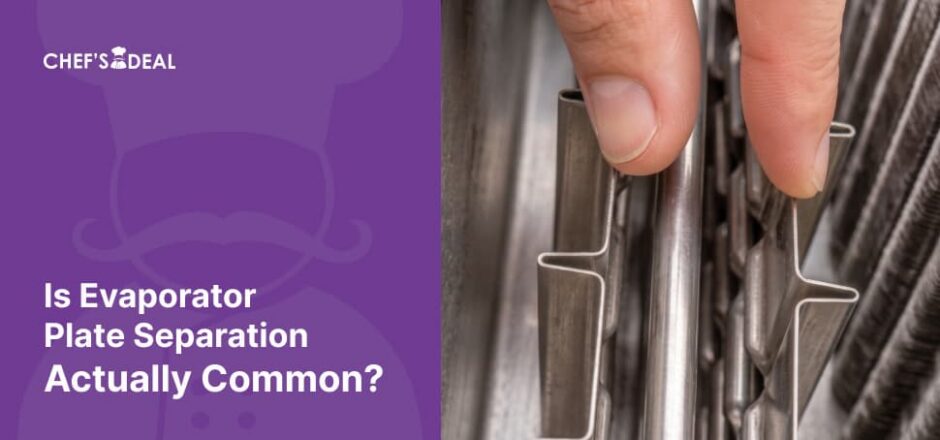
Evaporator plate separation is the physical breakaway of an ice machine’s ice-forming surface or grid from the refrigerant tubing that chills it. This reduces heat-transfer efficiency, spoils the ice shape (fingers/shark-teeth ice), and causes ice to form between the stainless steel plate/grid and the evaporator.
Commercial ice machine evaporators are engineered to transfer heat efficiently between water and refrigerant while withstanding constant temperature fluctuations and a wide range of water conditions. According to the ACHR News article ” Ice Machine Evaporators With Separating Grids, these evaporators are commonly built from stainless steel, nickel-plated stainless, or nickel-plated copper, all of which offer good heat transfer and hold up under varied conditions.
Hoshizaki takes a different approach in its crescent cubers, such as the KM-520MRJZ: a double-sided KMEdge stainless-steel evaporator with a smooth, open surface. Whichever design a machine uses, the ice-forming layer can gradually pull away from the surface behind it.
Common causes include repeated expansion and contraction across freeze and harvest cycles, scale and mineral buildup, thermal stress, simple age, and, on nickel-plated evaporators specifically, cleaners that aren’t nickel-safe. Ice begins forming between the two parts, and the ice slab no longer releases cleanly during harvest. In the early stage, the machine continues producing ice during an extended harvest cycle, yet the slab still drops.
As the separation widens, the slab will not release at all, and most ice machines shut down on a long-harvest alarm. The practical consequence for an operator is the noticeable drop in the daily output before the machine ever throws a fault.
Is This Actually a Hoshizaki-Specific Problem?
No, evaporator separation shows up across most brands, but the specific mechanism depends on how the evaporator is built. Hoshizaki’s version of the failure overlaps in terminology with Manitowoc’s, but the mechanism and the symptoms differ. This is also why frequency estimates conflict: online discussions rarely specify which mechanism or brand they mean, so the same phrase ends up covering two different failures with two different rates.
Stainless vs. Nickel-Plated Evaporators
| Factor | Hoshizaki | Manitowoc / Scotsman / Ice-O-Matic |
| Evaporator surface | Stainless steel plate | Nickel-plated grid |
| Typical separation mode | Plate disconnects from the coils | Cube grid detaches from back of plate |
| Nickel-safe cleaner required | No | Yes |
| Field-visible symptom | Loose tubing or plates, abnormal ice formation | Grid visibly standing off or detached from the back of the plate |
On Hoshizaki Machines, the Stainless Plate Separates from the Coils
On Hoshizaki equipment, the failure occurs where the stainless-steel evaporator plate disconnects from the coils behind it, according to EasyIce (Do I Need New Ice Machine? Five Signs You Need a Replacement). This failure is a visible separation between the coil tubing and plates, or ice forming in an abnormal pattern across the plate.
On Manitowoc Machines, the Nickel-Plated Grid Detaches from the Plate
Manitowoc ice machines incur separation failure when nickel-plated grids detach completely from the back of the evaporator plate, which is a different physical event from a plate coming away from its coils. This is also true for Scotsman and Ice-O-Matic’s nickel-plated evaporators, and harsh acids can damage and corrode nickel plating.
The Debate: Why Technicians Disagree on How Common This Is
Technicians disagree on how often evaporator plate separation occurs because they work on different machines, in different water, with different maintenance histories. While one technician reported seeing evaporator separation only twice in roughly 30 years, both times on units approaching 20 years old, another reported seeing it twice within two weeks, on units less than 5 years old. These are individual impressions from a public technician discussion, not statistics.
Both accounts can be accurate at the same time because the parameters causing this failure are local, not universal. Water hardness and scale conditions differ enormously by region; maintenance history varies from quarterly professional cleaning to no service for a decade, and machine age and design differ across a service territory. A technician who mostly encounters filtered, well-maintained kitchens will see this rarely. A technician who mostly handles deferred-maintenance accounts on hard water will see it far more often.
Additionally, evaporator plate separation on Hoshizaki ice machines may result from different mechanical problems. EasyIce attributes Hoshizaki plate separation specifically to poorly maintained machines. ACHR News frames grid separation more generally as something that happens to these evaporators over time, without tying it to maintenance quality. Neither source is wrong; they are answering slightly different questions, one about a specific brand’s service pattern and one about the general mechanics of grid-design evaporators.
Signs You’re Looking at Plate or Grid Separation
Signs of plate or grid separation include longer-than-normal harvest cycles, ice cubes with small “fingers” or “shark teeth” on the ends, and a visibly loose or detached plate or grid on direct inspection. They usually appear in that order, and the cheapest way is also the earliest: checking how long harvest is taking.
- Longer-Than-Normal Harvest Cycles: A harvest cycle that runs longer than normal is the first and most reliable indicator, and it shows up well before the machine stops operation. ACHR News (Ice Machine Evaporators With Separating Grids) advises inspecting the grids whenever you notice longer-than-normal harvest cycles.
- Ice With “Fingers” or “Shark Teeth”: Cubes in deformed shapes with “fingers” or “shark teeth” on the ends are a direct symptom of an extended harvest, and one of the clearest indications that separation is underway. If the ice coming out of the bin has changed shape and nothing about the water supply or ice setting has changed, check the evaporator.
- Visible Separation on Inspection: EasyIce recommends removing the front panel and the water curtain to let you see the evaporator. Look for tubing and plates that have come loose, a grid standing off the back of the plate, or ice forming in a pattern that doesn’t match the cube layout.
Quick field check before you call anyone:
- Time the harvest cycle and compare it against the machine’s normal baseline.
- Pull a handful of cubes from the bin and look at the ends for fingers or shark teeth.
- Shut down the machine, remove the front panel and water curtain, and inspect the evaporator for separation.
- Look for loose tubing, a standing-off grid, or ice forming between layers.
Can Evaporator Separation Be Fixed?
No, there is no safe way to reattach a separated evaporator plate or grid, according to ACHR News, since any adhesive, silicone, or cold welding is not safe for food contact. Therefore, you can’t repair evaporator separation in place. The only practical solution is to replace the evaporator if your machine is still under warranty. If not, the reasonable solution is to replace the whole machine. For instance, Hoshizaki KM-520MRJZ is listed at around 4,700 USD, while an evaporator kit runs roughly $1,000 in parts alone.

Several hours of skilled labor and refrigerant work will narrow the gap enough, and on an older machine, the repair rarely pays for itself. Check warranty status first, then weigh the machine’s age and overall condition before committing to a repair. Hoshizaki lists the KM-520MRJZ with three years of parts and labor on the entire machine, five years of parts and labor on the evaporator itself, and five years of parts on the compressor and air-cooled condenser coil.
Some technicians remove the separated grid section entirely as a stopgap when a customer cannot afford to replace the machine. It is only a temporary fix, and other grids will eventually separate as well, but the machine often keeps operating, producing some larger-than-normal cubes.
Reducing the Risk of Evaporator Plate Separation
To reduce the risk of evaporator plate separation, follow a real cleaning and water-treatment schedule and match your cleaner type to the evaporator material.
- Follow a maintenance routine and water quality checks: Routine maintenance and water treatment prevent evaporator plate separation, since EasyIce states that ignored maintenance is the primary factor behind these issues, and Hoshizaki plate separation specifically occurs in poorly maintained machines. Even if there are conflicting ideas about the cause of evaporator separation, regular cleaning, descaling, and water treatment are low-cost precautions against a failure whose cheapest outcome is a new evaporator.
- Match the Cleaner to the Evaporator Material: Use nickel-safe cleaner on nickel-plated evaporators, and check which of your machines need it. Manitowoc, Scotsman, and Ice-O-Matic evaporators are nickel-plated and require nickel-safe cleaner, because harsh acids can corrode the plating and cause ice to release poorly once the plating wears. Hoshizaki’s stainless-steel plates don’t have that requirement. If your kitchen runs more than one brand, label the machines and the chemicals so the wrong bottle never ends up on the wrong evaporator.
When to Call a Technician
Call a technician for any confirmed visible separation. This is not a DIY repair, since there is no safe way to reattach the plate or grid and the fix is a component replacement. Beyond that, you should call a professional if you experience:
- Visible separation on inspection: loose tubing, a plate standing off its coils, or a grid detached from the plate.
- Measurably longer harvest cycles: harvest time that has grown against the machine’s baseline with no other identified cause.
- Persistent cube deformity: ice consistently showing fingers or shark teeth on the ends.
Catching separation during a routine harvest-time check will be much cheaper, since waiting until a production stop and machine shutdown can endanger your ice supply for a long time.
FAQs About Evaporator Plate Separation
What are the signs of a bad evaporator?
Signs of a bad evaporator include longer-than-normal harvest cycles, ice cubes with small fingers or shark teeth on the ends, and a visibly loose or separated plate or grid on inspection. Harvest time changes first, so it is the most useful early indicator.
What is the most common evaporator style on a cuber ice machine?
Plate-style and grid-style evaporators are the standard on commercial cuber ice machines. They are typically built from stainless steel, nickel-plated stainless, or nickel-plated copper, and many use a grid design that improves heat transfer by pulling heat from five sides of each cube as it forms.
Will plate separation get better on its own, or does it always get worse?
Plate separation progresses and does not improve on its own. Mild separation may only lengthen the harvest cycle at first, but ACHR News notes it eventually worsens to the point that the ice slab will not drop off the evaporator and the machine stops.
Is Hoshizaki evaporator plate separation caused by poor maintenance?
Partly, yes. But the sources disagree. EasyIce attributes Hoshizaki plate separation specifically to poorly maintained machines, while ACHR News frames grid separation more generally as something that happens over time without tying it to maintenance quality. The honest answer is that both maintenance and cumulative material fatigue likely play a role.
Final Thoughts: How Worried Should You Actually Be?
Evaporator plate separation is real and worth knowing how to spot, but the frequency question has no single answer, and anyone who gives you one is generalizing from their own route. The failure is well documented on both Hoshizaki’s stainless plates and the nickel-plated grids used by Manitowoc, Scotsman, and Ice-O-Matic, and field technicians report seeing it anywhere from twice in 30 years to twice in two weeks. Those reports aren’t contradictory so much as measurements of different water, different maintenance, and different machine ages.
If separation is confirmed, the decision is short. No repair is truly safe or definitive; evaporator replacement costs thousands and can approach the price of a new unit. So, a new machine is usually the better spend unless the evaporator is still under manufacturer warranty, in which case the calculation flips. Get the model, serial, and install date in hand before you make that call.
Chef’s Deal carries Hoshizaki, Manitowoc, Scotsman, and Ice-O-Matic commercial ice machines, ice makers, storage bins, and ice machine cleaning and water filtration supplies, with competitive pricing, free shipping on qualifying orders, financing options, and parts and service support available across the catalog.

