

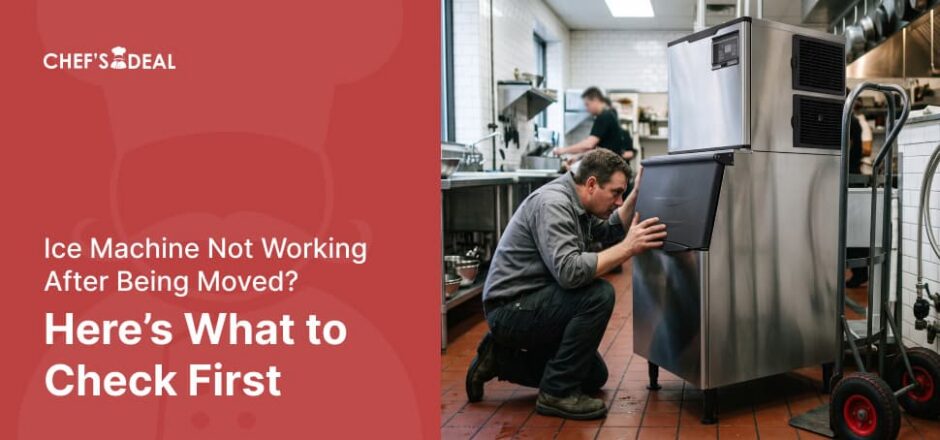
An ice machine that isn’t working after being moved is usually due to the relocation itself, such as a compressor that was tilted and needs rest time, a connection that wasn’t restored, a blown fuse, or handling damage. Since issues are common after relocation, you can do a quick check before calling a technician.
When you remodel your kitchen, rebuild your bar, move to a new location, or relocate the unit to make room for new equipment or additional space, the machine gets shut off, disconnected from water and drain, wheeled or lifted. Sometimes, the ice machine is laid down to get through a doorway, and then reconnected by whoever is on site, often a moving crew or general contractor rather than a refrigeration technician. Each step creates a failure point that can look like equipment failure once the unit is plugged back in.
Leading ice maker manufacturers like Hoshizaki require installation, service, and maintenance to follow the service manuals. Failures caused by not following those instructions are not covered under warranty. So, a short set of checks costs you little time, starting with the connections and ending with some rest time before calling a technician.
TL;DR: Ice Machine Not Working After Being Moved
- An ice machine that stops working right after a move is usually not actually broken. You need to find and fix something specific to the move, and you can check most of it in a few minutes.
- Let it stand upright for a few hours to 24 hours before you power it on if the machine was tilted or laid on its side during the move. Lubricating oil can shift out of the compressor when a unit is laid down, and running it too soon risks starving the compressor.
- Confirm power at the outlet or breaker; confirm the water supply is reconnected; confirm the shutoff valve is open; and check any internal fuse. A disconnected line or a blown fuse after relocation is a real, documented cause, not a rare fluke.
- Physical damage from the move, dents, kinked refrigerant lines, or a base that is no longer level can still prevent operation, even without an electrical or refrigeration issue.
- Most manufacturers, like Hoshizaki, require proper installation, and improper handling is not covered by the manufacturer’s warranty.
Check the Basics First: Power, Water, and Fuses
The most common fix for an ice machine that stopped working after a move is a connection that was never fully restored, so check power, water, and fuses before you touch anything else. These three checks take minutes, require no tools beyond a flashlight, and resolve most problems before you call a technician.
- Confirm the unit is actually receiving power: Check the breaker first, since breakers trip easily when equipment is being disconnected and reconnected, and a tripped breaker looks identical to a dead machine. Then confirm the receptacle itself is live, and the cord is fully seated. On a machine that was hardwired at its old location and re-terminated at the new one, verify the connection is correct.
- Confirm the water supply line is connected and the valve is open: A machine with power but no running water starts operating but makes no ice. Before calling the technician for a possible compressor failure, verify the supply line is reattached and not crimped. Additionally, ensure the shutoff valve is fully open, the water filter was reinstalled properly, and the drain line is reconnected and sloped downward so it drains by gravity.
- Check for a blown internal fuse: In one field repair case, a relocated ice machine that would not start at all had a blown fuse on the front of the control box, and replacing it brought the unit back. Although this isn’t a manufacturer-documented common failure, check the fuse location in your unit’s service manual and verify the fuse is functional.
Inspect for Physical Damage From the Move
A visual inspection catches damage that would otherwise send you chasing an electrical or refrigeration fault that does not exist, so walk the cabinet before you open a control panel. Pay attention to three things: impact damage to the cabinet itself, damage to refrigerant lines, and whether the unit is sitting level on its new base.
- Dents, scrapes, and impact marks on the cabinet: Visible exterior damage suggests the move or transportation was rough. That does not mean the dent caused the failure, but it is a reason to inspect internal components more carefully to check for a shifted or loosened component.
- Kinked, crimped, or visibly damaged refrigerant lines: Refrigerant tubing or water line can be damaged during transportation. This is a general mechanical risk rather than a manufacturer-stated failure mode. Still, it is worth a direct look at the lines you can see before assuming the fault is electrical.
- Whether the unit is sitting level on its new base, leveling affects internal water and drainage behavior, so a machine that is out of level in its new position can spill water or fail to drain even when nothing is damaged. Check level front-to-back and side-to-side with an actual level rather than by eye and adjust the legs or the base as needed.
If the Unit Was Tilted: Give the Compressor Rest Time
If the machine was laid on its side or significantly tilted during the move, let it stand upright for 2 to 24 hours before you power it on. When a unit is tilted, lubricating oil can migrate out of the compressor, and starting it before the oil settles back in risks running the compressor starved of lubrication.
For a real case where this exact mechanism led to a freeze-timer alarm and a full diagnostic walkthrough, see “3 Beeps and No Ice”: A Real Troubleshooting Walkthrough After a Machine Got Moved.
Who’s Responsible? Installation, Warranty, and a Moving Crew
It depends on your moving contract and who handles the reconnection. Hoshizaki’s service manuals state that product failure or property damage caused by improper installation is not covered under warranty.
The Hoshizaki manual places the obligation on whoever performed the work, stating that “proper installation is the responsibility of the installer.” It notes that failing to install, operate, and maintain the unit according to the manual affects safety, performance, component life, and warranty coverage. This does not cite relocations specifically, but it applies directly the moment a non-refrigeration crew handles a reconnection.
Moving companies and general contractors are not refrigeration installers. A crew can move a machine competently. However, reconnecting the water, drain, and electrical supply incorrectly can cause failure, which probably won’t be covered by the manufacturer’s warranty.
For a smoother installation and warranty process, first, document who did the work: who physically moved the unit, who reconnected the water and drain, who handled the electrical connection, and when. If you file a warranty claim, that record can be the difference between a straightforward claim and a dispute. Second, call a qualified technician to verify the reconnection rather than trusting it was done correctly.
When to Call a Technician
Call a technician once the free checks are exhausted, because everything past that point involves the sealed system, the control board, or the electrical supply. You should call a technician if:
- The basic checks- power confirmed, water supply open and connected, fuse intact- are done and the unit still will not start.
- There is any visible physical damage to the cabinet or, especially, to a refrigerant line. Suspected refrigerant restriction or loss is not a DIY diagnosis.
- The unit was significantly tilted or laid down, and you are not confident about the right rest period for your model. Waiting longer is free, while guessing wrong is costly.
- A moving crew or contractor performed the reconnection, and no one qualified has verified the connection.
- The machine starts but produces no ice, produces poor-quality ice, or throws a fault code after the move, and you’ve ruled out the basics.
- None of these means the machine is ruined. They mean the next step requires an experienced, certified technician with gauges, a meter, and the model’s service manual.
A Short Summary:
| Symptom | Likely cause | Check first | DIY or tech |
| Won’t start at all | Tripped breaker, loose cord, blown internal fuse | Reset breaker, seat cord, check fuse (downstream of the bin control switch in one documented case) | DIY; tech if the fuse blows twice |
| Runs but no ice | Water off or crimped, filter misfitted, compressor started too soon after tilting | Open the shutoff valve, reseat the filter; if tilted, rest upright for a few hours to 24 hours | DIY; tech if water is confirmed and still no ice |
| Leaking water | Drain not reconnected or not sloped, unit out of level | Reconnect and slope the drain, level front-to-back and side-to-side | DIY |
| Fault code after the move | No water, blocked airflow, bin control knocked out of position | Look up the code, confirm water and condenser clearance | DIY; tech for sealed-system or board codes |
Next Time: Planning a Move to Avoid This
You can avoid post-move failures by planning your move around three things before the unit leaves its spot:
- Loop in a qualified refrigeration technician for the reconnection step: If a non-refrigeration crew is handling the move, call the technician to verify water, drain, and electrical connections and confirm the unit is level and started correctly.
- Document the unit’s condition and settings before the move: Take photos of the cabinet, the connections, and the data plate, and log any DIP switch positions or settings that apply to your model. If something is wrong after the move, that record helps you detect the problem quickly and supports any damage claim.
- Build in a deliberate rest period before power-on: Any time the unit is tilted or laid down, let the ice maker stand upright for a few hours to 24 hours before energizing it, and schedule the move so the wait doesn’t conflict with a shift that needs ice.
FAQs About Ice Machines That Stop Working After a Move
Why won’t my ice machine start after being moved?
An ice machine that won’t start after relocation usually has a power or water connection issue, a blown internal fuse, or physical damage from the move. Or, if the unit was tilted, the compressor needs rest time before it runs. An unrelated, coincidental failure is also possible, but it is easier to do these free checks first before calling a technician.
How long should an ice machine rest after being moved before powering on?
Hoshizaki has not published a specific number. General refrigeration guidance for compressor equipment that has been tilted ranges from 2 hours to about 24 hours, depending on how far it was tilted and for how long; when in doubt, keep it off longer and confirm with Hoshizaki support for your exact model.
Is a moving company responsible if they damage my ice machine?
That depends on your moving contract and whatever liability coverage is attached to it. Hoshizaki’s warranty does not cover damage resulting from improper installation, so it is worth having a qualified technician verify the reconnection regardless of who ends up financially responsible for any physical damage.
Conclusion
An ice machine that stops working after a move is usually not failed. In most cases, it is a connection that was never fully restored, a blown fuse, handling damage, or a compressor that needs rest time after being tilted. So, conduct a few checks: power, water, fuse, then a visual inspection, before you assume the sealed system or control board is at fault. Those checks cost a few minutes and no money, and they resolve most post-relocation failures.
While doing the checks, confirm the breaker is set and the receptacle is live; verify the supply line is reconnected, the shutoff valve is fully open, and the drain is reconnected. Also, check the cabinet for dents or kinked refrigerant or water lines, and ensure it is level front-to-back and side-to-side.
If the unit was laid on its side or significantly tilted at any point, let it stand upright for a few hours to 24 hours before you energize it, since lubricating oil migrates out of the compressor when a unit is tilted and starting it early risks running the compressor starved of lubrication.
Hoshizaki requires proper installation and excludes failures caused by improper installation from warranty coverage. So, a moving crew or general contractor reconnecting the water, drain, and electrical supply is not covered under the warranty claim.
Document who moved the unit, who reconnected each service, when, and have a qualified refrigeration technician verify the work. If the basics check out and the machine still will not run, or if there is visible damage to a refrigerant line, stop there and call a technician.
Chef’s Deal provides replacement parts for commercial ice machines, including fuses, control boards, and water filtration components, along with a full range of ice machines and bins if a unit does not survive the move.
Contact us for parts sourcing or a certified service partner referral, with competitive pricing and free shipping across the catalog.

