

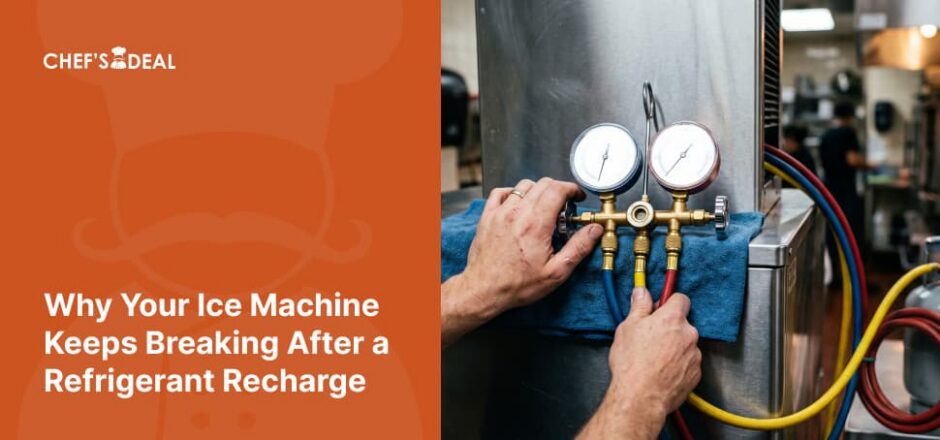
An ice machine that keeps breaking after a refrigerant recharge deserves a closer look at the previous repair. An improper refrigerant recharge is one possible cause, including the wrong refrigerant, an incorrect charge amount, or contaminated refrigerant. Symptoms such as recurring failures, abnormal frost, low ice production, or unusual pressures can signal that the system needs professional evaluation.
TL;DR
- Repeat ice machine failures after a service visit can indicate an improper refrigerant recharge, including the wrong refrigerant, incorrect charge amount, or contaminated refrigerant.
- Most Hoshizaki KM-series cubers use R-404A, but the exact model determines the factory-specified refrigerant. Using the wrong or mixed refrigerant can risk the compressor’s health and warranty coverage.
- Overcharging and undercharging create different refrigeration problems. Overcharging increases the risk of liquid refrigerant reaching the compressor, while undercharging reduces cooling capacity and can contribute to compressor overheating.
- Refrigerant service requires EPA Section 608 Technician Certification, so repeat failures after a recharge warrant professional evaluation of the refrigerant type, charge, and service procedure.
- The fix is a proper recovery and recharge to the exact factory-specified refrigerant type and amount, confirmed against gauge readings rather than assumed.
The Story: Repeat Failures After a Service Visit
The story behind repeat failures after a service visit began with a machine that kept freezing up after a technician had already serviced it. A second person examined the situation and suggested that the refrigerant itself might be the problem. Possible causes involved a substitute refrigerant used to top off the charge or contamination from reused, unidentified refrigerant.
That explanation remains a hypothesis, not a confirmed diagnosis. The available account does not establish what refrigerant entered the machine, whether the refrigerant was contaminated, or whether the recharge caused the repeated freeze-ups. It does, however, raise the practical question this article addresses: what happens when a refrigerant recharge goes wrong, and how do you know?
Why the Right Refrigerant Matters on a Hoshizaki KM Cuber
The refrigerant matters on a Hoshizaki KM Cuber because the refrigeration system and its diagnostic reference data depend on the refrigerant specified for that exact model. R-404A is the baseline for many KM-series crescent cubers, while a small number of specific Hoshizaki models use R-134A instead. Refrigerant choice affects diagnosis, future service, and warranty considerations.
- The specified refrigerant establishes the diagnostic reference point. The expansion valve, compressor, and control system operate within a refrigeration circuit designed around the refrigerant’s pressure-temperature behavior. A different or mixed charge changes system pressure relative to technician reference data.
- A refrigerant mismatch can create a second diagnostic problem. Gauge readings from the wrong or mixed refrigerant no longer match the specified reference chart. A technician then evaluates the system against the wrong baseline instead of isolating the original fault.
- The specified refrigerant also matters for future service and warranty considerations. Using a refrigerant that doesn’t match the manufacturer’s specification creates a warranty risk and complicates later diagnosis.
The exact refrigerant type and charge amount belong to the specific model. Always check the model’s nameplate and applicable Hoshizaki service documentation to avoid bad recharge issues.
What a “Bad Recharge” Actually Means
A “bad recharge” actually means the refrigeration circuit received the wrong refrigerant condition, charge amount, or system preparation. Three other problems, beyond the wrong refrigerant, are overcharge, undercharge, and moisture or air left in the system.
- Overcharge means too much refrigerant enters the system. Excess refrigerant raises head pressure and increases the risk of liquid refrigerant reaching the compressor, a condition known as liquid slugging that can damage internal components over time.
- Undercharge means too little refrigerant remains in the system. The reduced refrigerant flow lowers cooling capacity and can limit compressor motor cooling, increasing the risk of overheating and premature compressor failure.
- Moisture or air left in the system creates contamination-related problems. Air acts as a non-condensable gas that raises system pressure, while moisture can react with refrigerant and oil over time to form acids that corrode internal components.
These are general refrigeration engineering principles, not Hoshizaki-specific manufacturer guidance. Each can create different symptoms and failure paths. Always look for the specific signs that may indicate an incorrect recharge in your Hoshizaki ice machine.
Signs Your Ice Machine May Have Been Recharged Incorrectly
Signs that your ice machine may have been recharged incorrectly include recurring problems, abnormal frost patterns, prolonged operation with low ice production, and unusual refrigerant pressures.
- Problems return soon after service: The charge, leak repair, or system preparation may need further investigation if poor ice production or refrigeration problems return within days or weeks of a refrigerant-related service visit.
- Unusual frost or ice appears on refrigerant lines: Unexpected frosting can indicate abnormal refrigerant flow or operating conditions. An incorrect charge is one possible cause, but this symptom alone cannot distinguish overcharge from undercharge.
- The machine runs constantly with low production: Extended operation without reaching normal ice production can indicate a refrigeration problem, including an incorrect charge. Water flow, airflow, components, and operating conditions can cause similar symptoms.
- A technician finds abnormal R-404A pressures: Pressure readings during follow-up service that don’t match the specific Hoshizaki model’s expected operating conditions, for R-404A or R-134A, whichever that model specifies, can provide stronger evidence that the refrigeration circuit needs investigation.
These signs can point to a recharge problem, but confirming it requires evaluating pressure readings and other operating conditions against the R-404A pressure-temperature relationship and Hoshizaki’s model-specific service data. That level of diagnosis isn’t a simple DIY job.
Why This Isn’t a DIY Job: The EPA Certification Requirement
Refrigerant work on a commercial ice machine isn’t DIY: it requires EPA certification when the work could reasonably be expected to compromise the refrigerant circuit’s integrity. Section 608 of the Clean Air Act, implemented through 40 CFR Part 82, Subpart F, regulates activities such as adding or removing refrigerant and connecting gauges or hoses to measure pressure.
The certification category depends on the equipment’s classification under EPA’s definitions. EPA recognizes Type I for small appliances, Type II for high- or very-high-pressure appliances, Type III for low-pressure appliances, and Universal for all three.
Three practical steps matter for an operator dealing with a repeat failure:
- Don’t add refrigerant or connect gauges yourself: EPA includes adding or removing refrigerant and attaching or detaching gauges to measure pressure among regulated technician activities.
- Request the previous service records: Ask for the refrigerant type and amount used, along with the servicing technician’s Section 608 certification information.
- Have a certified technician evaluate the recharge: The technician can recover the existing charge, perform the required evacuation procedure, and recharge the machine with the exact factory-specified refrigerant and amount.
When to Call a Technician
Call a technician when a repeat failure clearly connects to recent refrigerant service or signs of compressor strain. These signals do not prove an improper recharge, but they indicate that continued monitoring without professional evaluation is not appropriate.
- Problems return within days of a refrigerant-related service visit: A rapid recurrence after service makes the previous repair an important part of the diagnostic history.
- A technician reports pressure readings outside the expected range: A technician reports pressure readings outside the expected range: Readings must match the applicable model-specific pressure-temperature reference for that machine’s specified refrigerant (R-404A on most KM-series units, R-134A on the small number of exceptions) before the charge receives a clean bill of health.
- The compressor shows signs of strain: Unusual compressor noise, a tripped breaker, or an overheating compressor housing warrants prompt evaluation rather than continued operation.
Reducing the Risk on Future Service Visits
Reducing the risk on future service visits requires two simple habits: verify the technician’s certification and keep a service record for each machine. These steps create a documented service history, rather than leaving the next technician to reconstruct what happened from symptoms alone.
- Verify EPA Section 608 certification directly: Ask to see the current Section 608 certification before hiring a technician for refrigerant work. EPA requires certification for technicians who perform regulated service activities on covered refrigerant-containing equipment.
- Keep a documented service log for each machine: Record the exact refrigerant type and amount used, the service date, and the work performed after refrigerant-related service. A running record helps identify a repeat problem without rebuilding the service history.
FAQs
Why do my ice machines keep breaking?
Your ice machines keep breaking because repeat failures can indicate an improper refrigerant recharge, including the wrong refrigerant, incorrect charge amount, or contaminated refrigerant. Other causes to consider include Hoshizaki harvest jamming and the disputed possibility of Hoshizaki evaporator plate separation.
What refrigerant does a Hoshizaki ice machine use?
Most Hoshizaki KM-series cubers use R-404A; a small number of specific models use R-134A instead. Always confirm against the exact model’s nameplate or service manual rather than assuming.
Can mixing refrigerants damage my ice machine?
Yes. A mixed or contaminated charge can make pressure readings difficult to interpret against the specified refrigerant’s reference data and create service and warranty concerns.
Conclusion
A machine that keeps failing after a refrigerant service visit tells you something measurable. Confirm the exact refrigerant specified for the model, review what was used during the previous service, and have a certified technician verify the charge and system condition.
Investigate the machine’s specific failure pattern rather than assuming refrigerant is always the cause if the symptoms point elsewhere. See the guides on Hoshizaki harvest jamming and 3 Beeps and No Ice for other documented causes and symptoms.
Shop Hoshizaki Ice Machines & Genuine Parts at Chef’s Deal
Chef’s Deal stocks Hoshizaki ice machines and genuine replacement parts, with financing options up to 84 months. Consult an EPA Section 608-certified technician for refrigerant recovery, evacuation, or recharge work. Chef’s Deal’s team can help match the correct model and specifications, but a certified technician must perform the recharge work; this guide alone is not a substitute for professional service.

