

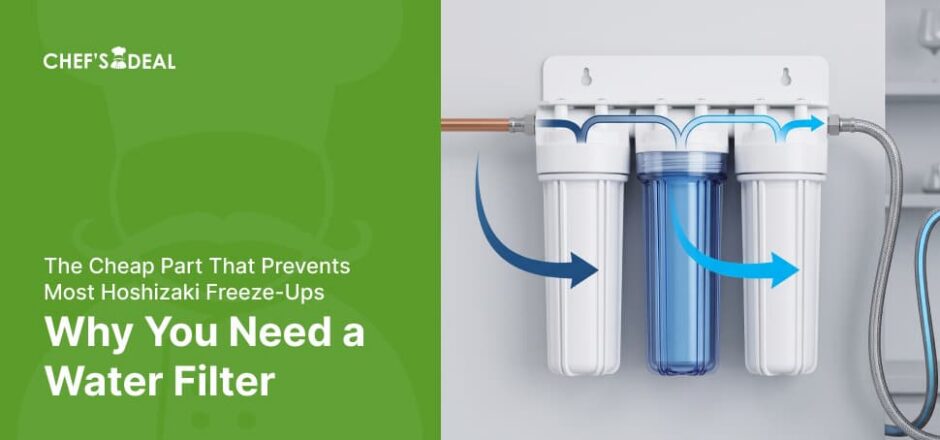
A Hoshizaki water filter is a relatively inexpensive preventive-maintenance component that reduces sediment, rust, chlorine, and mineral buildup before they reach critical water-system components. Regularly replacing the 4HC-H filter cartridge at the recommended interval helps reduce the risk of clogged distribution lines and scale-related malfunction of valves, pumps, and floats.
TL;DR
- Hoshizaki identifies scale buildup as a cause of clogged distribution lines and malfunctioning floats, pumps, and valves in commercial ice machines.
- A Hoshizaki filter cartridge provides routine scale prevention at a lower cost than emergency service or replacement of scale-affected components.
- Filtration helps reduce water-related issues like leaking valves, restricted water distribution, ice jamming, and declining ice quality.
- Filters need replacing on a schedule, roughly every 6–12 months or at their rated gallon capacity, whichever comes first, rather than waiting for scale-related symptoms.
- Filtration capacity depends on machine production requirements. Check the exact Hoshizaki model before choosing a single-, twin-, or triple-cartridge configuration.
Why Scale Buildup Is the Root Cause Behind So Many Ice Machine Problems
Scale buildup is the root cause behind many ice machine problems because unfiltered water leaves mineral deposits that restrict or jam moving parts throughout the machine. Hoshizaki states this directly on the product page for its 9795-90 E-20 Prefilter System: a filter “reduces scale buildup which can result in the clogging of distribution lines, malfunction of floats, pumps, and valves.”
That manufacturer guidance supports this article’s central argument: reducing mineral buildup addresses several components that depend on clean, consistent water flow. The same mechanism appears in other troubleshooting cases covered on this site. Mineral scale can restrict spray-tube openings (see Ice Machine Jamming After Cleaning? Check Your Spray Tube Alignment First) and reduce water coverage during harvest. At the same time, scale and debris can prevent a drain valve from seating completely during a freeze (a failure covered in The Hoshizaki Dump Valve Failure Nobody Talks About).
These conditions create different symptoms, but both involve restricted or disrupted water flow. Filtration helps prevent these water-related problems upstream. A filter reduces the sediment and mineral load entering the machine, while scheduled cartridge replacement keeps that protection in place before scale reaches distribution lines, valves, pumps, or floats.
What a Hoshizaki Water Filter Actually Does
A Hoshizaki water filter reduces sediment, rust particles, and disinfectant chlorine in incoming water before those contaminants reach the ice machine’s water system. It reduces maintenance frequency by preventing lime buildup. Hoshizaki’s 4HC-H filter is available as the H9655-11 single cartridge and H9655-06 six-pack.
- The 4HC-H cartridge filters to 0.5 micron, minimizing sediment and rust particles in the incoming water supply.
- The cartridge reduces disinfectant chlorine by up to 97.3%, helping limit chlorine-related taste and odor in finished ice.
- The 4HC-H cartridge meets NSF/ANSI Standard 42 for applications involving particulate, taste, and odor reduction.
- The cartridge supports a maximum flow rate of 2 gal (7.571 L) per minute and approximately 21,000 gallons (79,493.647 L) of capacity in a single-cartridge configuration.
- Filtration capacity changes with the configuration: higher-production applications can use twin- or triple-cartridge systems rather than a single cartridge.
Hoshizaki recommends replacing the cartridge approximately every 6–12 months or when it reaches its rated gallon capacity, whichever comes first. That schedule matters because mineral buildup can accumulate inside water lines, valves, pumps, and other components before an operator notices a visible or operational problem. Proper cartridge replacement keeps the filtration system operating at its rated capacity.
How to Replace a Hoshizaki Water Filter Cartridge (Step-by-Step)
Replacing a Hoshizaki 4HC-H filter cartridge is a 6-step process applicable to H9320-51, H9320-52, and H9320-53 filtration systems.
- Shut off the water supply and relieve line pressure. Lift the handle fully until it stops on filter heads with a built-in shut-off valve.
- Hold the filter head firmly and push upward on the cartridge. Turn the cartridge a quarter turn to the left until rotation stops.
- Pull the cartridge down and out of the head. This releases the used cartridge once the quarter-turn lock has cleared.
- Align the new cartridge’s lug with the label on the head. Hold the head firmly and insert the new cartridge straight into position.
- Turn the new cartridge a quarter turn to the right until rotation stops. Repeat steps 2-5 for each additional cartridge on multi-head systems.
- Turn the water supply back on. Lower the handle to restore flow on filter heads with a built-in valve.
Why This Is the Cheapest Insurance on the Whole Machine
Routine filter replacement is the cheapest insurance on the whole machine because it costs far less than replacing a scale-affected water-system component. A 4HC-H filter cartridge is a predictable maintenance expense, while a pump, valve, or other component failure can add a substantially higher parts cost plus labor and diagnostic charges.
The Hoshizaki PA0613 pump motor assembly provides a concrete comparison: while a 4HC-H filter cartridge costs roughly $125–$270, current OEM listings for the pump range from about $700 to over $1,400 before labor. That means a pump replacement can cost several times more than the filter that helps reduce scale buildup affecting water-system components.
Hoshizaki identifies scale buildup as a condition that can cause pumps, valves, floats, and distribution lines to malfunction. A filter does not guarantee a pump will never fail, but reducing the mineral load entering the machine addresses one documented cause of water-system problems before it reaches those components.
Treating filter replacement as a routine maintenance budget item therefore makes the expense more predictable than waiting for scale-related symptoms and component repairs. A pump failure, a diagnostic service call, or, in more serious cases, a full evaporator or machine replacement all cost dramatically more than a cartridge. The exact filter cost depends on how many filters your machine needs.
Does Your Model Need One Filter, or More?
Your Hoshizaki model determines the recommended filtration configuration. Larger-production machines generally use larger-capacity filtration systems. Hoshizaki’s 4HC-H filter lineup includes the H9320-51 as a single system, H9320-52 as a twin system, and H9320-53 as a triple system.
| Filtration System | Configuration | Ice Production Capacity per Day | Compatible Hoshizaki Models |
|---|---|---|---|
| H9320-51 | Single | Up to 900 lb (408.2 kg) | AM-50, C-80, KM-81, KM-116, KM-161, KM-231, KM-301, KM-350, KM-520, KM-660, KML-325, KML-500, KML-700, KMS-830, DKM-500, IM-200, IM-500, IM-50, F-450, F-300, F-330, F-500, F-801, F-1002, F-1501, F-20 |
| H9320-52 | Twin | 900–1,301 lb (408.2–590.1 kg) | KM-901, KM-1100, KMD-860, KMS-822, KMS-1122, KMS-1402, KMH-2000, KMH-2100, IM-50 |
| H9320-53 | Triple | More than 1,301 lb (590.1 kg) | KM-1301, KM-1340, KM-1601, KM-1900, KM-2200, KM-2600, KMH-2100 |
Note: IM-50 and KMH-2100 are listed by Hoshizaki as compatible with more than one filtration tier; confirm the exact configuration for your installation using Hoshizaki’s official filtration selection guide.
Check the exact model against Hoshizaki’s current filtration selection information before ordering. Hoshizaki also notes that challenging water conditions or higher usage can require additional filtration or prefiltration, so production capacity alone does not determine every filtration decision.
Filtration and Your Warranty
Filtration connects to your Hoshizaki warranty through the manufacturer’s general maintenance requirements. Hoshizaki does not state that filtration itself is a specific warranty condition, but it affects coverage. Hoshizaki’s warranty for KM Series ice machines (document 2A4016‑011) excludes coverage for component failure or damage resulting from failure to clean or maintain the machine as specified.
That distinction matters. Hoshizaki’s warranty language does not specifically say that failing to install or replace a water filter voids coverage. However, Hoshizaki reports in its Official Support, Training, and Technical FAQs that components that fail because of scale buildup or inadequate preventive maintenance are not considered warranty issues.
Water filtration therefore counts as part of maintaining the machine under its operating conditions, not as a separate filter-specific warranty requirement. In a scale-related component failure, the key question is whether you maintained the machine according to Hoshizaki instructions. Keep the machine’s maintenance records and follow the filtration, cleaning, and water-treatment requirements applicable to your model.
When to Call a Technician
Call a technician when declining ice quality, production, or cycle performance suggests that scale has already accumulated inside the machine. Installing a new filter prevents future mineral buildup; existing scale requires remediation by a qualified technician.
- Visible mineral deposits or restricted water flow at the inlet, filter housing, or service valves warrant inspection for existing scale or another water-system restriction.
- Slower ice production or abnormal cycle timing warrants inspection, not just a filter-replacement issue.
- Suspected existing scale buildup warrants descaling and inspection by a qualified technician before or alongside filter replacement, because filtration prevents additional buildup rather than removing deposits already inside the machine.
Setting Up a Filter Replacement Schedule
Setting up a filter replacement schedule means replacing the cartridge on a calendar or usage basis rather than waiting for a symptom to appear.
- Replace each cartridge every 6–12 months or at its rated gallon capacity, whichever comes first. Use the cartridge’s capacity and the machine’s operating conditions to determine the applicable interval.
- Record the installation date for each filtration system so you can schedule the next replacement without relying on memory or waiting for a performance problem.
- Confirm the correct filtration configuration, single, twin, or triple, for the specific Hoshizaki model before ordering replacement cartridges, rather than assuming every machine uses one cartridge.
A simple replacement log turns filtration into routine preventive maintenance instead of a response to declining ice quality or machine performance. Schedule replacements for machines with multiple cartridges together so the filtration system maintains consistent protection.
FAQs
These FAQs answer common operator questions about Hoshizaki water filtration in a direct-answer format.
How often should I replace my Hoshizaki water filter?
Replace your Hoshizaki water filter roughly every 6 to 12 months, or at the filter’s rated gallon capacity, whichever comes first. A single cartridge is rated for approximately 21,000 gallons (79,493.647 L), with actual service life depending on water conditions and usage.
How many water filters does my Hoshizaki ice machine need?
The number of water filters your Hoshizaki ice machine needs depends on the model’s ice production capacity. Smaller-capacity units typically use a single filter, while higher-capacity KM cubers may need a twin- or triple-filtration system. Check Hoshizaki’s official filtration selection guide for the exact model.
How do I replace a Hoshizaki water filter cartridge?
Shut off the machine and the water inlet, relieve pressure through the flushing valve, remove the old cartridge, install the replacement, and restore power. See the step-by-step section above for full detail.
Can scale buildup really cause my ice machine to jam or freeze up?
Yes. Hoshizaki’s documentation states that scale buildup can clog distribution lines and cause floats, pumps, and valves to malfunction.
Conclusion
Scale reduction is a documented reason for using Hoshizaki’s water filtration systems: Hoshizaki states that reducing scale buildup can help prevent clogged distribution lines and malfunctioning floats, pumps, and valves. A filter is therefore a relatively small, scheduled maintenance expense compared with addressing water-system problems after they develop.
Check your current cartridge’s installation date and usage today, confirm that the filtration configuration matches your Hoshizaki model, and schedule the next replacement before the cartridge reaches its service limit.
Chef’s Deal stocks Hoshizaki 4HC-H replacement cartridges alongside single, twin, and triple configurations. Benefit from financing options up to 84 months and free shipping on qualifying equipment.
