

An ice machine jamming right after a cleaning is most likely due to a distribution tube (spray tube) that was removed for sanitizing and then reinstalled slightly out of position.
So, water runs down the outside of the evaporator plates instead of between them. The ice never fully releases, cubes stack instead of dropping, and the bin fills with a fused sheet. Sometimes, the proper installation of the parts does not solve the problem.
This time, the solution is to adjust the harvesting cycle time, which is not long enough to release the ice. Set the harvest time on the control board to ensure a proper harvesting cycle.
Key Takeaways
- Timing is the clue: Intermittent harvest jams that begin right after cleaning usually indicate a misaligned distribution or a spray tube, not a refrigeration fault.
- The diagnostic indicates that water cascading down the outside of the evaporator plates during harvest, instead of running down between them, confirms tube misalignment.
- Two causes can stack: A jam can have two independent causes at once, tube alignment and insufficient harvest-cycle time, so fixing one may only partially resolve the problem.
- Confirm live: Verify any fix by watching an active harvest cycle. Do not reassemble the unit and assume the issue is resolved.
- Do not guess on timing: Harvest-cycle timing adjustments made through dip switches are model-specific. Verify the correct setting against the manufacturer’s manual or tech support before changing anything.
The Symptom: Ice Jamming That’s “Too Frequent to Be Random”
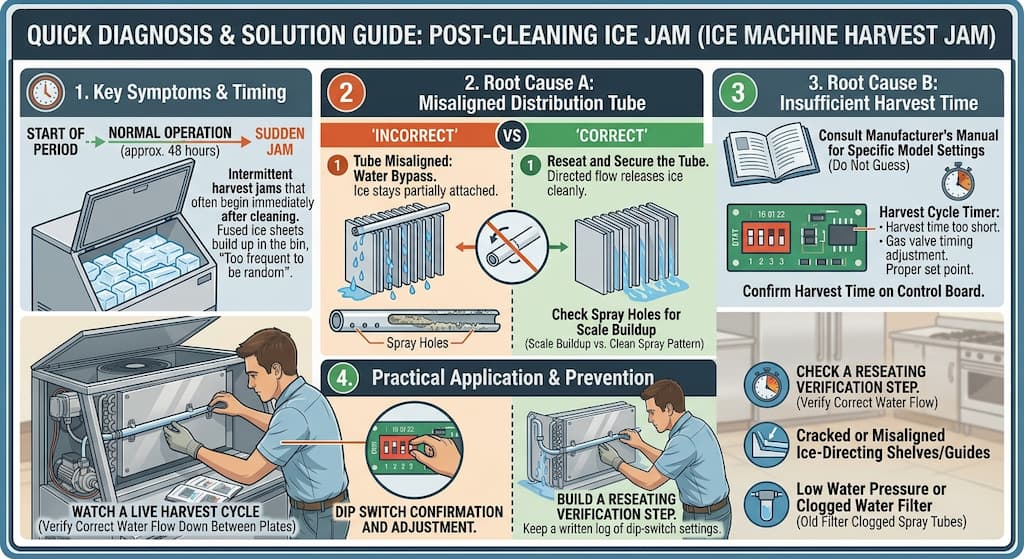
The primary symptom is the ice not releasing cleanly from the evaporator plate, building up into sheets or blocks in the bin at unpredictable intervals. The pattern that distinguishes this specific failure from a general performance problem is its inconsistency: the machine can run cleanly for 48 hours, then jam again in as little as 8 hours. It is not random enough to dismiss and not regular enough to tie to a load, temperature, or shift pattern.
This is harder to diagnose than a hard-stop error code precisely because the machine is mostly working. It fills, it freezes, it initiates harvest, and it makes ice that looks correct when it drops. Total-failure causes such as a dead water pump, a failed compressor, a bad thermistor, or a locked-out control board are ruled out since you are still getting ice. The problem is a mechanical fault in the water delivery system during ice production.
The user conducts a standard first round of checks, cleaning the condenser coil, checking the hot gas valve, lowering the water level, and running a full descaling cycle. Ruling out those common problems is correct. But it is not a dead end, and it does not mean the machine needs to be replaced. It means the fault is in a place that a standard maintenance pass does not inspect: the distribution tubes themselves.
Root Cause #1: Misaligned Distribution (Spray) Tubes
A misaligned distribution tube causes ice jamming because it aims to eject water at the wrong surface during harvest, so cubes never fully release from the plate. The distribution tube assembly sits above the evaporator or the freezing grid to spray water evenly across the plate and release the ice cleanly.
When these tubes are removed for cleaning or replaced with a sanitized spare set from a soak tank, they need to be installed properly. If they go slightly out of position or rotate slightly on their axis, water runs down the outside of the plate assembly rather than between the plates. The cubes on the plate hang, the next batch forms behind them, and within a few cycles you have a fused block instead of loose cubes falling into the bin.
This happens even when an experienced person handles the maintenance and cleaning. “Clean” and “correctly seated” are two different conditions, and a tube can meet every sanitation standard even when assembled incorrectly. Operations that rotate spare distribution tubes through a sanitizing soak are the most likely to produce this exact symptom. Every soak cycle is another removal and reinstallation, which means another occasion for a tube to go back in slightly off.
How to Confirm It: Watching a Live Harvest Cycle
To confirm a tube alignment problem, observe an active harvest cycle with the top panel removed, rather than inspecting the tubes at rest. The procedure is short. Power the unit, remove the top panel per your model’s manual, and observe the machine through a full harvest cycle, especially the mid-cycle. Watch where the water goes.
- Correct behavior: Water runs down between the evaporator plates, contacts the plate faces, and releases cubes cleanly into the bin.
- Misalignment confirmed: Water cascades down the outside of the plate assembly, bypassing the plate faces, and cubes stay partially attached or drop late.
Fixing Tube Alignment
To fix the ice jamming and align the spray tube, work through it in this order:
- Power down the unit and follow your model’s lockout procedure before opening anything.
- Remove the top cover per the manufacturer’s manual.
- Inspect tube seating at every mounting point, checking both depth and rotational position against the manual’s reference image. Check whether there is a factory-designed directional clip and verify that it is not broken.
- Check the spray holes for scale buildup or partial clogging; a correctly seated tube with blocked holes can produce a similar starved-spray pattern.
- Reseat each tube by hand until it sits firmly in its intended position with no play.
- Verify the tube stays put. If it can shift under light hand pressure, it will shift under water flow and vibration.
- Confirm the repair by watching a live harvest cycle as described in the previous section. Do not consider this resolved until you have seen water running down between the plates with your own eyes.
Root Cause #2: Harvest Cycle Timing
Reseating the spray tube solves most problems, but if the problem persists, the solution is adjusting the harvest cycle time. Harvest cycle timing controls how long hot gas runs to release cubes from the evaporator plate, and if that duration is too short, ice will not fully release even if water flow is correctly aligned. This is the second, independent root cause in this case.
Spray and distribution alignment determines where the assist water goes; harvest cycle timing determines how long the plate stays warm enough for release. Harvest timing is commonly adjusted through dip-switch banks on the control board.
Correct settings vary by brand and model, so you must follow the guidelines of the brand and model manuals to avoid new failures. The recommendation is simple: do not guess with dip switches. Confirm first, then adjust, then verify through a live cycle.
Other Things to Rule Out
If your ice jamming problem persists, you can try 2 more checks:
Cracked or misaligned ice-directing shelves and guides: These parts steer released cubes toward the bin, and a cracked or shifted guide can cause cubes to hang up even after a clean release from the plate. Inspect them visually while the top cover is already off.
Low water pressure or a clogged water filter: Chemicals used during cleaning or an old filter can clog the spray tubes. Even when every tube is seated correctly, clogging can produce weak, uneven coverage across the plate. So, you should check the filter age, clean any chemical residue, and verify the supply pressure before concluding that the alignment fix failed.
When to Call a Technician
Call a technician when tube realignment and harvest-timing adjustment do not resolve the jamming within a few observed cycles. At that point, you have exhausted the two most likely mechanical causes, and what remains- refrigerant charge, hot gas valve performance, control board faults, thermistor calibration, needs gauges, model-specific diagnostics, and, in most cases, EPA certification to work legally.
If the control board does not respond as expected to a dip-switch change, return the switches to their documented original positions and call for support rather than working through combinations. A short service call costs far less than a control board or a compressor damaged by a guess at configuration.
Preventing This From Happening Again
You prevent ice-jamming failure by changing your ice machine cleaning and maintenance routine itself, not by cleaning more often. Three habits address these two root causes directly:
- Build a reseating verification step into your sanitizing rotation. If you rotate spare distribution tubes through a soak, add a documented seating check to the reinstallation step.
- Watch at least one full harvest cycle after any teardown or cleaning. Before the unit goes back into normal service, confirm that water is running down between the plates.
- Keep a written log of harvest-cycle and dip-switch settings for each unit. Record the factory-correct configuration per machine, per location. Restore the documented setting instead of reconstructing it by guesswork if a tech changes it or someone bumps a switch during a board service,
FAQs About Ice Machine Jamming After Cleaning
What’s the difference between a tube-alignment problem and a refrigeration problem?
A tube-alignment problem shows up as water running to the wrong place during an otherwise normal-sounding cycle, even as the machine continues making ice. A refrigeration problem typically shows up as the evaporator plate failing to get cold at all, or taking far too long to reach.
Why does my ice machine only jam after cleaning, not before?
Because the distribution tubes are removed and reinstalled during cleaning, and slightly off-reseating is the most common trigger for harvest jams. The timing is not a coincidence; the cleaning disturbed the tube position, even though the cleaning itself was performed correctly.
How do I know if my distribution tubes are misaligned?
Watch water flow during an active harvest cycle with the top panel removed. If water runs down the outside of the evaporator plates instead of between them, the tubes are misaligned.
Can I adjust harvest cycle timing myself?
You can adjust the harvest cycle timing only using the exact settings for your specific model, as specified in the manufacturer’s technical manual (for instance, Hoshizaki) or via tech support. Reusing another model’s dip-switch positions, or guessing, is a documented way to create a new problem on top of the ice jamming.
Final Thoughts: Diagnosing Ice Machine Jamming After Cleaning
When a cuber-style ice machine starts jamming right after a cleaning, check distribution tube alignment before you touch anything refrigeration-related. The diagnostic path is short and cheap: pull the top panel, run the unit, and watch where water goes during harvest. Watering down the outside of the plates instead of between them confirms the fault, and reseating the tube and installing the correct factory retaining clip resolve it in most cases.
The part most operators get wrong is stopping there. Harvest-cycle timing is a separate variable that produces the same jamming symptom, and the two faults stack, which is why a tube fix can cut jam frequency without ending it. If jamming persists after confirming correct alignment, verify harvest timing against your model’s technical manual or manufacturer tech support, rather than adjusting dip switches by trial and error. If neither correction holds through a few observed cycles, the remaining causes need a certified technician.
Both root causes are ultimately preventable through procedure. Add a reseating verification step to your sanitizing rotation, watch one full harvest cycle before returning any unit to service after a teardown, and keep a written log of each machine’s correct timing configuration. Those three habits cost minutes and prevent the version of this failure that shows up mid-service with a full house.
Chef’s Deal carries commercial ice machines, ice makers, ice bins, and water filtration systems for cuber, flaker, and nugget applications, with competitive pricing, free shipping on qualifying orders, and financing available across the catalog.

