

Peak season multiplies the load on a commercial ice machine, increasing the pressure on its components. Therefore, they require careful cleaning and maintenance to preserve the reliability of their components and first-day performance.
Maintenance and cleaning are often treated as the same task, but they protect against two different failure modes. Cleaning protects the ice itself by removing scale, lime, and mineral deposits that threaten food safety.
Maintenance ensures the machine can keep producing that ice under sustained load, hour after hour, throughout the full run of the event calendar. A commercial kitchen, sports bar, or hotel that does only one of the two is still exposed to the failure that the other prevents.
Ice machine maintenance carries greater weight during high-demand events such as the 2026 FIFA World Cup, summer tournaments, and festival season to prevent unexpected breakdowns, while cleaning helps maintain the safety of the ice produced.
What separates cleaning from maintenance is the most common point of failure that operators encounter under peak load, as well as the preventive tasks, service intervals, and staff routines that keep a machine producing through the busiest stretch of the year.
Ice machines require proactive maintenance because they are regulated as food-contact equipment and must meet strict sanitation standards. Performance is heavily influenced by water quality and proper airflow, while high ambient temperatures can significantly reduce ice production during busy seasons.
Routine deep cleaning, especially in high-volume venues, along with early attention to warning signs such as reduced output or unusual operation, helps prevent failures. For operations expecting peak demand, having a backup ice supply plan is an essential part of reliable event-season preparedness.
Why Ice Machine Maintenance Matters More During Peak Season?
Ice machine maintenance matters more during peak season because the machine handles a much greater burden, more frequent production cycles, consistently high output, and challenging environmental conditions, and that combination compounds the risk of failure exactly when ice demand is highest.
Increased Demand Creates More Continuous Production Cycles
Increased demand during the event season forces ice machines into a more continuous production cycle. A machine engineered to freeze, harvest, and rest for a while runs near-constant cycles for a full day of service, with shorter rest periods between harvests. This nonstop operation accelerates wear on the compressor, water pump, and harvest mechanism.
How Equipment Downtime Cuts Revenue Within Hours
Event season concentrates the demand in a few hours of the service window for sports bars, restaurants, and concession stands. Hence, equipment downtime can cut your revenue within hours because beverage service is the first casualty of an ice failure. A sports bar or stadium-area restaurant without ice cannot serve a cold draft beer, a soda, or a cocktail at full speed, and customers do not wait around for a fix; they move to the next vendor.
How Peak Summer Heat Reduces Ice Production
Major sports events like the FIFA World Cup and the Olympics take place in the summer, with rising temperatures reducing ice production. Ice machine capacity ratings in the spec sheets are typically calculated at 70°F (21.11°C) ambient air and 50°F (10°C) incoming water.
However, event kitchens during summer tournaments and festivals routinely run at ambient temperatures of 80°F to 90°F (26.67°C to 32.22°C). These conditions reduce actual output by 20% to 30%, meaning a machine that looks adequately sized on paper falls short of your needs when peak-season heat arrives and demand rises.
What is the Difference Between Ice Machine Cleaning and Maintenance?
The difference between ice machine cleaning and maintenance is the problem each one solves. Cleaning is a sanitation task that protects the ice quality; maintenance is a reliability task that protects the machine’s ability to keep producing that ice under load.
| Category | Cleaning | Maintenance |
| Primary Goal | Food safety and sanitation | Equipment reliability and uptime |
| What It Addresses | Scale, slime, mold, bacterial growth on ice-contact surfaces | Airflow, refrigerant performance, mechanical wear |
| Typical Frequency | Every 3–6 months (deep clean); quarterly in high-volume settings | Ongoing inspection, filter checks, and condenser care between deep cleans |
| Who Performs It | Staff or a certified technician, per manufacturer guidance | Trained staff for daily checks; a technician for inspections and repairs |
| Consequence of Skipping | Health code violations, contaminated ice, off-tasting product | Reduced capacity, breakdowns, emergency repair costs |
Cleaning Focuses on Sanitation
Cleaning focuses on sanitation because ice is a food product, and every surface that touches it must be clean and hygienic. Regular cleaning removes mineral scale, mold, and lime that form in the water lines and on ice-production surfaces, while sanitizing all ice-contact surfaces to eliminate bacteria before they reach the glass.
Maintenance Focuses on Reliability and Performance
Maintenance ensures reliable performance by inspecting filters, checking the condenser, verifying water pressure, and reviewing harvest cycle times, catching mechanical issues before they cause a major breakdown. A machine can pass a sanitation inspection but still fail under load if airflow is restricted, the gaskets are torn, or a worn component is one cycle away from failing.
Why Cleaning and Maintenance Matter Before Major Sporting Events?
Both cleaning and maintenance matter in the foodservice industry, especially during the major sporting events, because you will not have enough time to make the necessary repairs or compensate for a compromise in the beverage taste. Event-season readiness requires both tracks to run on their own schedules, not one substituting for the other.
What Are the Most Common Ice Machine Problems During Peak Season?
The most common ice machine problems during peak season are reduced production capacity, water filtration and scale issues, airflow restrictions at the condenser, and ice quality or sanitation concerns.
1. Reduced Ice Production Capacity
Reduced ice production capacity is the first symptom operators notice, usually a half-full bin at a point in service when it should be full. The underlying reason is typically a combination of evaporator scale, a partially restricted water filter, and elevated ambient temperature. (Click ice machine parts and accessories to find the parts and accessories you need right now, or to stock up on items for future use.)
2. Water Filtration and Scale Buildup Issues
Water filtration and scale buildup issues are the leading cause of reduced ice machine performance. Dissolved minerals in the water supply, particularly calcium and magnesium in hard-water regions, deposit on the evaporator plate at every freeze cycle, especially with an overdue filter. That layer of scale insulates the surface and slows heat transfer.
3. Airflow Restrictions and Condenser Problems
Airflow restrictions and condenser problems caused by grease-laden kitchen air, dust from outdoor vendor setups, and high foot traffic near air-cooled units increase with dust and debris on the condenser coil. A fouled condenser forces the compressor to work harder to reject heat, increasing energy consumption, slowing the freeze cycle, and shortening the compressor’s lifespan.
4. Ice Quality and Sanitation Concerns
Mold and lime growing in the water supply lines and on ice-making surfaces can cause cloudy, off-tasting ice or visible discoloration in the product. This spoils the taste and appearance of beverages, causing complaints and reduced purchases.
What is the Most Important Part of Ice Machine Maintenance?
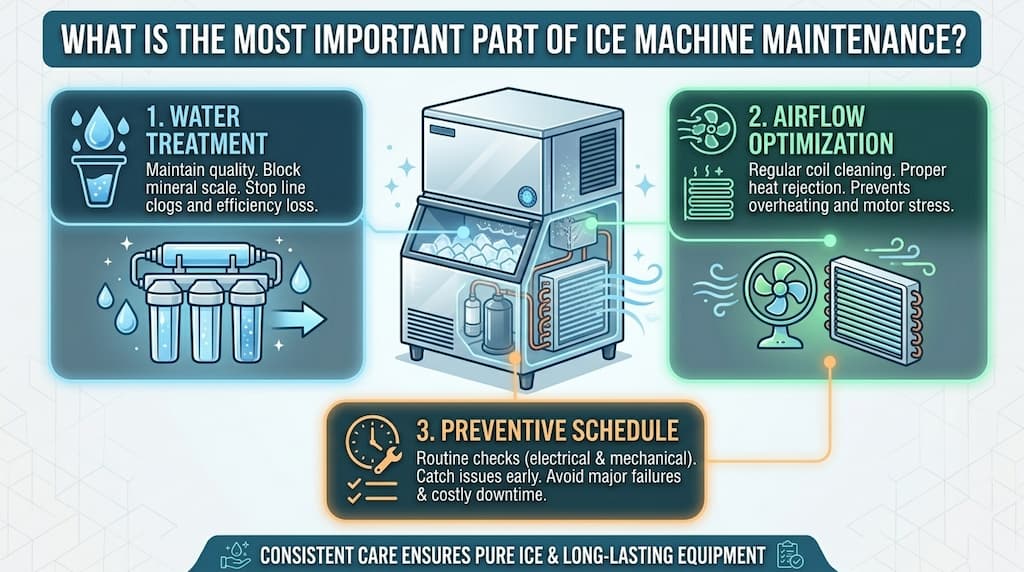
The most important parts of ice machine maintenance are water quality management, airflow, condenser care, and a routine of preventive inspections.
Water Quality Management
Water quality management deserves top priority because it is the primary factor directly affecting both ice quality and ice machine performance. Operators in known hard-water regions should follow a strict routine of replacing water filters as they head into peak season.
Airflow and Condenser Maintenance
Airflow and condenser maintenance ensure a clean, unobstructed condenser operating within its designed energy and capacity envelope, while a soiled one results in longer cycle times and higher energy draw for the same output.
Preventive Inspections Before Failures Occur
Preventive inspections before failures catch a partially clogged filter or a slowly rising harvest time, giving an operator time to act before the event season starts. Waiting for a visible symptom, a half-full bin, or a grinding noise means the problem has already progressed far enough to affect service.
Pre-Season Setup: One-Time Tasks Before the Event Calendar Fills
Before peak season begins, work through this one-time readiness sequence; each task is a setup action you complete once to confirm the machine is event-ready: inspect air filters and ventilation areas, verify water supply and filtration condition, inspect ice storage bins and drainage, review the manufacturer’s specific maintenance requirements, and schedule professional service before demand arrives, not after a problem appears.
1. Inspect Air Filters and Ventilation Areas
Inspecting air filters and ventilation areas should be one of the first tasks on the pre-season list, since a blocked filter or an obstructed vent restricts the airflow that the entire cooling cycle depends on. You need to confirm that nothing prevents or reduces the unit’s intake or exhaust channels. You should also clean or replace the air filters according to the manufacturer’s schedule before the first high-volume week begins.
2. Verify Water Supply and Filtration Condition
Verifying water supply and filtration condition includes checking the age of the current filter cartridge, confirming water pressure falls within the manufacturer’s specified range, and testing for any recent changes in water hardness or taste.
3. Inspect Ice Storage Bins and Drainage Systems
Inspecting ice storage bins and drainage systems helps you detect buildup that accumulates in areas staff rarely inspect during daily service. Standing water at the base of the bin, slow drainage, or visible buildup along bin walls are early indicators that the drain line or bin gasket needs attention and maintenance.
4. Review Manufacturer Maintenance Requirements
Every manufacturer has special maintenance requirements and routines. So, you should review the model-specific maintenance guide covering filter change intervals, descaling frequency, and recommended professional service schedules.
5. Schedule Professional Service Before High-Demand Periods
You should schedule a professional maintenance service before the high-demand period to ensure technician availability, since every other operator in the area is trying to do the same thing. A technician visit before a major sports event or the festival season can help diagnose issues and prevent unexpected breakdowns.
How Often Should Commercial Ice Machines Be Serviced?
Commercial ice machines should be serviced according to manufacturer recommendations first, then adjusted upward for local water conditions, and again for high-volume, event-season operation, rather than following a single universal interval that ignores how the specific machine is actually used.
Why Manufacturer Recommendations Should Come First?
Manufacturer service recommendations are the primary factor in determining your service routine because they are tailored to the specific design, refrigerant system, and component tolerances of that model, rather than a generalized industry practice. Most manufacturers set a 3- to 6-month interval for deep cleaning and sanitation, which aligns with FDA Food Code guidance to prevent the accumulation of soil or mold, whichever comes first.
Water Conditions Can Change Maintenance Needs
Water conditions significantly alter maintenance needs and parameters, since hard-water regions accelerate scale formation. An operator in a high-mineral-content water area needs more frequent descaling even outside of peak season, and that interval should tighten further as event season increases operational volume.
High-Volume Operations Often Require More Frequent Inspections
High-volume operations often require more frequent inspections because continuous ice production cycles increase stress on components and accelerate water-quality issues compared to standard use. Hotels, sports bars, and stadium-area restaurants running near-constant production through event season should plan more frequent professional service, with weekly staff-level checks filling the gap between technician visits.
What Are the Signs Your Ice Machine Needs Attention?
The signs an ice machine needs attention are slower-than-normal production, changes in ice appearance or consistency, unusual noise or vibration, and water leaks or drainage problems. Any one of these symptoms, when it appears during peak season, should prompt an inspection rather than a wait-and-see approach.
Slower Ice Production Than Normal
Slower-than-normal ice production is usually the first sign that your ice machine needs attention. This points to scale accumulation, a restricted filter, or a condenser airflow issue, and it rarely resolves on its own without maintenance.
Changes in Ice Appearance or Consistency
Changes in ice appearance or consistency, cloudy cubes, soft or undersized pieces, or an off-taste are product-quality problems that indicate water quality issues or an overdue cleaning cycle. Your staff should consider a visible change in ice quality as a sign to immediately check filtration systems and cleaning routines.
Unusual Noise or Vibration
Unusual noise or vibration, grinding, clunking, or a rattle shows a problem; something mechanical has shifted, loosened, or begun to wear. These signals will worsen quickly with continuous production during the peak season if not properly fixed in time.
Water Leaks and Drainage Problems
Water leaks and drainage problems require urgent fix since standing water near the base of the unit creates both a slip hazard and conditions conducive to bacterial growth. A leak that seems minor during a slow period can become a persistent puddle or a hindrance to operation during peak season. So, they should be diagnosed and repaired before a major breakdown.
How Sports Bars, Restaurants, Hotels, and Food Trucks Approach Ice Machine Maintenance
Sports bars, restaurants near stadiums, hotels, and food trucks each maintain ice machines differently because their demand profiles place different stresses on the equipment during the same event season, from a bar’s concentrated game-time rush to a hotel’s always-on, multi-point demand.
Sports Bars Preparing for Tournament Crowds
Sports bars preparing for tournament crowds expect beverage-heavy demand concentrated into short, intense windows around game time. Because nearly every beverage order involves ice, sports bars should prioritize professional service before and throughout tournament season and assign a staff member to continuously monitor bin levels during game-day rushes.
Restaurants Near Stadiums and Fan Zones
Restaurants near stadiums and fan zones have a mixed demand profile, serving both food and beverage orders with pre- and post-event foot traffic. These operations benefit from ice machine readiness and should maintain maximum production capacity through proper cleaning and maintenance. Temporary food vendor setups around stadiums and fan zones often rely on smaller undercounter or portable ice machines with limited daily capacity, which makes preventive checks before each event critical.
Hotels Managing Continuous Guest Demand
Hotels managing continuous guest demand typically run ice machines across multiple service points, the main kitchen, banquet areas, room service, and poolside or rooftop bars. This distributed, always-on-demand profile means hotels should schedule professional service across units rather than arranging maintenance for all the machines at once, ensuring at least one point of service remains fully operational at all times.
Food Trucks and Mobile Vendors
Food trucks and mobile vendors operate under space and utility constraints that prevent them from using large reach-in ice machines. Therefore, food trucks and street food businesses rely on compact units or pre-purchased ice to meet demand during the event season and match days. Because these units have a tighter capacity margin, food trucks should check filtration and bin drainage before every multi-day event.
Why Staff Training Matters During Peak Season?
Staff training matters during peak season because the people closest to the machine, not the technician who visits quarterly, are the ones positioned to catch a developing problem before it becomes a failure during service.
What Staff Should Monitor Daily
To prevent last-minute breakdowns and stock problems, your staff should follow a daily monitoring list for:
- Ice bin ice levels relative to expected demand,
- Any unusual sound or vibration from the unit
- Visible buildup or moisture around the base,
- The appearance and taste of the ice being served.
When Staff Should Escalate a Problem
Staff should escalate potential issues as soon as a symptom appears, not after it has affected multiple orders. This preventive response, flagging a slowdown in production or a strange noise to a manager immediately, gives the operation time to contact a technician before the issue or to activate backup ice plans before the rush begins.
Creating Simple Inspection Routines
Creating simple inspection routines turns staff awareness into operational consistency rather than relying on individual attentiveness. A short, standardized checklist posted near the unit, covering bin levels, visible condition, and any noise, keeps inspection habits consistent across shifts and staff turnover.
Energy Efficiency Tips for Ice Machines During Peak Season
Energy-efficiency tips for ice machines during peak season can reduce your bills and increase your profitability by maintaining proper ventilation, keeping the condenser clean, and resisting the temptation to push an undersized machine beyond its rated capacity.
Maintain Proper Ventilation Around the Unit
Maintaining proper ventilation around the unit is a widely accepted practice and a requirement by most manufacturers. Adequate clearance around an air-cooled unit allows it to reject heat efficiently and with less energy consumption, while a unit crowded by storage, equipment, or foot traffic has to work harder and longer to complete the same freeze cycle.
Keep Condensers Clean
A dusty condenser coil forces the compressor to run longer to achieve the same heat rejection, increasing energy draw for every pound of ice produced. Wiping down and brushing the condenser coil on a regular schedule keeps energy consumption closer to the manufacturer’s rated figures.
Avoid Overworking Undersized Machines
A unit that was marginally adequate for normal operation will run continuously, with little to no rest cycle, once event-season volume is added, and continuous operation at maximum output accelerates wear far faster than the same machine running its designed duty cycle. If a unit cannot keep pace with peak demand even when properly maintained, the fix is additional capacity, not longer runtime from an undersized machine.
How to Respond to Ice Machine Problems During High Demand?
Identify the problem early, activate a backup ice plan, and contact service before the unit fails completely, with priority support arranged in advance for businesses most at risk of downtime. Responding to ice machine problems during high demand is a matter of response planning, not repair instructions.
1. Identify the Problem Early
The first thing you should do upon an ice machine failure is to identify the problem early to reduce downtime. So you should train your staff to recognize and report slower ice production, sound changes, or visible buildup in the ice machine, and arrange regular service for your ice machines and other commercial refrigeration units.
2. Activate Backup Ice Plans
To respond quickly to an ice machine failure, you should have a backup ice plan to supply ice for your operations. This can be a pre-arranged supplier, a bagged-ice account, or a borrowed-capacity agreement with a neighboring station ready to go before peak season starts.
3. Contact Service Before Complete Failure Occurs
Preventive maintenance and service calls before failure occur are an ideal approach to event readiness, providing enough time to fix any malfunction before a breakdown.
In-Season Recurring Checklist: Run This Between Every Major Event
Once peak season is underway, repeat these checks on a recurring basis between events to hold the machine at full capacity:
- Review the water filtration condition and confirm the filter age against the manufacturer’s replacement schedule
- Inspect airflow and ventilation, confirming nothing obstructs the condenser intake or exhaust
- Clean and inspect storage bins for buildup, moisture, or gasket wear
- Verify drainage systems are clear and draining at a normal rate
- Review the manufacturer’s maintenance guidance specific to the unit’s model
- Schedule preventive service with a qualified technician before peak demand arrives
- Confirm a backup ice plan is in place and contact information is on hand
FAQs About Ice Machine Maintenance During Peak Season
How often should ice machines be serviced?
Most manufacturers recommend a deep clean and sanitization every 3 to 6 months as a baseline, in line with FDA Food Code requirements. High-volume environments such as hotels, sports bars, and stadium-area restaurants should schedule quarterly professional service during peak season, with weekly staff-level checks in between.
What is the most important part of ice machine maintenance?
Water quality management is the most important part of ice machine maintenance, since scale and sediment from poor water quality are the leading cause of reduced capacity and mechanical strain. Airflow and condenser care rank second, followed by scheduled preventive inspections that catch developing issues before they cause a failure.
What are the signs my ice machine needs cleaning or maintenance?
Slower-than-normal ice production, cloudy or oddly shaped ice, unusual noise or vibration, and water pooling near the base of the unit are the four most common signs that an ice machine needs attention. Any one of these symptoms during peak season should prompt an inspection rather than a wait-and-see approach.
Final Thoughts: Keeping Ice Machines Event-Ready During Peak Season
Ice machine reliability during peak season comes down to prevention, not repair speed. The operators who avoid downtime are the ones who treat cleaning and maintenance as two distinct, scheduled tracks well before the event calendar fills up, addressing water quality and filtration first, since that single factor drives the majority of capacity loss and mechanical strain across the industry.
Airflow and condenser care close right behind it, particularly in event environments where higher ambient temperatures and continuous production cycles push every machine closer to its limits.
Uptime is protected long before the first high-demand day arrives. A pre-season inspection that catches a worn filter or a fouled condenser, a staff routine that flags a slowdown the moment it appears, and a backup ice plan that is already in place rather than improvised mid-crisis are what separate an event season that runs clean from one that loses revenue to a problem that was visible weeks earlier.
Every failure pattern covered in this guide, reduced capacity, water filtration issues, airflow restriction, and sanitation concerns, is preventable with a maintenance schedule that runs ahead of demand instead of reacting to it.
Chef’s Deal carries commercial ice machines, replacement filters, and the full range of refrigeration and beverage equipment foodservice operators need to stay event-ready through peak season, with access to parts and service support that keeps downtime from turning into lost revenue.

