

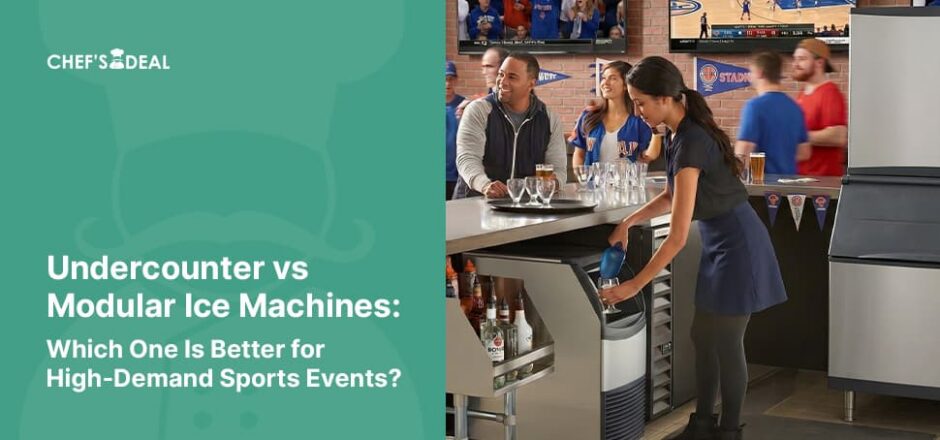
Undercounter vs. modular ice machines differ primarily in production capacity, storage flexibility, and installation footprint. Undercounter units integrate the ice-making head and storage bin into a single compact body, while modular systems separate the head from the bin.
Foodservice operators preparing for high-demand sporting events, such as the FIFA World Cup 2026, rely on this architectural distinction to match equipment to peak beverage demand. Modular systems suit high-volume, beverage-heavy operations, while undercounter units serve compact kitchens, secondary stations, and other space-constrained settings.
Quick Comparison: Undercounter vs. Modular Ice Machines
| Category | Undercounter Ice Machine | Modular Ice Machine |
| Daily Capacity | 50–350 lb (22.679–158.757 kg) | 250–2,600+ lb (113.398–1,179.339+ kg) |
| Storage | Built-in bin, 80–100 lb (36.287–45.359 kg) cap | Separate bin, independently sized |
| Footprint | Fits under 34-in (86.36 cm) counters | Requires dedicated floor or stacking space |
| Installation | Self-contained, simpler setup | Head-plus-bin, more complex setup |
| Scalability | Limited; replace the unit to grow | Stackable heads expand output |
| Ideal For | Bars, cafés, food trucks, secondary stations | Sports bars, stadiums, hotels, concessions |
TL;DR: Which Ice Machine Type Is Right for Your Operation?
- Choose an undercounter ice machine for food trucks, cafés, satellite beverage stations, and compact kitchens because the self-contained design fits limited spaces.
- Choose a modular ice machine for sports bars because beer, cocktails, and fountain drinks draw from the same ice supply throughout the event.
- Choose a modular ice machine for restaurants near stadiums because pre-game beverage demand creates concentrated peak-hour ice usage.
- Choose a modular ice machine for hotels and event venues, as multiple service points require higher production and storage capacities.
- Choose an undercounter ice machine for temporary mobile vendors when installation space, power availability, or setup time limit equipment options.
- Choose a modular machine with a remote condenser for hot climates, outdoor fan zones, and rooftop venues because it maintains output more effectively during summer event conditions.
Why Ice Demand Changes during Major Sporting Events
Ice demand spikes during major sporting events because beverage consumption rises sharply within compressed service windows, rather than spreading evenly across the day. Sports bars, restaurants near stadiums, and fan-zone vendors preparing for the FIFA World Cup 2026 face 2 to 5 times their normal beverage volume during pre-kickoff and post-match rushes, placing direct pressure on ice production and storage.
Key Event Drivers
- Match-time demand spikes: Customers purchase food and drinks within narrow pre-game, halftime, and post-match windows.
- Higher beverage attachment rates: Sports-event customers purchase beverages more frequently than standard restaurant guests.
- Compressed service periods: Pre-game, halftime, and post-match demand concentrate into 60–90 minutes.
- Longer operating hours: Event venues frequently extend service before and after matches.
- Weather-driven consumption: Hot outdoor conditions increase demand for cold beverages and ice.
- Higher customer volume: Sports bars, restaurants, and fan-zone vendors often experience 2-5 times normal traffic during major tournaments.
Higher Beverage Consumption during Peak Crowd Periods
Higher beverage consumption during peak crowd periods concentrates demand into narrow windows governed by the match clock, rather than typical meal patterns. A sports bar serving 150 covers on a standard Saturday can serve 300 to 750 covers during a World Cup match window, and nearly every transaction in that environment includes a beverage.
Why Running Out of Ice Creates Immediate Revenue Loss
Running out of ice causes immediate revenue loss because beverage service stalls the moment the bin empties. Staff redirect attention to manual restocking from backup coolers, transaction speed drops, and queues lengthen during the exact window when foot traffic peaks. The lost revenue extends beyond the drink itself, since beverages frequently drive combo-attachment sales across food orders.
Different Ice Needs for Sports Bars, Restaurants, and Event Vendors
Different ice needs separate sports bars, restaurants, and event vendors because each operation channels beverage demand through a distinct service model.
- Sports bars draw ice continuously across beer service, cocktails, and fountain drinks.
- Restaurants near stadiums concentrate demand into a pre-game window.
- Temporary event vendors operate with limited space and intermittent power access, narrowing equipment choices before volume even enters the equation.
What Is an Undercounter Ice Machine?
An undercounter ice machine is a self-contained unit that integrates the ice-making mechanism and storage bin in a single cabinet designed to fit beneath standard commercial countertops. Undercounter ice machine widths typically range from 15 in (38.1 cm) to 30 in (76.2 cm). The integrated bin eliminates the need for separate bin sizing.

How Undercounter Ice Machines Work
Undercounter ice machines operate by housing the compressor, evaporator, and storage bin in a single enclosure, producing and storing ice within the same footprint. Air-cooled models require at least 6 in (15.24 cm) of rear clearance and 3 in (7.62 cm) of side clearance in most installations. Front-breathing designs eliminate the need for side clearance, allowing flush installation between cabinetry.
Typical Daily Production Capacity
Typical daily production capacity for undercounter ice machines ranges from 50 lb (22.679 kg) to 350 lb (158.757 kg), depending on the model and ambient conditions. The built-in storage bin capacities cap at 80 lb (36.287 kg) or 100 lb (45.359 kg) on most units, limiting how much reserve ice remains available between production cycles.
This architecture comparison only gives an approximate capacity range. Find dedicated sizing calculations for individual business types in the Ice Machine Size Options guide.
Best Applications for Undercounter Ice Machines
Undercounter ice machines are best for compact back-bar installations, small cafés, food trucks, and secondary beverage stations that supplement a primary ice source. The self-contained design suits operations with constrained floor space or operations that need a dependable ice supply without committing to a separate bin and floor footprint.
What Is a Modular Ice Machine?
A modular ice machine is a commercial ice production system that separates the ice-making head from the storage bin. The modular head enables operators to independently configure production and storage capacities. Ice-making heads typically measure 22 in (55.88 cm) to 48 in (121.92 cm) wide, excluding the bin.

How Modular Ice Machines Work
Modular ice machines use a head-plus-bin configuration, in which the ice-making head sits atop a separately sized storage bin connected via manufacturer-specific top-kit fittings. This separation lets operators select a bin sized to peak-hour draw rather than to production capacity alone, and stackable heads allow 2 compatible units to share a single bin.
Why Modular Units Dominate High-Volume Operations
Modular units dominate high-volume operations because the independent head-and-bin design scales production without forcing a complete equipment replacement. Stackable configurations double output within the same floor footprint, and side-by-side setups on shared bins further extend capacity. This flexibility supports sports bars, stadiums, hotels, and concession operations that face sustained or growing demand for ice.
Typical Production Capacity for Modular Systems
Typical production capacity for modular systems ranges from 250 lb (113.398 kg) to over 2,600 lb (1,179.339 kg) per day across the commercial market. Storage bins pair with the head at a ratio sized to operational demand, with high-capacity institutional bins holding up to 1,660 lb (752.962 kg).
Undercounter vs. Modular Ice Machines: Key Differences
Undercounter vs. modular ice machines differ across 5 operational categories: production capacity, storage and peak-hour recovery, installation footprint, energy efficiency, and maintenance complexity. Undercounter machines top out at lower daily output with built-in storage, while modular systems scale production and storage independently across a much wider range.
| Factor | Undercounter | Modular |
| Daily Output | 50–350 lb | 250–2,600+ lb |
| Storage | Built-in | Separate |
| Expansion | Replace unit | Add head |
| Installation | Easier | More complex |
| Best For | Small operations | High-volume operations |
Ice Production Capacity: How Much Ice Can Each Produce?
Ice production capacity separates the two architectures by an order of magnitude at the upper end.
- Undercounter units top out at around 350 lb (158.757 kg) per day.
- Modular systems exceed 2,600 lb (1,179.339 kg) and allow stacking and side-by-side configurations.
Air-cooled units in either category lose 10% to 15% of rated output once ambient air approaches 90°F (32.2°C), a common summer condition in World Cup 2026 host cities.
Storage Capacity and Peak-Hour Recovery
Storage capacity and peak-hour recovery often receive less attention than production capacity, even though they directly determine whether a bar or restaurant survives a concentrated rush.
- Undercounter units cap built-in storage at 80 lb (36.287 kg) to 100 lb (45.359 kg), leaving minimal reserve once that bin empties.
- Modular systems pair with an independently sized bin, commonly set at 20% to 50% of daily production, giving operators room to build a larger reserve before peak demand arrives.
Installation and Space Requirements
Installation and space requirements favor undercounter machines in compact environments and modular systems in operations with dedicated floor space.
- Undercounter units fit beneath standard 34-in (86.36 cm) counters as a single self-contained piece.
- Modular systems require floor space for the bin, clearance for the head, and, in many cases, 3-phase electrical service for larger floor-standing configurations.
Energy Efficiency Considerations
Energy efficiency considerations depend more on individual machine technology, condenser type, and ENERGY STAR certification than on whether a unit is undercounter or modular.
- Air-cooled condensers in both categories draw more power per pound of ice in high ambient heat.
- Remote-condenser configurations, available primarily on modular systems, reduce kitchen heat load in hot outdoor environments.
Neither architecture has a fixed efficiency advantage across all models.
Maintenance and Service Requirements
Maintenance and service requirements differ mainly in complexity rather than frequency.
- Undercounter units combine fewer components in a single enclosure, often simplifying routine cleaning access for a single technician visit.
- Modular systems involve separate cleaning procedures for the head and bin, plus more components across a larger footprint.
Which Ice Machine Is Better for Each Foodservice Operation?
Which ice machine performs better depends on the business type, beverage intensity, and available installation space. Sports bars, restaurants near stadiums, food trucks, hotels, and concession stands each draw ice through distinct demand patterns that favor one architecture over the other.
| Operation | Recommended Architecture | Reason |
| Sports Bars | Modular | Continuous beverage demand |
| Restaurants Near Stadiums | Modular | Peak pre-game rush |
| Food Trucks | Undercounter | Space limitations |
| Hotels | Modular | Multi-point demand |
| Temporary Vendors | Depends on infrastructure | Variable power and space |
Sports Bars Preparing for World Cup 2026 Crowds
Sports bars preparing for World Cup 2026 crowds need modular ice machines because beer service, cocktails, and fountain drinks draw from the same supply simultaneously throughout a match. The independent head-and-bin configuration supports the high beverage demand. Read the Beverage Sales Strategy for Sports Events post to see how shared-viewing events drive food-and-drink attachment well above standard weekend volume.
Restaurants Near Stadiums and Fan Zones
Restaurants near stadiums and fan zones face mixed beverage and kitchen demand that concentrates sharply in the pre-game window. A modular system with adequate storage handles the beverage side of this surge; ice needs for food prep remain comparatively modest. The Temporary Food Vendor Setup near Stadiums guide covers broader infrastructure planning for pop-up operations positioned near venue perimeters.
Food Trucks and Mobile Vendors
Food trucks and mobile vendors operate under space constraints that rule out modular systems. Undercounter units fit the limited interior footprint of a mobile kitchen and pair well with insulated backup coolers preloaded with bagged ice. Find more details on equipment planning specific to mobile and temporary stall formats in the Street Food Business Setup post.
Hotels and Event Venues
Hotels and event venues manage continuous demand across multiple service points, including restaurants, bars, banquet rooms, and room service. Modular systems support this distributed demand by enabling operators to install separate units sized for each department rather than relying on a single centralized source. Occupancy increases of 50% to 100% during major tournaments further strain every point of use.
Concession Stands and Temporary Event Operations
Concession stands and temporary event operations process high-volume transactions within fixed, often short service windows. Modular systems support permanent or semi-permanent concession locations with sustained beverage throughput. Undercounter units or pre-loaded insulated storage serve temporary stalls where power access and installation time remain limited.
Can an Undercounter Ice Machine Handle Event-Level Demand?
An undercounter ice machine can handle event-level demand only in lower-volume or supplemental roles. Its daily output and limited storage bin leave little buffer once a sustained rush begins. Operations expecting sports-bar-level beverage volume during major events typically outgrow undercounter capacity well before peak demand arrives.
Situations Where an Undercounter Unit Works Well
Situations where an undercounter unit performs best include secondary beverage stations, satellite bars, food trucks, and lower-demand cafés. Their compact footprint and self-contained design make them practical when space is limited, and demand remains relatively predictable.
Undercounter units work well for:
- food trucks and concession carts with limited beverage menus and moderate customer volume,
- satellite beverage stations that supplement a larger ice production system,
- cafés and snack bars that experience occasional demand spikes rather than continuous rush periods,
- temporary event vendors operating in restricted spaces with limited equipment capacity,
- operations with backup ice storage or access to additional ice supplies during peak periods
Warning Signs That Demand Has Outgrown an Undercounter Machine
Warning signs that demand has outgrown an undercounter machine become more noticeable as beverage sales increase. Frequent ice shortages during busy periods often indicate that production and storage capacity no longer match operational requirements.
- The ice bin empties during peak service periods.
- Staff regularly purchase bagged ice to meet demand.
- Beverage service slows because ice production cannot keep up.
- Storage capacity runs out before the machine can replenish inventory.
Major event days generate 2 to 5 times the demand of normal operating periods. Operations expecting sports-bar-level beverage demand during major tournaments typically benefit from the higher production and storage capacity of a modular ice machine.
3 Benefits of Modular Ice Machines for High-Volume Events
Benefits of modular ice machines for high-volume events center on 3 operational advantages: higher production capacity, greater storage flexibility, and greater scalability as demand grows across back-to-back tournament seasons or as service lines expand.
1. Higher Production Capacity
Higher production capacity enables modular systems to sustain output across a range of operations, from a single full-service restaurant to a stadium-adjacent concession operation. This headroom matters most during compressed demand windows when a machine cannot pause production to catch up.
2. Greater Storage Flexibility
Greater storage flexibility comes from pairing the ice-making head with a bin sized independently of production output. Operators size the bin toward the upper end of the 20%-50% production ratio for event-heavy operations. This flexibility enables them to build a larger reserve that absorbs a concentrated pre-kickoff or post-match rush without waiting for the next production cycle.
3. Better Scalability for Future Growth
Modular systems offer better scalability for future growth. Their stackable head designs double production within the same floor footprint as demand increases. Side-by-side configurations on shared bins extend this further, letting an operation add capacity ahead of a recurring tournament season without relocating equipment or rebuilding the installation from scratch.
Modular Ice Machine with Remote Condenser vs. Self-Contained Unit
Modular ice machines are available in 2 condenser configurations: remote and self-contained. The remote condenser relocates heat rejection away from the ice-making head, while the self-contained design keeps all components in a single assembly.
| Factor | Remote Condenser | Self-Contained |
| Heat Output Near Equipment | Lower | Higher |
| Noise Near Service Area | Lower | Higher |
| Installation Complexity | Higher | Lower |
| Installation Cost | Higher | Lower |
| Performance in Hot Environments | Better | Standard |
| Best Fit | Hot climates, outdoor venues, rooftop bars | Indoor restaurants, sports bars, and standard kitchens |
Remote Condenser Advantages
A remote condenser system places the condenser away from the ice machine, typically on a roof or exterior wall. Removing heat from the immediate workspace improves operating conditions and helps maintain consistent ice production during periods of heavy demand.
A remote-condenser system
- reduces heat buildup in kitchens, bars, and food preparation areas.
- lowers noise levels near staff and customers by operating the condenser remotely.
- supports more consistent production in hot climates and warm indoor environments.
- improves comfort in compact workspaces where excess heat can affect operations.
Self-Contained Advantages
A self-contained modular machine houses the condenser within the unit itself. This design simplifies installation and typically reduces upfront costs, making it a practical choice for indoor restaurants, sports bars, and standard kitchens.
A self-contained system:
- requires less complex installation.
- usually costs less up front than a comparable remote condenser setup.
- simplifies maintenance access because major components remain in one location.
- works well in climate-controlled indoor environments.
- reduces the need for additional rooftop or exterior equipment.
Which Option Fits High-Demand Sports Venues Better?
The best choice depends on operating conditions rather than production capacity alone. Both configurations can support high-volume ice production when properly sized.
- Choose a remote condenser system for hot climates, outdoor fan zones, rooftop bars, enclosed kitchens, and venues where heat buildup can reduce equipment efficiency.
- Choose a self-contained modular system when installation simplicity, lower upfront costs, and straightforward maintenance are higher priorities.
- Choose either modular configuration when demand exceeds what an undercounter machine can reliably produce during major sporting events.
The decision often comes down to facility conditions: remote condensers help manage heat and noise, while self-contained systems prioritize installation simplicity and lower initial investment.
Common Mistakes When Choosing Between Undercounter and Modular Ice Machines
Common mistakes when choosing between undercounter and modular ice machines fall into four recurring categories: prioritizing purchase price alone, ignoring peak-demand requirements, focusing on production while forgetting storage, and underestimating future growth.
Mistake #1: Choosing Based Only on Purchase Price
Choosing based only on purchase price overlooks the operational cost of running short on ice during a peak event. An undercounter unit costs less upfront, but an operation that exceeds the unit’s ceiling capacity during a tournament rush instead absorbs the cost of emergency bagged ice and lost beverage sales.
Mistake #2: Ignoring Peak-Demand Requirements
Ignoring peak-demand requirements leads operators to size equipment against average daily volume rather than the busiest service window. Event-day demand concentrates within a compressed match-day timeline, so a machine that performs adequately on a normal weekend can still fall short once a stadium-level crowd arrives.
Mistake #3: Focusing on Production but Forgetting Storage Capacity
Focusing on production but forgetting storage capacity creates a bottleneck at the point of access rather than at the point of manufacture. A modular head rated for high daily output still runs short during a rush if paired with an undersized bin, because the bin determines the volume of ready-to-serve ice when the crowd arrives all at once.
Mistake #4: Underestimating Future Growth
Underestimating future growth locks an operation into equipment that fits today’s volume but not next season’s. Modular systems absorb growth through stacking and side-by-side bins, but undercounter units typically require full replacement once daily demand exceeds the top capacity of their built-in storage.
Ice Machine Decision Checklist for Major Events
Use this ice machine decision checklist to confirm equipment architecture for major events. Each item narrows the choice between undercounter and modular configurations based on operational realities rather than assumptions.
- Evaluate Daily Ice Demand: Estimate total ice consumption for a full event day using established business-type benchmarks.
- Evaluate Peak-Hour Demand: Identify the steepest hourly draw during pre-kickoff and post-match windows, since this figure matters more than the daily total.
- Review Available Installation Space: Confirm floor space, counter clearance, ventilation requirements, and electrical service before selecting an architecture.
- Consider Expansion Plans: Account for additional tournaments, seasonal events, or business growth that could increase ice demand beyond current levels.
- Review Maintenance Requirements: Check service access, technician availability, and cleaning complexity for each architecture before finalizing a decision; see the Ice Machine Maintenance during Peak Season guide for more details.
FAQs About Undercounter and Modular Ice Machines
Which is better: an undercounter ice machine or a modular ice machine?
Neither type is universally better, as the right choice depends on production needs and available space. Modular ice machines suit high-volume operations, such as sports bars and stadium concessions. Undercounter units suit compact kitchens, secondary stations, and other space-constrained settings.
How much ice does an undercounter machine produce compared to a modular unit?
Undercounter machines produce around 50 lb (22.679 kg) to 350 lb (158.757 kg) per day, while modular units produce 250 lb (113.398 kg) to more than 2,600 lb (1,179.339 kg) per day. The gap widens further at the high end, since modular systems scale through stackable and side-by-side configurations that undercounter units cannot match.
Are modular ice machines more energy efficient?
Modular ice machines are not inherently more energy efficient than undercounter units. Efficiency depends on the specific model, condenser type, and ENERGY STAR certification rather than the head-and-bin architecture itself. Both categories include high- and standard-efficiency models from brands such as Hoshizaki and Ice-O-Matic.
Which type is easier to maintain?
Undercounter machines are generally easier to maintain because they combine fewer components into a single enclosure, simplifying routine cleaning. Modular systems involve separate maintenance procedures for the head and bin, as well as additional components across a larger installation footprint.
What is the best ice machine for a sports bar?
The best ice machine for a sports bar is a modular ice machine because beer, cocktails, and fountain drinks draw from the same ice supply continuously throughout a match. The independent head-and-bin configuration supports both high production and a storage reserve sized to absorb peak crowd surges.
Final Thoughts: Choosing the Right Ice Machine for Event-Level Demand
Choosing the right ice machine for event-level demand depends on operational fit rather than the highest production rating or the lowest purchase price. Undercounter units serve compact kitchens, secondary stations, and space-constrained vendors well; modular systems support the sustained, high-volume beverage demand that sports bars, stadium-adjacent restaurants, and concession operations face during major tournaments.
The right architecture aligns with how an operation actually experiences demand, not how it performs on an average day. Determine your priorities before evaluating your options.
| If Your Top Priority Is… | Choose… | Why |
| Small footprint | Undercounter | Self-contained design fits limited spaces |
| Lower upfront cost | Undercounter | Simpler installation and equipment requirements |
| High-volume beverage service | Modular | Higher production and storage capacity |
| Event-day demand spikes | Modular | Better equipped to handle sustained peak usage |
| Future expansion | Modular | Production and storage can scale with demand |
| Hot operating environments | Modular with remote condenser | Better heat management and consistent production |
| Secondary service stations | Undercounter | Convenient supplemental ice source |
| Multiple beverage locations | Modular | Supports larger and more distributed operations |
Treat this decision as an architectural fit question first. Then refine capacity and maintenance planning through dedicated sizing and service resources.

