

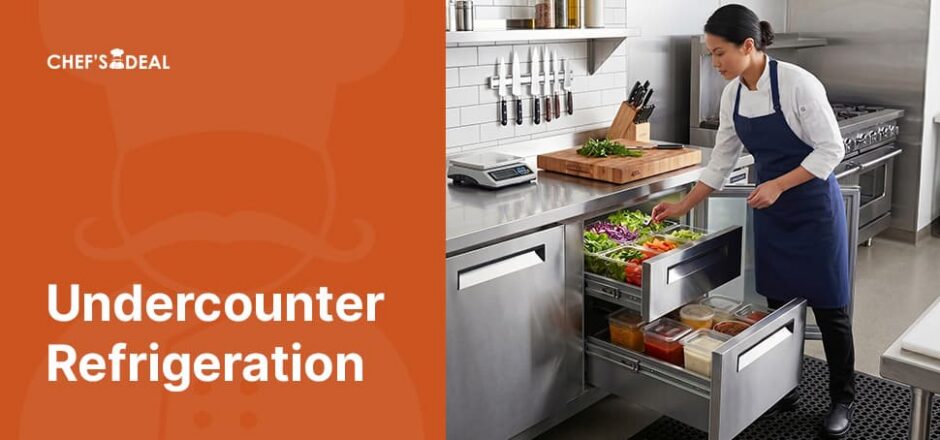
Undercounter refrigeration is a purpose-built, low-profile cooling solution designed to fit beneath standard countertops, delivering point-of-use cold storage exactly where ingredients and beverages are needed. Unlike tall reach-in refrigerators that handle bulk inventory, these compact units (typically 32 to 36 inches (81.28 to 91.44 cm) in height) serve as supplemental storage within prep lines, bars, and cooking stations.
Their key advantage lies in workflow optimization: by keeping frequently used items within arm’s reach, they reduce movement, improve service speed, and support food safety through consistent temperature control. However, their limited capacity also defines their role: they are not replacements for primary refrigeration but strategic additions to enhance station efficiency.
From an operational standpoint, undercounter refrigeration excels in space-constrained environments and high-speed service settings. It is particularly valuable in small kitchens, bars, food trucks, and distributed service areas where maximizing workspace and minimizing energy consumption are critical. Compared to worktop units, undercounter models prioritize storage over prep functionality, whereas, compared to reach-ins, they trade capacity for accessibility and placement flexibility.
Choosing the right unit requires careful evaluation of layout constraints, daily volume, door configuration, compressor placement, and energy efficiency, as poor sizing or ventilation mistakes can undermine performance and increase long-term costs. When properly selected and integrated, undercounter refrigeration becomes a high-impact efficiency tool that streamlines operations and reduces the total cost of ownership.
What is Undercounter Refrigeration?
Undercounter refrigeration refers to compact commercial refrigerators and freezers engineered to fit beneath standard countertop height. These commercial refrigeration units integrate directly into prep lines, bar counters, and cooking stations, providing cold storage at the point of use.
An undercounter refrigerator is a low-profile commercial cooling unit with a height of 32 to 36 inches (81.28 to 91.44 cm) and slides beneath a worktop. Commercial undercounter refrigeration equipment maintains safe storage temperatures between 33°F and 38°F (0.56°C to 3.33°C) for refrigerators and between 0°F and -10°F (-17.78°C to -23.33°C) for freezers.
The primary difference between undercounter refrigerators and standard refrigerators is their height. While standard commercial refrigerators stand 72 to 84 in (182.88 to 213.36 cm) tall and serve as primary bulk storage, undercounter units are 36 inches (91.44 cm) or shorter and function as supplemental, point-of-use storage for active ingredients and beverages. Thus, they are widely used in prep lines, cook stations in commercial kitchens, bars, and food trucks.

When Should You Use Undercounter Refrigeration?
Undercounter refrigeration units offer a compact, efficient cooling solution tailored for space-constrained commercial kitchens, bars, and prep areas. By combining cold storage with usable work surfaces, they maximize functionality in small layouts while reducing energy consumption.
Best for Small Commercial Kitchens
Undercounter refrigeration units are best for small commercial kitchens under 500 square feet (46.45 sq m) where the layout is not large enough to accommodate several reach-ins for cooking and prep. Despite occupying a similar area on the kitchen floor, undercounter refrigerators and freezers enable a fully functional working surface. Additionally, this compact refrigeration equipment cabinet requires less energy to maintain temperature.
Ideal for Bars and Beverage Stations
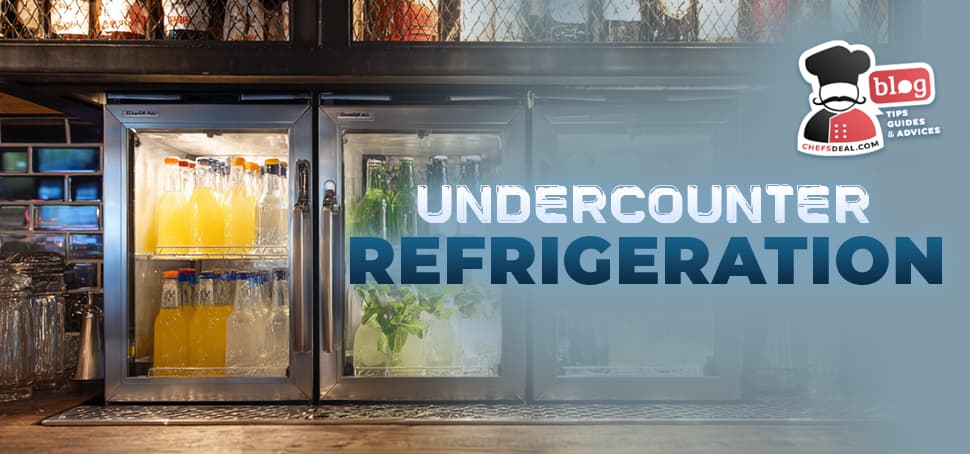
Undercounter refrigerators accelerate workflow by enabling quicker access to beverages, ingredients, and chilled/frozen foods for serving or cooking. For instance, a glass-door undercounter refrigerator keeps beer, wine, mixers, and garnishes within arm’s reach and fully visible, eliminating the search-and-retrieve.
Useful in Prep Stations
A solid-door undercounter cooler with drawers can fit under your prep counter and steel work table, preserving temperature-sensitive ingredients such as greens, proteins, dressings, and garnishes, and keeping them within arm’s reach.
Undercounter vs. Worktop Refrigerators
Undercounter and worktop refrigerators share the same height profile but serve fundamentally different functions. Undercounter units are designed solely for storage, while worktop units combine refrigeration with a functional stainless steel prep surface.
| Category | Undercounter Refrigerator | Worktop Refrigerator |
| Top Surface | Flush-fit lid; slides under existing counter | Reinforced stainless steel worktop for prep tasks and backsplash |
| Primary Role | Cold storage only | Cold storage + workspace |
| Workspace Impact | Turns unused space into storage area under worktables and counters | Replaces a separate prep table |
| Typical Width | 24–119 in (60.96–302.26 cm) | 27–119 in (68.58–302.26 cm) |
| When to Choose | You already have prep tables; need cold storage beneath them | You need to build a new station and want prep surface + refrigeration combined |
Undercounter vs. Reach-In Refrigerators
Reach-ins and undercounter refrigerators are not competitors, and most commercial kitchens need both types of commercial refrigeration.
| Category | Undercounter Refrigerator | Reach-In Refrigerator |
| Storage Capacity | 5–23 cu ft (141.58–651.09 liters) | 20–50+ cu ft (566.34–1,415.84+ liters) |
| Height | Up to 36 inches (91.44 cm) | 72–84 in (182.88–213.36 cm) |
| Floor Footprint | Fits under existing counters | Freestanding; requires 4–8 sq ft (0.37–0.74 sq m) of dedicated floor space |
| Ventilation Needs | Front-breathing or side-vented options for built-in installations | Mostly bottom or top-vented |
| Capacity Role | Used mostly in point of use to holds ingredients | Primary bulk storage for a full day’s inventory |
| Operational Use | Prep lines, bars, cooking stations | Back-of-house bulk storage in commercial kitchens |
| Best For | Supplemental, station-based cold storage | Primary refrigeration in kitchens without a walk-in cooler |
Best Undercounter Refrigeration by Business Type
The best undercounter refrigeration varies by business type, as requirements differ significantly across types.
- Restaurants: Full-service restaurants use undercounter refrigeration through the prep and cook lines to keep active ingredients within arm’s reach during service. Additionally, undercounter refrigerators store and preserve butter, cream, sauces, and other frequently used ingredients at cooking stations.
- Bars and Cafes: Solid-door undercounter refrigerators are ideal for storing kegged beer, while glass-door undercounter coolers are perfect for storing and showcasing bottled beer, wine, mixers, and garnishes at eye level. Cafes use a smaller undercounter refrigerator beneath the coffee machines to store syrups, milk, cream, and cold brew.
- Food Trucks and Small Kitchens: Food trucks cannot accommodate a reach-in refrigerator due to height and space limitations. Undercounter refrigerators can fit under prep counters to store a full day’s supply of ingredients for a focused menu.
- Hotels and Catering: Hotels use distributed undercounter refrigeration across multiple service points: the main kitchen, banquet prep area, room service pantry, and rooftop or pool bar. Catering operations benefit from undercounter refrigerators in event venues for on-site cold holding during service.
How to Choose the Right Undercounter Refrigeration
To choose the right undercounter refrigerator and freezer, consider available space, capacity needs, door type, compressor position, temperature range, and energy efficiency before purchasing.
- Match Size and Dimensions to Your Layout: Measure the installation space before selecting a unit. Standard undercounter heights range from 32 to 36 in (81.28 to 91.44 cm), fitting at or just beneath 36-in (91.44-cm) counters, with clearance for legs or casters.
A few models measure exactly 36 inches, so confirm your counter clearance before ordering. Varying widths also offer door-quantity options: 24 to 27 in (60.96 to 68.58 cm) for single-door models, 48 to 60 in (121.92 to 152.40 cm) for two-door models, and 60 to 72 in (152.40 to 182.88 cm) for three-door models.
- Select Storage Capacity Based on Daily Volume: Undercounter refrigerators are designed for active-service stock, not for bulk inventory. Hence, sizing should cover one service period without restocking.
Single-door models (5 to 7 cu ft / 141.58 to 198.22 L) suit low-volume bars and single-operator setups. Two-door models (10 to 15 cu ft / 283.17 to 424.75 L) cover medium-volume prep lines. Three-door units (18 to 23 cu ft / 509.71 to 651.50 L) support high-volume operations or multi-item stations.
- Choose the Right Door Type for Your Operation: Undercounter refrigeration units are available in solid or glass doors. Solid doors maximize insulation and minimize energy consumption. They are mostly used in back-of-house prep and storage applications where visibility provides no operational benefit.
Glass-door under-counter refrigerators allow visual inventory checks without opening the unit, reducing unnecessary access events. These units are common in bars and beverage stations. There are hinged doors and drawer-type models as well. Hinged-door units accommodate large containers, while drawer-type refrigerators allow multiple staff members to work side by side.
- Consider Compressor Location for Maintenance and Airflow: Compressor placement determines installation flexibility and long-term serviceability. Rear-mounted compressors require 3 to 6 in (7.62 to 15.24 cm) of rear clearance, and the unit must be pulled forward for service.
Side-mounted compressors allow flush rear installation but require side clearance. Front-breathing compressors enable true built-in installation against walls and inside cabinetry, with no side or rear clearance required.
- Define the Required Temperature Range: Standard undercounter refrigerators maintain temperatures between 33°F and 38°F (0.56°C and 3.33°C) for produce, dairy, prepared foods, and beverages. Undercounter freezers operate at 0°F to -10°F (-17.78°C to -23.33°C) for frozen proteins, desserts, and long-term stock.
Dual-temperature models split the cabinet into a refrigerator section and a freezer section, meeting both needs in a single footprint. Specialty applications, such as wine at 45°F to 55°F (7.22°C to 12.78°C) and pastry at 55°F to 60°F (12.78°C to 15.56°C), need dedicated units built for those specific temperature ranges.
- Evaluate Energy Efficiency and Long-Term Costs: ENERGY STAR-certified undercounter refrigerators consume 10% to 20% less energy than non-certified equivalents. At $0.12 per kWh and 2 to 4 kWh of daily consumption, a certified unit saves $87 to $175 annually compared to a non-certified model.
- Research Brand Reputation: When deciding on your undercounter refrigeration unit, consider the brand’s reputation in addition to pricing, performance, and size. An unexpected breakdown due to a low-quality part, extended downtime due to a sparse service network, or long waiting times for spare parts disrupt your workflow and waste your initial investment.
In addition, check warranty terms ranging from 1 to 3 years for parts and labor, with 3 to 5 years for the compressor. Chef’s Deal carries high-quality commercial undercounter refrigerators and freezers from leading commercial refrigeration brands such as True, Turbo Air, Beverage-Air, Delfield, Hoshizaki, and Continental.

Energy Efficiency and Operating Costs
Energy efficiency directly shapes the total cost of ownership for undercounter refrigeration. A unit priced $300 lower at purchase that consumes $120 more per year in electricity costs $900 more over its service life at standard commercial operating hours. A better-insulated, ENERGY STAR-certified alternative with a higher price often delivers a lower 10-year cost.
Undercounter refrigerators consume 1.5 to 4.5 kWh per day, depending on cabinet size, ambient kitchen temperature, and door-opening frequency. Glass-door models run 10% to 20% higher than solid-door equivalents due to greater heat transfer through glass panels and the anti-condensation heaters built into door frames.
Cost Considerations & ROI
Commercial undercounter refrigeration ranges from roughly $900 to $19,000, depending on size, door configuration, build quality, and brand. Single-door, solid-door units sit at the low end, while three-door, glass-door, and dual-temperature models from premium brands reach the top of the range. Purchase price, however, is only the first cost — energy use, maintenance, and warranty coverage shape the true cost of ownership over the unit’s service life.
Undercounter refrigerators consume 1.5 to 4.5 kWh per day, depending on cabinet size, ambient kitchen temperature, and door-opening frequency. At $0.12 per kWh, that works out to roughly $65 to $200 per unit in annual electricity costs. Glass-door models run 10% to 20% higher than solid-door equivalents because of greater heat transfer through the glass and the anti-condensation heaters built into their door frames.
ENERGY STAR–certified units consume 10% to 20% less energy than non-certified equivalents, saving approximately $10 to $40 per year per unit. That figure looks small in isolation, but it compounds across multiple units and a 7-to-10-year service life, and the gap widens further on larger or glass-door cabinets. A unit that costs $200 less upfront but uses $30 more in electricity each year erodes its purchase-price advantage in under seven years and ends up costing more over its full lifespan. A better-insulated, ENERGY STAR–certified model with a higher sticker price often delivers the lower 10-year total cost.
Beyond energy, factor in serviceability and protection. Chef’s Deal offers financing options to spread the upfront investment, and most units carry 1- to 3-year parts-and-labor warranties, with 3- to 5-year coverage on the compressor. Warranty length, service-network coverage, and resale value all affect long-term ROI as much as the initial price, a cheaper unit from a brand with a sparse service network can cost far more in downtime and lost product than it saves at purchase.
Common Mistakes When Buying an Undercounter Refrigerator and Freezers
Most undercounter refrigeration failures trace back to purchasing decisions rather than equipment defects. The following errors appear consistently in commercial kitchen installations.
- Choosing Too Small a Capacity: A station that serves 80 covers per dinner rush needs capacity for the active components of those 80 portions. Restocking mid-service requires your staff to step away from their tasks to gather ingredients, which can stall your service flow. So, you should size for peak service demand, not average daily demand.
- Ignoring Ventilation Space: Blocking the condenser is the most common cause of premature compressor failure in undercounter refrigeration, as it prevents airflow into the compressor and forces continuous operation at elevated temperatures. This increases energy consumption by 20%-30% and reduces the compressor lifetime. So, you must always confirm the manufacturer’s ventilation requirements.
- Using it as a Primary Refrigerator: Undercounter refrigerators hold active-service stock for one station during a single service period. They are not designed to replace a reach-in or walk-in as a kitchen’s primary cold storage.
- Additional common mistakes: Selecting glass doors for back-of-house storage where visibility adds no value; ignoring temperature-range requirements for specialty products like wine or chocolate; or failing to verify local service network coverage before purchasing from a lesser-known brand.
The Three Main Undercounter Refrigeration Configurations
The three main undercounter refrigeration configurations are refrigerators, freezers, and refrigerator-freezer combos, distinguished by their temperature ranges. Refrigerators run 33°F to 38°F (0.56°C to 3.33°C) for daily prep ingredients and beverages, freezers run 0°F to -10°F (-17.78°C to -23.33°C) for frozen proteins and pastry stock, and dual-temperature combos pack both ranges into a single cabinet.
Match the configuration to what each station stores and how often staff need it, then refine your choice with the door-style and specialty variants listed at the end of this section.
Choose Undercounter Refrigerators for Daily Ingredient Access
Standard undercounter refrigerators, solid-door or glass-door, one- to three-door, serve the majority of commercial kitchen applications with a wide temperature range between 33°F and 38°F (0.56°C to 3.33°C). They hold active prep ingredients, beverage stock, and service components at the station where they are consumed.
Use Undercounter Freezers for Frozen Storage Needs
Undercounter freezers maintain temperatures between 0°F and -10°F (-17.78°C to -23.33°C) for frozen proteins, ice cream, pastry components, and long-term frozen stock at the station where they are used.
Consider Refrigerator-Freezer Combos for Flexible Storage
Dual-temperature undercounter units combine a refrigerator and freezer section in a single cabinet, providing both temperature ranges without the footprint of two separate units. These combos suit prep stations that store both fresh proteins in the refrigerator section and frozen proteins in the freezer section, or bars that need ice cream alongside chilled mixers and fresh fruit garnishes.
Apart from these 3 primary models, undercounter refrigeration systems are available in several other models to address foodservice requirements:
- Glass-door undercounter refrigeration
- Solid-door undercounter refrigeration
- Drawer-style undercounter refrigeration
- Blast chillers or shock freezers
- ADA-compliant undercounter refrigerators

Space Optimization Tips for Commercial Kitchens
Undercounter refrigeration is an integrated cold storage strategy. You can maximize the functional use of available kitchen space with smart spacing and layout methods:
- Combining Undercounter Refrigerators with Reach-Ins: Reach-in refrigerators handle large quantities of ingredients and backup inventory, while undercounter units are placed at prep stations or cooking lines for quick access to frequently used items.
- Using Multiple Small Units vs. One Large Unit: Two 48-in (121.92-cm) undercounter units placed at two separate stations outperform one 96-in (243.84-cm) unit placed centrally in most kitchen workflows. Distributed placement eliminates sharing conflicts during peak service, reduces per-cook travel distance, and allows each station to maintain its own organized inventory without interference from adjacent cooks.
- Station-Based Refrigeration Setup: Undercounter refrigerators and freezers can be positioned in each active production station, for instance, one for the prep station, one for the grill station, and a separate glass-door unit behind the bar.
FAQs About Undercounter Refrigeration
What size undercounter refrigerator do I need?
The size of the undercounter refrigerator you need depends on the volume of ingredients consumed at that station during one service period. A single-door model (5 to 7 cu ft / 141.58 to 198.22 L) suits low-volume bars and single-operator positions. Two-door models (10 to 15 cu ft / 283.17 to 424.75 L) cover medium-volume prep lines. Three-door units (18 to 23 cu ft / 509.71 to 651.50 L) handle high-volume or multi-item stations.
What is the difference between undercounter and worktop refrigerators?
Undercounter refrigerators slide beneath existing prep tables and bar counters. The top surface is not designed for use as a workspace. Worktop refrigerators feature a reinforced stainless-steel top engineered as a functional prep surface, often with an integrated cutting board and backsplashes.
How much does an undercounter refrigerator cost?
Commercial undercounter refrigerators and freezers range from roughly $900 to $19,000. Single-door solid-door models are the least expensive; three-door, glass-door, and dual-temperature units from premium brands are the most expensive. Energy efficiency and warranty terms affect long-term cost as much as the purchase price.
How much space is needed for ventilation?
Ventilation requirements depend on compressor placement. Rear-mounted compressors require 3 to 6 in (7.62 to 15.24 cm) of clearance at the rear. Side-mounted compressors need 2 to 3 in (5.08 to 7.62 cm) on the compressor side. Front-breathing models require only unobstructed access to the front grille. Always check the manufacturer’s specific requirements before finalizing the installation location.
Can undercounter refrigerators replace reach-ins?
No. Undercounter refrigerators hold active service stock for one station during one service period. A reach-in holds a full day’s bulk inventory for the entire kitchen. Most commercial kitchens need both: a reach-in or walk-in for primary storage and undercounter units at active stations for immediate access. However, undercounter coolers and freezers can serve as primary units in food trucks.
Are undercounter refrigerators energy efficient?
Are undercounter refrigerators energy efficient?
Mostly, yes. Many models of undercounter refrigerators feature ENERGY STAR certification and consume 10% to 20% less energy than non-certified equivalents, typically 1.5 to 4.5 kWh per day depending on cabinet size and ambient conditions.
How does an undercounter refrigerator differ from a prep table?
An undercounter refrigerator differs from a prep table primarily in that it offers cold storage, whereas a prep table combines refrigerated storage with a work surface for food preparation. Undercounter units prioritize compact cooling, whereas prep tables integrate both storage and a functional workspace and prep area.
Can undercounter freezers maintain safe frozen storage over the long term?
Yes, undercounter freezers can maintain safe frozen storage temperatures in the long term. This feature ensures the integrity of frozen goods, such as meats, desserts, and other perishable items.
Do undercounter refrigerators meet NSF and health department compliance?
Yes, undercounter refrigerators from reputable brands meet NSF and health department compliance. Certifications, along with proper maintenance and temperature control, ensure public safety.
Conclusion
Undercounter refrigeration stands out as a strategic, efficiency-driven solution rather than a primary cooling system, delivering measurable improvements in workflow, space utilization, and service speed. By positioning cold storage directly at the point of use, these compact units minimize unnecessary movement, support food safety, and enable smoother operations across prep lines, bars, and cooking stations.
Their true value emerges when they are correctly matched to the kitchen’s layout and service volume, functioning alongside reach-ins or walk-ins to create a balanced, high-performance refrigeration system rather than attempting to replace bulk storage.
Ultimately, the effectiveness of undercounter refrigeration depends on informed decision-making and proper integration. Factors such as capacity sizing, ventilation, door configuration, compressor placement, and energy efficiency directly impact both day-to-day performance and long-term operating costs.
Avoiding common purchasing mistakes and aligning the unit with specific business needs ensures maximum return on investment. When thoughtfully selected and strategically placed, undercounter refrigeration becomes a critical component of modern commercial kitchens, enhancing productivity while reducing total cost of ownership over time.

