

Power and generator planning for food trucks covers load calculations, generator sizing, electrical setup, fuel selection, safe connections, physical placement, and backup strategies. A food truck’s revenue depends entirely on keeping every appliance, the point-of-sale (POS) terminal, and the lighting system running simultaneously.
Generators are the primary power source for food trucks, concession stands, food tents, and other operations during high-demand periods such as the FIFA World Cup 2026. Selecting the wrong generator size, ignoring surge loads, or skipping backup plans are the most common and most costly mistakes in food truck operations.
Power Needs at a Glance: Food Truck Generator Sizing by Truck Size
| Truck Size | Typical Load | Recommended Generator | Typical Appliance Set |
| Small | 4–8 kW running | 7–10 kW | 1 griddle, refrigerator, POS, lights |
| Medium | 8–15 kW running | 12–20 kW | Griddle + fryer + refrigerator + freezer + microwave + POS |
| Large / High-Volume | 15–30 kW running | 20–35 kW | Full commercial cooking line, HVAC, multiple refrigeration units |
Why Power Planning Decides Whether a Food Truck Serves or Stalls
Power planning for food trucks determines whether the truck serves customers or sits idle during peak demand. A generator failure shuts down every appliance, POS terminal, and light at exactly the moment when revenue pressure is highest. No other single equipment fault causes a complete operational shutdown.
Most operators underestimate how quickly a power gap compounds. A stalled food truck near a FIFA World Cup 2026 fan zone during a 90-minute pre-kickoff rush loses immediate F&B sales, combo-attachment revenue, and repeat customers. A generator failure takes the entire operation offline, unlike a broken fryer, which turns off only one menu item.
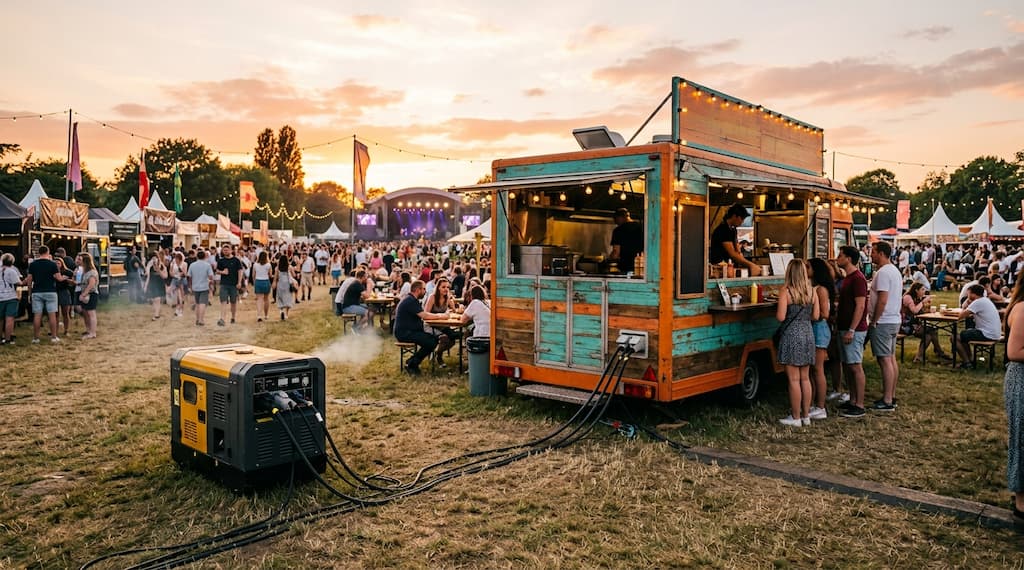
The stakes are higher for temporary and event-season operators because shore power is rarely available, and sourcing emergency equipment near a stadium perimeter during a major tournament is difficult. Operators who plan the power infrastructure their food truck needs before the event season recover equipment costs faster and sustain throughput when it matters most.
What Power Does a Food Truck Actually Need?
A food truck needs sufficient electrical capacity to operate all appliances simultaneously while accommodating the highest startup surge from motor-driven equipment. Generator sizing depends on 3 factors: individual appliance consumption, the difference between starting and running watts, and total load calculation.
(Review the Food Truck Equipment Checklist to see what appliances you need before you start power planning for food trucks)
Common Appliance Power Draw (Watts and Amps)
Common food truck appliances vary significantly in both their starting and running power requirements. Resistive heating elements, such as griddles, fryers, and ovens, draw the same power on startup as during operation. Motor-driven appliances, such as refrigerators, freezers, blenders, and HVAC fans, draw high startup current and set the surge ceiling for generator sizing.
| Appliance | Running Watts | Starting Watts | Typical Amps (120V) | Notes |
| Commercial griddle (36 in / 91.44 cm) | 1,600–3,200 | Same | 13–27 A | Resistive load; negligible surge |
| Countertop fryer (40 lb / 18.14 kg) | 1,500–1,800 | Same | 12–15 A | Resistive; negligible surge |
| Reach-in refrigerator | 150–400 | 600–1,200 | 1–3 A running | Compressor startup surge |
| Undercounter freezer | 100–400 | 500–1,000 | 1–3 A running | Surge, the most critical sizing item |
| Commercial microwave (1,000 W) | 1,000–1,500 | Same | 8–13 A | Intermittent use |
| Commercial blender | 1,000–1,500 | 2,000–3,000 | 8–13 A running | Motor surge on start |
| POS terminal + receipt printer | 100–250 | Same | 1–2 A | Needs clean (inverter) power |
| LED lighting (full truck) | 150–300 | Same | 1–3 A | Resistive; negligible surge |
| Rooftop HVAC / exhaust fan | 800–2,000 | 2,400–6,000 | 7–17 A running | Motor surge 3× running watts |
| Food warmer / holding cabinet | 300–600 | Same | 3–5 A | Resistive heating element |
| Convection oven (countertop) | 1,440–2,400 | Same | 12–20 A | 240V models common; check voltage |
Starting Watts vs. Running Watts
Starting watts and running watts are two distinct power measurements that both determine generator sizing. Running watts represent the continuous power an appliance draws during steady-state operation. Starting watts, also called surge watts, measure the brief power spike a motor or compressor requires at startup, typically lasting 1 to 3 seconds.
A reach-in refrigerator drawing 200 running watts may demand 800 starting watts at startup. A rooftop HVAC unit running at 1,500 watts can surge to 4,500 watts for 2 seconds at startup. Generators that meet the running load but fall short of the surge load trip the breaker, cutting power to every connected appliance simultaneously.
The practical rule is to size the generator for the largest single startup surge, plus the total running load of all other appliances simultaneously operating. Griddles, fryers, and heating elements present minimal startup surge. Refrigerators, freezers, blenders, and HVAC units all create surge events that the generator must absorb without tripping.
How to Calculate Your Total Power Load
Calculating the total power load for a food truck follows a 4-step sequence that produces the minimum generator output required for reliable operation.
Step 1. List all appliances: Record every electrical appliance in the truck, including the POS terminal, lights, and exhaust fans.
Step 2. Sum running watts: Add the running watts of all appliances operating simultaneously at peak service.
- Example for a medium truck: griddle (2,400 W) + fryer (1,700 W) + refrigerator (250 W) + freezer (200 W) + microwave (1,200 W) + POS (150 W) + lights (200 W) + exhaust fan (800 W) = 6,900 W running load.
Step 3. Identify the largest startup surge: Find the appliance with the highest starting watts. HVAC or the largest refrigeration compressor typically sets this figure.
- Example: An HVAC unit with 800 W running watts and 2,400 starting watts adds a 1,600 W surge above its running contribution.
Step 4. Calculate the sizing load: Add the running load total to the startup surge of the largest single motor.
- Example: 6,900 W running + 1,600 W surge = 8,500 W, minimum generator capacity. Apply the 80% rule (see below) to determine the required generator size: 8,500 ÷ 0.80 = 10,625 W, making an 11–12 kW generator the appropriate choice.
Convert watts to amps using the formula Amps = Watts ÷ Volts. A 6,900 W load draws 57.5 A on a 120V single-phase system or 28.75 A on a 240V single-phase system. Confirming the expected amp draw also verifies that the generator, distribution panel, circuit breakers, and transfer equipment match the truck’s electrical system.
What Size Generator Does a Food Truck Need?
The generator size a food truck needs equals the total running load plus the largest single startup surge, divided by 0.80 to respect the. Correct generator sizing depends on the 80% rule and kW ranges by truck size.
The 80% Rule for Generators
The 80% rule for generators holds that continuous operation above 80% of the generator’s rated capacity accelerates wear, overheats the windings, and shortens service life. Generator manufacturers and the National Electrical Code (NEC) both recognize this continuous-duty limitation. A 10 kW generator provides a continuous capacity of 8 kW.
- The sizing formula: Required Generator Capacity = Total Sizing Load ÷ 0.80
- Example: A food truck with a calculated sizing load of 8,500 W requires 8,500 ÷ 0.80 = 10,625 W, so you need an 11 or 12 kW generator.
The same rule explains why a 5,000-W generator cannot power most commercial food trucks. Applying the 80% guideline leaves only about 4,000 W of continuous usable capacity, which is often insufficient for even a modest setup. A 5 kW generator may power a very small beverage trailer or coffee cart, but most commercial food trucks require significantly more capacity.
Larger generators follow the same principle. A 20 kW generator provides approximately 16 kW of recommended continuous capacity under the 80% rule. That equals roughly 67 amps of continuous load (16,000 W ÷ 240 V) at 240 V single-phase, while the generator’s full-rated output is approximately 83 amps.
Similarly, a 20-kVA generator can typically carry about 16 kVA of continuous load when operated within the same guidelines. The exact available kW depends on the generator’s power factor.
Operating a generator at 50%-70% of rated capacity during normal service generally provides the best balance of fuel efficiency, engine longevity, and reserve capacity for unexpected startup surges. Inverter generators automatically adjust engine speed to match electrical demand, while conventional generators operate at a constant engine speed regardless of load.
Generator Sizing by Truck Size (kW Ranges)
Generator sizing by truck size translates the load calculation steps into practical equipment choices. The table below provides starting benchmarks. Actual requirements depend on the specific appliance mix and whether appliances are 120V or 240V.
| Truck Size | Running Load | Surge Allowance | Recommended Generator | Typical Appliance Set |
| Small | 4–8 kW | 2–3 kW | 7–10 kW | 1 griddle, 1 refrigerator, POS, lights |
| Medium | 8–15 kW | 3–6 kW | 12–20 kW | Griddle + fryer + refrigerator + freezer + microwave |
| Large | 15–30 kW | 6–10 kW | 20–35 kW | Full cooking line, HVAC, multiple refrigeration units, ice machine |
Best Generators for Food Trucks
Selecting the best generator for a food truck involves 5 factors: fuel type, inverter versus conventional design, noise rating, wattage class, and run time per tank. The right combination depends on the truck’s cooking equipment, operating environment, and the availability of shore power as an alternative.
Inverter vs. Conventional Generators
Inverter generators differ from conventional generators in power quality, noise output, fuel efficiency, and output capacity. The choice determines whether sensitive electronics operate reliably and whether the generator complies with local noise ordinances near stadiums or fan zones.
| Factor | Inverter Generator | Conventional Generator |
| Power quality | Clean sine wave; safe for POS, tablets, variable-speed equipment | Modified or rough sine wave; may damage sensitive electronics |
| Noise level | 50–60 dBA at 25% load; quieter for urban events | 65–75 dBA; may violate local noise ordinances near stadiums |
| Fuel efficiency | Throttles down under low demand; lower fuel cost per hour | Runs at constant RPM regardless of load |
| Power output | Typically 1–7 kW per unit; parallel-capable models double capacity | Scales to 35+ kW; better for full commercial cooking lines |
| Purchase cost | Higher per kW of output | Lower per kW; more economical at large capacity |
| Best for | Small trucks, cafes, POS-heavy setups, events with noise limits | Medium and large trucks with full cooking lines |
Food trucks that run POS systems, tablets, or variable-speed equipment, such as commercial blenders, require inverter-quality power. Most generator manufacturers label models as producing “clean power” or “total harmonic distortion (THD) below 3%,” which is the threshold for safe operation of sensitive electronics.
Conventional generators typically deliver THD in the 15–25% range, which is acceptable for resistive heating elements but can corrupt POS data or damage power supplies over time. Clean power is a necessity, not a convenience, if your food truck relies on electronic payment processing.
Gas vs. Propane vs. Diesel Generator Fuel
Generator fuel type affects operating costs, runtime, storage safety, and refueling convenience at events.
- Propane offers a practical advantage for many food trucks by consolidating fuel into a single supply, reducing the number of fuel types carried on board and simplifying refueling during long events.
- Gasoline generators remain the most widely available portable option.
- Diesel generators are better for larger commercial operations that require higher continuous power output.
| Factor | Gasoline | Propane (LP) | Diesel |
| Fuel cost (approx.) | Moderate; volatile with market price | Lower per BTU; stable bulk pricing | Comparable to gasoline; more stable |
| Runtime (full load) | 6–12 hrs per tank | 20+ hrs on a 100 lb (45.359 kg) cylinder | 12–24 hrs per tank |
| Storage & refueling | Stales after 30 days; fire risk | Tank exchange at most event venues; LP cooking equipment common in trucks | Requires diesel supply; less available at events |
| Cold-weather operation | Good down to 20°F (–6.667°C) | LP vaporization drops below 0°F (–17.778°C) | Best cold-weather performance |
| Emissions/odor | Higher CO; odor noticeable | Lower CO and particulates | Higher particulates; restricted at some events |
| Best for | Versatile; widest generator availability | Trucks already using LP cooking equipment; low-odor urban events | Large commercial generators; rooftop or remote mount installations |
A propane generator’s runtime depends on generator load, engine efficiency, and tank size. A stationary generator connected to a 250-gal (946.352 L) propane tank can operate for several days under moderate loads; a portable food truck generator connected to a 100-lb (45.359 kg) propane cylinder can operate for 20+ hours before refueling. Lower electrical loads extend runtime regardless of fuel type.
Operators preparing for the FIFA World Cup 2026 or similar events should verify local generator and fuel regulations before arrival. The 2021 International Fire Code (IFC), Section 319, establishes requirements for generator placement, fuel storage, and fire safety at outdoor events. Local authorities and event organizers may impose additional restrictions, particularly on diesel generators operating in dense pedestrian areas.
How to Set Up a Food Truck Electrical System
Setting up a food truck electrical system involves a safe connection to a transfer switch and proper grounding. Electrical work in food trucks is governed by the National Electrical Code (NEC) and requires inspection by the local Authority Having Jurisdiction (AHJ). Hire a licensed electrician for all wiring, connection, and panel work.
Connecting Safely with a Transfer Switch
A transfer switch safely alternates the food truck between generator and shore power while preventing both power sources from energizing the electrical system simultaneously. It isolates each power source and protects the truck’s electrical panel from dangerous backfeed. Transfer switches are available in manual and automatic types.
- Manual transfer switches require the operator to manually switch power sources.
- Automatic Transfer Switches (ATS) detect a loss of shore power and automatically transfer the load to the generator.
Food trucks that primarily operate on generator power commonly use a load-center transfer switch to safely connect to shore power when an event venue provides electrical service.
Code Requirement: Transfer switches used with portable generators must comply with applicable provisions of the National Electrical Code (NEC), including Article 702 (Optional Standby Systems). The local AHJ enforces installation and inspection requirements, and many event venues require proof of electrical compliance before allowing generator operation.
Safety Warning: Never connect a generator directly to a food truck’s electrical system or shore-power inlet without a properly rated transfer switch. Backfeeding can energize utility lines, create a serious electrocution hazard for utility workers and operators, and permanently damage generators and connected equipment.
Operational Tip: Have a licensed electrician install and test the transfer switch before the event season, and keep inspection documentation available if required by event organizers or the local fire marshal.
Grounding and Neutral Bonding
Proper grounding and neutral bonding protect both operators and equipment by providing a safe path for fault current. The correct configuration depends on how the generator, transfer switch, and electrical panel are connected. Not every food truck uses the same grounding arrangement.
- The neutral-to-ground bond is established at the generator when a generator is configured as a separately derived system.
- The neutral bond remains at the truck’s electrical panel when the transfer switch does not create a separately derived system.
Determining the correct configuration requires evaluating the entire electrical system, not just the generator.
Code Requirement: Grounding and neutral bonding requirements are governed by NEC Article 250, with specific requirements depending on whether the generator is installed as a separately derived system. Food truck electrical systems should also comply with applicable OSHA workplace electrical safety requirements.
Safety Warning: Never modify the generator’s grounding or neutral bonding configuration without confirming that the transfer switch and electrical panel are correctly designed. Incorrect bonding can create parallel neutral current paths, nuisance GFCI trips, equipment damage, and serious electric shock hazards.
Operational Tip: Have a licensed electrician verify the grounding and bonding configuration before returning the food truck to service whenever you replace or modify a generator, transfer switch, or electrical panel.
Where Should the Generator Go on a Food Truck?
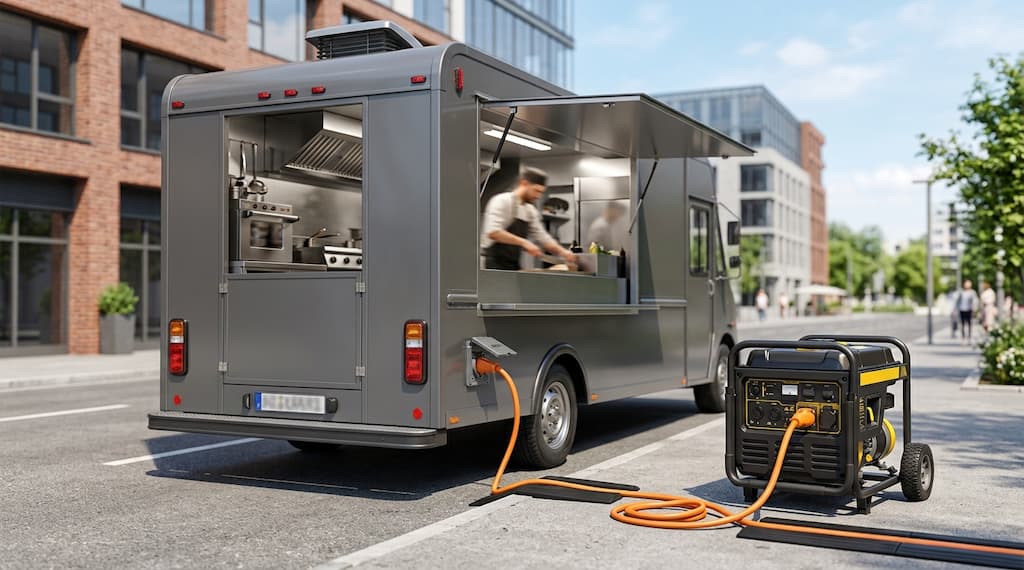
Generator placement on a food truck must address 3 constraints simultaneously: carbon monoxide (CO) exhaust clearance, exhaust direction, and refueling & maintenance accessibility. Most operators mount generators in a rear-mounted enclosure, a side-mounted box, or a rooftop platform, depending on the truck’s chassis design and the generator’s weight and dimensions.
- Rear-mounted external enclosures are the most common configuration for food trucks because they keep exhaust directed away from the service window and cooking area.
- Side-mounted boxes work for smaller generators in medium-length trucks with limited rear clearance.
- Rooftop mounting reduces the truck’s center-of-gravity risk and keeps the exhaust well above pedestrians, but it requires structural reinforcement and increases the truck’s overall height.
Carbon Monoxide Safety and Clearance
Carbon monoxide clearance is the most critical safety requirement in food truck generator placement. The Centers for Disease Control and Prevention (CDC) and the Consumer Product Safety Commission (CPSC) both mandate that portable generators be operated at least 20 ft (6.096 m) from any opening that leads to an occupied space.
Generator exhaust contains CO concentrations that can incapacitate or kill within minutes in enclosed or semi-enclosed spaces. The CPSC reports that generators cause more CO poisoning deaths during power outages and events than any other portable fuel-burning appliance. The IFC 2021 Section 319.6 requires CO alarms in any structure where a combustion engine operates nearby.
Food trucks serving as enclosed work environments must install listed CO detectors in the food preparation area. The exhaust outlet must point away from the truck’s interior, the service window, any LP storage, and neighboring vendor setups at all times during operation.
Enclosed generator compartments on food trucks require forced ventilation that meets the generator manufacturer’s minimum airflow specifications. An under-ventilated enclosure causes CO buildup within the compartment, overheats the generator, and reduces output capacity. Do not operate a generator inside a trailer, garage, or any enclosed space.
What Permits and Codes Apply to Food Truck Generators?
Generator operation on a food truck falls under 4 governing frameworks: NFPA 96, IFC 2021 Section 319, the National Electrical Code (NEC), and local fire marshal inspection requirements. Verify compliance with the local AHJ in every city where the truck operates because requirements vary by municipality and event venue.
- NFPA 96 governs commercial kitchen exhaust systems, including hood clearances, duct construction, fire suppression, and ventilation requirements for generator-powered cooking equipment.
- IFC 2021 Section 319 establishes fire safety requirements for mobile food units, including generator installation, carbon monoxide alarms, LP-gas systems, fuel storage, and fire marshal inspection before operating at permitted events.
- NEC addresses electrical installation requirements for generators, transfer switches, grounding and bonding, overcurrent protection, and wiring methods to ensure the safe distribution of generator and shore power.
- Local Fire Marshal and AHJ Inspections verify compliance with adopted fire and electrical codes before approving generator operation. Many event organizers require proof of inspection or permit approval before assigning vendor locations.
Food trucks planning to operate near FIFA World Cup 2026 venues should also review our Street Food Business Setup for World Cup 2026 article for more requirements specific to event cities. Each host city applies its own AHJ review process in addition to the baseline requirements established by the NEC, IFC, and NFPA standards.
How to Manage and Reduce Power Use in a Food Truck
You can manage and reduce power use by staggering appliance startups to stay under the surge ceiling and supplementing with solar power for low-draw loads. These strategies reduce fuel consumption, extend generator service intervals, and lower the risk of generator tripping during a rush.
Staggering Startup Loads
Staggering startup loads keep the generator below its starting-watt surge ceiling by allowing only one motor-driven appliance to start at a time. Starting every appliance simultaneously at the beginning of the shift creates a surge demand that can exceed the generator’s rated capacity and trip the main breaker. A practical startup sequence follows 6 steps.
- Start the generator and allow it to stabilize for 2–3 minutes with no electrical load.
- Power on the refrigerator and freezer first because their compressors create the highest startup surges.
- Wait about 60 seconds for the compressors to reach normal operating conditions.
- Start the exhaust fan or HVAC system and allow its motor to complete its startup cycle.
- Turn on the griddle and fryer, as their resistive heating elements add running load but create little additional startup surge.
- Power on the microwave, POS terminal, lighting, and other small electronics after the major equipment is operating normally.
This startup sequence keeps the combined surge below the generator’s available capacity while maintaining reliable operation throughout the shift. It also prevents nuisance overload trips that operators often mistake for wiring faults or generator failures.
Chef’s Deal’s Operational Tip: Train every employee to follow it consistently once a startup sequence is established. Starting appliances in the same order every shift reduces unexpected generator trips and makes troubleshooting much easier if problems occur.
Solar Power as a Supplement
Solar power supplements a food truck’s generator for low-draw loads but does not replace it for most food trucks. Electric griddles, fryers, ovens, HVAC systems, and other high-wattage appliances require far more power than rooftop solar panels can continuously produce. Solar works best as a supplemental power source for lighting, POS systems, communications equipment, and battery charging.
A typical food truck solar system combines 400–800 W of rooftop solar panels, a lithium battery bank, and an inverter. This setup can operate LED lighting, POS terminals, routers, phone chargers, and tablet ordering systems under favorable conditions. It reduces generator runtime and fuel consumption.
Realistic solar output for a rooftop panel on a food truck depends on weather, roof angle, and shading from neighboring vehicles at a crowded event site. Expect 60–80% of rated panel output even on clear summer days. Cloud cover, tree shading in fan zones, and adjacent tall vehicles further reduce actual output.
The most practical solar configuration dedicates battery-backed solar power to electronics and lighting while leaving cooking equipment on the generator. This arrangement keeps payment processing, communications, and lighting operational during generator refueling or short maintenance stops without interrupting customer service.
Chef’s Deal’s Operational Tip: Treat solar as a way to improve fuel efficiency and provide limited backup power, not as a replacement for a properly sized generator. Always calculate generator capacity assuming that cooking equipment operates independently of the solar system.
Generator Maintenance for Food Truck Owners
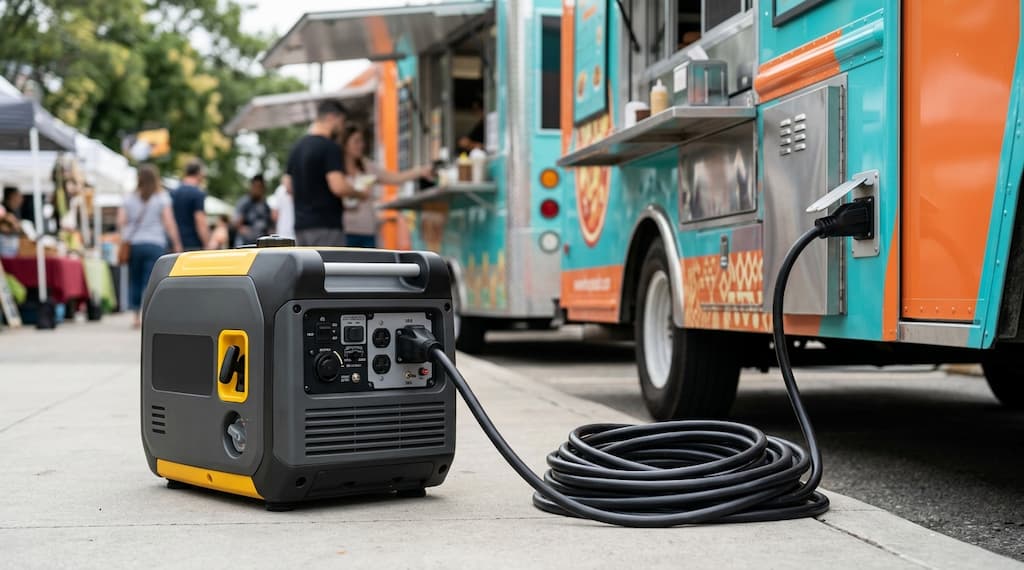
Generator maintenance for a food truck includes 5 routine tasks: changing the oil and filters at the manufacturer’s recommended intervals, replacing worn ignition components, logging operating hours, exercising the generator during storage, and performing a full inspection before major events. Preventive maintenance is the most effective way to avoid generator failures during busy service periods.
- Change oil and filters regularly: Replace engine oil every 100–200 operating hours or at least once per year, following the generator manufacturer’s maintenance schedule. Inspect the oil level before every shift.
- Inspect the air filter and spark plugs: Clean or replace the air filter every 50–100 operating hours in dusty environments, and replace spark plugs every 100–300 hours on gasoline generators.
- Track operating hours: Maintain a runtime log to schedule maintenance before service intervals are exceeded. Logging operating hours is more reliable than estimating usage, particularly during consecutive event weekends.
- Exercise the generator during storage. Run the generator once each month for about 30 minutes with a load of at least 50% of its rated capacity. Exercising the generator circulates oil and keeps fuel components in good working order.
- Perform a pre-event load test: Operate the generator at its expected service load for approximately one hour 2-3 weeks before a major event. Full-load testing identifies fuel delivery problems, voltage instability, overheating, and oil leaks before event day.
Best Practice: Commercial generators can operate for extended periods when properly maintained and loaded within their continuous-duty rating. Most food trucks run 8–16 hours per day during events. A 30-minute monthly exercise run under load during storage helps keep the generator reliable for the next event season.
Troubleshooting Common Food Truck Power Problems
Common food truck power problems fall into 5 categories: generator overload, voltage drop, fuel delivery issues, overheating, and poor power quality that affects sensitive electronics. Identifying the correct failure mode before replacing equipment or calling for repairs saves time and prevents unnecessary downtime.
- Generator overload/tripping: The combined running load or startup surge exceeds the generator’s available capacity. Disconnect non-essential equipment, stagger appliance startups, or upgrade to a larger generator. Never replace the factory circuit breaker with a higher-rated device.
- Voltage drop/dimming: Extension cords or shore-power cables are too small for the load or cable length. Verify conductor size, minimize cable length, and measure voltage under load. Sustained voltage below 108V on a nominal 120V circuit indicates excessive voltage drop.
- Low engine power or unstable output: Old gasoline, clogged fuel filters, or a restricted carburetor can reduce engine performance and limit generator output. Use fresh stabilized fuel and replace fuel filters according to the manufacturer’s maintenance schedule.
- Overheating or automatic shutdown: Blocked cooling airflow, high ambient temperatures, or insufficient clearance around the generator can trigger thermal shutdown. Clean cooling fins and maintain adequate ventilation around the generator enclosure.
- POS or electronics malfunction: A conventional generator with high THD disrupts sensitive electronics. Use an inverter generator or dedicated clean-power circuit for payment systems and communications equipment.
Best Practice: Connect only equipment that matches the generator’s voltage, frequency, and power capacity. Never let high-demand appliances overload the generator, and never plug a POS or other sensitive electronic system into the same outlet strip as a high-draw resistive appliance.
Backup Power Planning for Events
Backup power planning for food truck events includes 4 contingency measures: a secondary generator, battery backup for critical electronics, confirmed shore-power access, and a rental equipment plan. Replacement generators may become unavailable within hours during high-demand events such as the FIFA World Cup 2026, making planning essential.
- Keep a secondary generator available: A 3–5 kW inverter generator dedicated to lighting, communications, and POS systems helps keep service running if the primary generator requires refueling or fails unexpectedly.
- Protect electronics with a UPS: A 1,000–2,000 VA uninterruptible power supply (UPS) shields POS terminals and networking equipment from voltage fluctuations while providing short-term backup power during generator changeovers.
- Confirm shore power availability before arrival: Verify the available amperage, voltage, connector type, and transfer switch requirements with the event organizer well before setup day. Carry compatible adapters and cables for the assigned electrical service.
- Plan generator rentals before the event season: Identify local rental suppliers, reserve equipment for major event weekends when possible, and establish an emergency contact before demand peaks. Generator availability near stadiums often disappears shortly before large events begin.
Best Practice: Treat backup power as part of the event plan rather than an emergency response. Testing backup equipment before departure and confirming alternative power sources prevent a minor equipment failure from ending service during the busiest hours.
Operators planning large temporary food operations can review our Temporary Food Vendor Setup Near Stadiums guide for additional guidance on shared electrical infrastructure, generator placement, and event-site power distribution.
What Does It Cost to Run a Generator for a Food Truck?
The cost of running a generator for a food truck comprises 3 primary components: the purchase price, fuel consumption per hour, and ongoing maintenance. Small inverter generators typically cost $700–$2,500, while commercial food truck generators range from $5,000–$12,000. A 20 kW commercial generator generally costs $6,000–$12,000, depending on the manufacturer, enclosure, fuel type, and electrical output.
| Generator Class | Purchase Price Range | Fuel Cost / Hour (gas)* | Annual Maintenance Est. |
| Small inverter (3–7 kW) | $700–$2,500 | $1.50–$3.00 | $150–$300 |
| Mid-range conventional (8–15 kW) | $2,000–$5,000 | $2.50–$4.50 | $250–$500 |
| Commercial (15–25 kW) | $5,000–$12,000 | $4.00–$7.00 | $500–$1,000 |
| Industrial (25–35 kW) | $10,000–$25,000+ | $6.00–$10.00+ | $800–$2,000 |
*Actual fuel cost depends on generator load, fuel type, engine efficiency, and local fuel prices.
Fuel consumption varies with generator size and electrical demand. A 15 kW generator operating at approximately 70% load typically burns 1.2–1.5 gallons (4.542–5.678 L) of gasoline per hour. Running a generator continuously for 24 hours can therefore result in substantial fuel expense, making long operating schedules far more expensive than the initial purchase price over time.
Maintenance is another critical factor when comparing ownership costs. Routine oil changes, filters, spark plugs, inspections, and periodic replacement parts add to annual operating expenses but significantly reduce the risk of costly failures during the event season.
Best Practice: Compare generators based on their total cost of ownership, not just purchase price. Food trucks that operate frequently at festivals and sporting events often spend more on fuel over several seasons than they initially paid for the generator, making fuel efficiency and reliability more valuable than the lowest upfront price.
FAQs About Food Truck Power and Generators
Does a food truck need a generator?
Yes, a food truck needs a generator unless the operating venue provides shore power at sufficient amperage. Most street and event locations lack electrical access, so a generator is the sole power source for the cooking line, refrigeration, POS system, and lighting.
How many amps does a food truck need?
Most food trucks require approximately 50–150 amps of electrical service, depending on the number of appliances and whether equipment operates on 120V, 240V, or both. Smaller trucks generally fall near the lower end of that range, while high-volume kitchens with HVAC and multiple refrigeration units require substantially more capacity.
What is the 80% rule for generators?
The 80% rule for generators limits continuous generator loads to about 80% of the generator’s rated output. A 10 kW generator delivers a reliable continuous load of 8 kW. Exceeding 80% causes overheating, accelerated wear, and voltage instability.
Can a 5000W generator run a food truck?
Yes. A 5,000W (5 kW) generator can run a very small food truck with one griddle, one refrigerator, a POS terminal, and basic lighting. It cannot reliably power a truck with a fryer, freezer, and HVAC simultaneously.
What is the best power source for a food truck?
The best power source for a food truck depends on the operating environment. A diesel or gasoline generator in the 10–20 kW range is the most versatile and widely available power source. Shore power from an event venue eliminates fuel costs and exhaust concerns when available. Solar works best as a supplemental source.
Is it okay to run a generator 24 hours a day?
Technically yes. It is okay to run a generator 24 hours a day, provided you strictly follow the load capacities and maintenance routines. Most food truck operators, however, run generators for 8–16-hour event shifts, monitor oil and fuel throughout the day, and perform regular maintenance to maximize service life.
What is the 20/20/20 rule for generators?
The 20/20/20 rule for generators is a maintenance and performance guideline.
* 20 Ft Away: Place the portable generator at least 20 ft (6.096 m) away from any occupied opening. This element mirrors the CDC and CPSC carbon monoxide clearance guidance for portable generator placement.
* 20-Minute Cooldown: Turn off the generator and let it cool for 20 minutes before adding gasoline or diesel.
* 20% Minimum Load: Maintain a minimum electrical load of 20% during operation to prevent “wet nesting” (unburnt fuel buildup) and ensure optimal engine efficiency.
How much does a generator cost for a food truck?
A generator for a food truck costs around $700–$2,500 for small inverter models to $10,000–$25,000+ for large commercial units. Most medium- and large-sized food trucks use generators costing $2,000–$12,000, with installation costs varying depending on the electrical panel, transfer switch, mounting method, and local labor rates.
Final Thoughts: Power and Generator Planning for Food Trucks Before Event Season
Power planning for a food truck before the event season aims to prevent failure points caused by overloading, improper installation, inadequate maintenance, and a lack of contingency planning. Optimal planning involves 4 decisions.
- Size the generator for the surge load rather than just the running load.
- Apply the 80% rule to every capacity calculation.
- Confirm CO clearance and exhaust direction before the first event.
- Establish a backup power plan before the rush begins.
Operators who complete this planning before the high-demand event season recover equipment costs faster, sustain throughput during peak windows, and avoid the emergency costs of renting replacement equipment at event-day rates.
Chef’s Deal supplies commercial kitchen equipment for food trucks, concession stands, and temporary event kitchens. Benefit from competitive pricing, free shipping, and financing options up to 84 months. Contact the Chef’s Deal team for equipment guidance specific to your food truck setup and event-season needs.

