
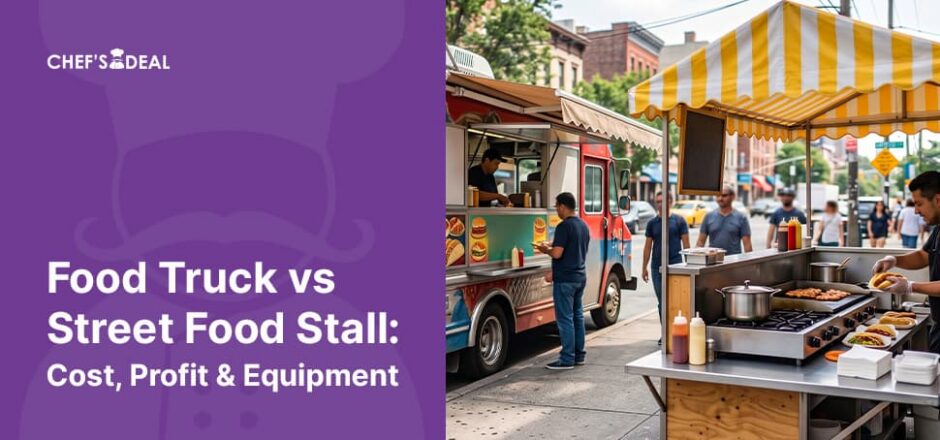
Choosing between a food truck and a street food stall comes down to four factors: startup cost, mobility, revenue ceiling, and equipment load. A food truck typically requires $50,000 to $200,000 to launch and delivers the highest daily revenue ceiling, while a street food stall can start for as little as $3,000 to $35,000 with a lower capacity but far less financial risk.
Operators preparing for the 2026 FIFA World Cup and the surrounding festival season need to match their format to their budget and growth plans before the tournament calendar fills up.
TL;DR: Food Truck vs. Street Food Stall
- Food Truck: A self-contained mobile kitchen mounted on a vehicle chassis, complete with cooking equipment, refrigeration, a power source, and water and waste systems.
- Street Food Stall: A stationary or semi-portable setup, typically a cart, tent, or booth, that operates from a fixed pitch. It relies on a smaller equipment footprint and often requires a nearby commissary kitchen for prep and cleaning.
- Food Truck: Requires a startup investment of $50,000 to $200,000 but delivers the highest daily revenue ceiling of $3,000 to $5,000.
- Street Food Stall: A lower-risk option starting at $3,000 to $35,000, with a more moderate revenue potential of $500 to $2,000 per operating day.
- Primary Cost Components: For either format, the startup costs break down into the same four categories: the vehicle or cart itself (the largest single line item), equipment fit-out, permits, and initial inventory.
- Food Trucks: Require a vehicle-sized parking spot and offer high mobility, allowing them to easily drive to new locations.
- Street Food Stalls: Require only a small pitch and have low to moderate mobility, requiring relocation on foot or by trailer.
- Food Trucks: Best for multi-city tournament circuits (like the upcoming 2026 FIFA World Cup) and higher-volume events.
- Street Food Stalls: Best for single-venue events, first-time operators, or those working with a lower budget.
Food Truck vs Street Food Stall Comparison
| Category | Food Truck | Street Food Stall |
| Startup Cost | $50,000–$200,000 | $3,000–$35,000 |
| Footprint | Vehicle-sized parking spot | Small pitch, cart, or tent |
| Mobility | High (drives to new locations) | Low to moderate (relocate on foot or by trailer) |
| Revenue Potential | $3,000–$5,000 per operating day | $500–$2,000 per operating day |
| Best For | Multi-city tournament circuits, higher-volume events | Single-venue events, first-time or lower-budget operators |

What’s the Difference Between a Food Truck and a Street Food Stall?
The difference between a food truck and street food lies in their construction. A food truck is a self-contained mobile kitchen mounted on a vehicle chassis, while a street food stall is a stationary or semi-portable cart, tent, or booth.
Street food refers to ready-to-eat foods sold in public places by vendors such as food stalls, concession stands, and food trucks. Each cuisine, from American, Asian, Chinese, and Japanese to European, African, and Middle Eastern, has its own type of street food.
The difference between a food truck and a food stall blurs when a food truck parks at the same location for an extended period or when food trailers require another vehicle to tow them.
What Qualifies as a Food Truck?
A food truck is a self-contained mobile kitchen built into a vehicle chassis, complete with its own cooking equipment, refrigeration, power source, and water and waste systems. Because everything travels with the vehicle, a food truck can relocate between neighborhoods, fan zones, or host cities without rebuilding its kitchen each time.
What Qualifies as a Street Food Stall?
A street food stall is a stationary or semi-portable setup, typically a cart, tent, or booth, that operates from a fixed pitch rather than driving between locations. It relies on a smaller equipment footprint and, in many cases, a nearby commissary kitchen for prep and cleaning rather than carrying that capability onboard.

Startup Costs: Food Truck vs Street Food Stall
Startup costs for either format break down into the same four components: the vehicle or cart itself, equipment fit-out, permits, and initial inventory. The vehicle or cart is the largest single line item in both cases, and it is also where the two formats differ most sharply in price.
| Cost Component | Food Truck | Street Food Stall |
| Vehicle / Cart | $40,000–$100,000 (used) to $200,000+ (custom build) | $2,000–$10,000 |
| Equipment Fit-Out | $10,000–$20,000 | $1,000–$5,000 |
| Permits & Licensing | $800–$17,000 (varies heavily by city) | $500–$2,000 |
| Initial Inventory | $3,000–$5,000 | $500–$2,000 |
Food Truck Startup Costs
A used food truck with basic equipment costs $50,000 to $80,000, while a new custom-built truck with a full commercial kitchen typically costs $95,000 to $230,000. The truck itself accounts for roughly half to two-thirds of the total startup cost. Permit fees cost around $28,000 from the very beginning, including annual operation licenses, as estimated by the US Chamber of Commerce.
Street Food Stall Startup Costs
A basic cart with a portable griddle or propane burner, folding prep tables, and insulated cold storage can launch for $3,000 to $15,000. A mid-range cart or trailer setup with more capacity and a wider menu runs $15,000 to $35,000. Permits and a commissary agreement typically add a few hundred to a few thousand dollars a year on top of the equipment cost.
You can find more detailed information about the street food business in our ‘Street Food Business Setup for World Cup 2026: Complete Guide for High-Demand Events‘ guide.
Ongoing Operating Costs Compared
Operating costs for either format center on the same five recurring expenses: fuel or power, location or pitch fees, staffing, maintenance, and insurance. Trucks incur higher recurring costs across nearly every category, since they combine vehicle maintenance with full kitchen operations.
Fuel, Power, and Maintenance
Food trucks depend on 4-30 kW generators, as specified in our ‘Power and Generator Planning for Food Trucks: Sizing, Setup & Event-Day Reliability‘ article, to power equipment such as commercial refrigerators and mixers. Hence, they incur fuel costs.
They need to maintain their vehicle and higher insurance premiums, which can reach $6,000 a year for combined liability and auto coverage. Street food stalls operate more cheaply, typically relying on propane or a smaller generator in the 5,000W to 10,000W range, with fewer moving mechanical parts to maintain.
Location and Pitch Fees
Both formats pay for prime spots near stadiums and fan zones, though the fee structures differ. Food trucks have to pay commissions or flat fees, for instance, around $1,500 for a parking spot in New York, according to a CNBC article, while stalls typically pay a smaller daily or per-event pitch fee ($40-$400). Some vendors make percentage-of-sales agreements, usually 10% to 25% for larger festivals.
Revenue Potential and Profitability
Revenue potential between the two formats depends on throughput, menu pricing, location reach, and profit margin on food and beverages, with food trucks holding a clear ceiling advantage due to mobility and larger equipment capacity.
Undercapitalization and a poor location choice, rather than the format itself, are the most common reasons why either type of operation fails to turn a profit.

Which Format Makes More Money?
A food truck typically generates $3,000 to $5,000 in revenue per operating day thanks to a larger cooking line and the ability to chase higher-traffic locations, while a well-placed street food stall can generate $500 to $2,000 per day with a fraction of the overhead. The stall’s lower fixed costs mean a smaller daily revenue figure can still produce a comparable profit margin.
Most Profitable Foods to Sell
The most profitable items in their menus for food trucks and food stalls are burgers, hot dogs, pizzas, tacos, loaded fries, and specialty sandwiches, which typically carry a $10 to $15 ticket price and require under 3 minutes of preparation. (You can also read our ‘Best Food Ideas to Sell During Major Sports Events (High-Profit & High-Volume Guide)‘ blog to see all profitable menus for street food businesses.)
However, the menu content should align with the equipment inventory and protect margins during a high-volume event window, rather than maximizing variety.
Equipment Needs: Food Truck vs Street Food Stall
Equipment needs for either format fall into four categories: cooking, refrigeration, power, and prep and holding equipment. Format is the primary factor determining the equipment purchasing plan.
| Equipment Category | Food Truck | Street Food Stall |
| Cooking | Full line: griddle, fryer, ventilation hood | Portable griddle or burner, limited stations |
| Refrigeration | Onboard reach-in or undercounter coolers and freezers, sandwich or prep tables, depending on the menu items | Compact cold storage such as undercounter coolers and freezers |
| Power | Onboard generator or shore power hookup | Small generator (5,000–10,000W) or propane |
| Prep & Holding | Multi-station stainless prep line, food warmers and holders | Folding prep tables, limited holding capacity |
Food Truck Equipment Load
A food truck’s equipment list includes a full cooking line (fryers, griddles, and ranges), refrigeration (reach-in refrigerators, prep tables, ice makers), a generator or shore-power hookup, and a ventilation hood with fire suppression. (Go to our What Equipment Do You Need for a Food Truck? ” page to see the whole list.)
This heavier, vehicle-mounted set is what gives a truck its higher production ceiling, but it also raises both the initial cost and the ongoing maintenance burden covered earlier.
Street Food Stall Equipment Load
A street food stall’s equipment load is lighter by design: countertop cooking equipment, compact cold storage, and a smaller generator or propane setup. That lighter footprint limits daily output to roughly 40 to 60 customers per hour for a single-operator setup, but it also keeps the stall easier to staff and relocate between events.
Permits and Legal Basics for Each Format
Permit and legal requirements for either format cover the same four areas: business structure, vendor permits, parking or pitch rules, and fire and health department compliance, though specific requirements vary by city and event organizer.
Street food operators working at World Cup 2026 venues should verify requirements at three levels: municipal health department, event organizer vendor credentials, and state business licensing, with a local authority before committing to a location.
Pros and Cons of Each Format
The trade-offs between a food truck and a street food stall come down to mobility, overhead, capacity, weather exposure, and scalability.
| Food Truck | Street Food Stall | |
| Pros | High mobility, higher revenue ceiling, weather protection, easier to scale into catering | Low startup cost, fast to launch, minimal ongoing overhead |
| Cons | High upfront investment, heavier permitting, higher fixed costs | Limited capacity, more weather exposure, lower revenue ceiling |
Which One Should You Choose for the 2026 World Cup?
You should choose the World Cup 2026 format based on budget, target locations, expected crowd size, and growth plans. Operators planning to follow the tournament circuit across multiple host cities, or targeting high-traffic fan zones with sustained crowds, are better matched to a food truck’s mobility and volume.
Operators testing a concept at a single venue, working with a tighter budget, or prioritizing a fast, low-risk launch are better matched to a street food stall, with room to scale into a truck once the concept proves out.

FAQs About Food Truck vs. Street Food Stall
Are food trucks considered street food?
Food trucks fall under the broader street food category, since both sell prepared food from a public, non-restaurant location. Still, a food truck is distinguished by its self-contained, vehicle-mounted kitchen rather than a stall’s stationary cart or tent setup.
Do you need an LLC to run a food truck?
An LLC is not a universal legal requirement for operating a food truck, but it is common practice because it separates personal assets from business liabilities. Requirements vary by state and city, so check with a local business licensing office before you launch.
Is a food truck a tax write-off?
Many food truck expenses, including the vehicle, equipment, and certain operating costs, can qualify for business tax deductions or depreciation. Still, eligibility depends on how the business is structured and how the vehicle is used. You should consult a tax professional to confirm what applies to your situation.
Can I set up a food truck anywhere?
Food trucks cannot park and sell anywhere; parking and pitch rules vary by city, with many requiring a specific mobile food vendor permit and restrictions on parking near existing restaurants or in residential zones. Event organizers add another layer of rules for vendor placement within fan zones and stadium perimeters.

Final Thoughts: Picking the Right Format Before the Tournament
A food truck is a fully self-contained mobile kitchen built directly into a vehicle chassis, complete with its own onboard power, water, and waste systems. In contrast, a street food stall is a stationary or semi-portable setup, such as a tent, cart, or booth, that operates from a fixed pitch and typically relies on a smaller equipment footprint, often requiring a nearby commissary kitchen for food preparation and cleaning.
Choosing between a food truck and a street food stall is a matter of matching format to budget, mobility needs, and revenue goals rather than picking whichever option sounds more established. A tighter budget and a single-venue plan point toward a stall; a multi-city circuit and a higher revenue target point toward a truck.
Once the format decision is made, the plan becomes real at the equipment level, since even the right format can underperform with an undersized cooking line, insufficient refrigeration, or a generator that can’t carry the load through a full event day.
When it comes to financial metrics, the two formats cater to completely different budgets and revenue ceilings. Launching a food truck involves a substantial startup cost of $50,000 to $150,000+, but it is offset by a high daily revenue potential of $2,000 to $10,000.
Conversely, a street food stall carries far less financial risk, requiring an initial investment of $3,000 to $15,000 and earning $500 to $2,000 per day. For both options, the largest expense is the physical vehicle or cart, followed by equipment fit-outs, permits, and initial inventory.
Choosing the right format ultimately depends on an operator’s target venues and growth strategy, a critical consideration for vendors gearing up for large-scale events like the 2026 FIFA World Cup. Because they can effortlessly drive between neighborhoods or host cities, food trucks are the optimal choice for multi-city tournament circuits and high-volume events.
Meanwhile, street food stalls are highly effective for single-venue events, first-time operators, or those with lower budgets who do not need the capacity to independently relocate over long distances. Chef’s Deal carries commercial cooking equipment, refrigeration, and generators sized for both food trucks and street food stalls, with equipment packages built around the demands of tournament-season volume.

