

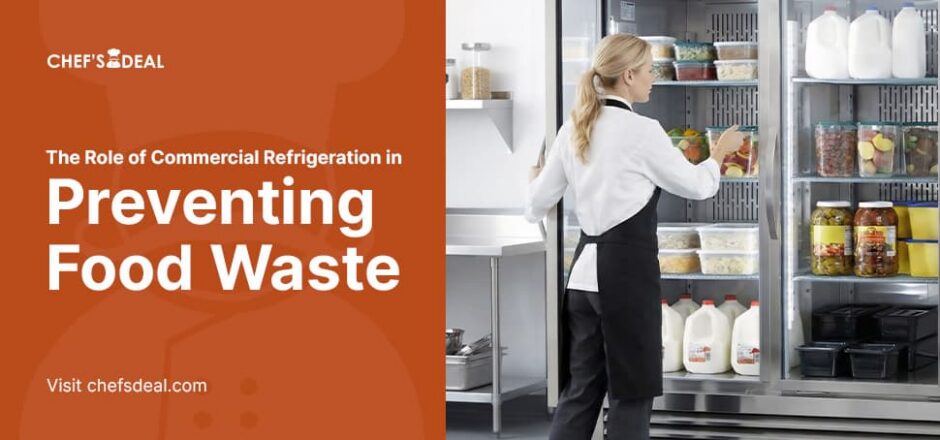
Commercial refrigeration prevents food waste by controlling temperature, humidity, and airflow throughout storage and production. Precise refrigeration systems protect inventory value, ensure food safety compliance, and preserve product quality in professional kitchens.
Key takeaways: Temperature Control and Food Waste Prevention
- Food waste starts with temperature abuse: even brief exposure to the danger zone (41°F–135°F (5°C-57.2°C)) accelerates bacterial growth and spoilage.
- Commercial refrigeration is the primary defense against waste, maintaining stable temperatures, slowing microbial activity, and extending shelf life.
- Temperature consistency matters more than setpoint alone; fluctuations cause hidden losses that shorten usable life without visible spoilage.
- Commercial systems outperform residential units by recovering temperature faster, handling heavy loads, and maintaining precise cooling under constant access.
- Different refrigeration systems reduce waste in different ways, from reach-ins for daily service to walk-ins for bulk storage and blast chillers for rapid cooling.
- Energy-efficient, modern refrigeration reduces both waste and costs, preventing temperature drift while lowering utility usage.
- Common mistakes like overloading, poor airflow, and neglected maintenance directly increase spoilage, even with good equipment.
- Food safety compliance and waste reduction go hand in hand, as proper logging and monitoring prevent forced disposal during inspections.
- Correct refrigeration selection improves inventory planning, enables bulk purchasing, reduces shrinkage, and stabilizes food costs.
- Commercial refrigeration is a strategic waste-prevention tool, not just storage, protecting food quality, safety, and profitability across operations.
Why Food Waste Starts With Temperature Control?
Food waste begins with temperature control, as perishable products degrade during post-harvest handling, processing, storage, and holding long before service. Commercial kitchens handle high volumes of proteins, produce, dairy, and prepared foods daily, which makes refrigeration the primary safeguard against spoilage. Stable cooling slows bacterial growth, suppresses enzymatic reactions, and preserves product integrity.
Commercial refrigeration protects inventory value by inhibiting spoilage, extending shelf life from days to more than a week, and inhibiting microbial decay. Food waste costs the U.S. retail food sector approximately $18 to $28 billion annually (ReFED), while global losses exceed $1 trillion (FAO). Temperature abuse and refrigeration malfunction rank among the leading causes of food spoilage in commercial kitchens.
How Food Spoilage Happens in Commercial Kitchens?
Food spoilage happens in commercial kitchens when food items stay in the temperature danger zone and are exposed to moisture, oxygen, and light. Commercial refrigeration systems limit these reactions by removing heat, stabilizing moisture levels, restricting oxygen exposure, and maintaining uniform air circulation.
The Temperature Danger Zone
The FDA defines the temperature danger zone as the range from 41°F to 135°F (5°C to 57.2°C), where pathogenic bacteria multiply fastest. Bacteria double approximately every 20 minutes within this range, rapidly converting food into waste. Food held in this zone for over 2 hours, or 1 hour above 90°F (32.2°C), exceeds safety thresholds and loses commercial viability.
Moisture, Oxygen, and Light as Spoilage Accelerators
Moisture, oxygen, and light act as spoilage accelerators when refrigeration fails to regulate the internal environment. Poor humidity control dehydrates produce, softens leafy greens, and promotes microbial decay when relative humidity exceeds 95%. Open refrigeration and fluctuating temperatures increase waste by exposing refrigerated items to oxygen and light.
Oxygen exposure accelerates enzymatic browning and lipid oxidation, which degrade meats, seafood, and dairy products by promoting rancidity and off-odors. Light exposure triggers photo degradation, destroying vitamins such as C and B. Fluctuating temperatures caused by worn gaskets, aging compressors, or blocked airflow create warm zones that allow bacteria to proliferate even when thermostat readings appear correct.
Why Commercial Refrigeration is Different From Residential Refrigeration?
Commercial refrigeration differs from residential refrigeration because professional kitchens demand continuous performance under heavy thermal loads and strict safety standards. Commercial systems sustain precise temperatures during constant access, rapid turnover, and compliance monitoring, while residential units prioritize convenience and comfort.
Design for Load, Not Convenience
Commercial refrigeration systems are designed for heavy loads, not convenience, to support nonstop kitchen activity. Continuous door openings introduce warm air dozens of times per hour. High-capacity, powerful compressors and oversized condensers quickly restore setpoints to protect inventory from temperature spikes.
Commercial units stand out for their high product turnover and larger thermal mass. They require commercial-grade materials, such as 304 stainless steel, that are easy to clean, bacteria-resistant, and durable enough to withstand frequent restocking. Their high-velocity fans circulate cold air evenly across dense loads without creating warm zones.
Precision vs. Average Cooling
Precision vs. average cooling separates food-code-driven systems from comfort-focused appliances. Commercial units maintain narrow temperature bands with digital controls that keep perishable items at or below 41°F (5°C) to meet food code requirements. These advanced thermostats enable operators to set and monitor desired precise temperatures to the decimal point for maximum safety.
Commercial refrigerators and freezers can also lower temperatures much faster than residential units. Their design focuses on compliance, rather than human comfort. Automated temperature logs, alarms for fluctuations, and integration with Energy Management Systems (EMS) are other features that home fridges lack.
What are The Key Commercial Refrigeration Systems That Reduce Food Waste?
Key commercial refrigeration systems that reduce waste include reach-ins, walk-ins, undercounter units, and blast chillers designed for specific storage and processing tasks. Each system controls temperature, airflow, insulation, and access to preserve shelf life and prevent discard.
Reach-In Refrigerators and Freezers
Reach-in refrigerators and freezers stabilize day-to-day storage during service. Insulated cabinets, high-output compressors, and tight door seals limit heat gain during frequent access, keeping ingredients within safe ranges and reducing prep spoilage. Reach-in refrigerators and freezers support rotation and organization. Adjustable shelving and clear layouts reinforce FIFO practices, reducing discard rates for prepped proteins, sauces, and garnishes under service pressure.

Walk-In Coolers and Freezers
Walk-in coolers and freezers preserve bulk inventory with thick insulated panels and high-capacity refrigeration that holds uniform temperatures across large volumes. Thermal mass and door integrity maintain conditions during peak traffic and short power interruptions. Walk-in refrigerators enable zoning to prevent waste. Dedicated areas for proteins, produce, and dairy control humidity and placement, which limits dehydration, drip contamination, and premature spoilage.

Undercounter Refrigeration at Prep Stations
Undercounter refrigeration at prep stations reduces food exposure to spoilage conditions. Point-of-use placement shortens retrieval time and limits exposure to ambient heat, helping preserve quality during rush periods. Undercounter refrigerators and freezers minimize cross-contamination and discard rates. Station-specific storage separates ingredients, improves workflow discipline, and prevents hidden spoilage common in overcrowded main cabinets.

Blast Chillers and Shock Freezers
Blast chillers and shock freezers deliver rapid temperature reduction after cooking. High-velocity airflow pulls food through the danger zone within 90 minutes, stopping bacterial growth. They prevent batch-cooking waste. Cook-chill workflows preserve cellular integrity through microcrystal formation, extend chilled holding up to 5 days, and protect texture and yield, so finished items serve rather than be discarded.
What is the Role of Temperature Consistency in Food Waste Reduction?
The role of temperature consistency in food waste reduction is to prevent cumulative microbial growth and quality degradation by keeping perishable food outside the danger zone. Stable internal temperatures slow bacterial multiplication, preserve texture and flavor, and maintain the whole intended shelf life of refrigerated and frozen inventory.
Why Temperature Fluctuations Cause Hidden Losses?
Temperature fluctuations cause hidden losses by triggering spoilage processes that remain undetectable until food reaches the point of use. Repeated warming and re-cooling accelerate bacterial and fungal growth at the microscopic level, even when food appears safe. This shortens the shelf life without visible warning signs. Inconsistent temperatures also promote wilting, souring, oxidation, and aroma loss.
Recovery Time After Door Openings
Slow temperature recovery after door openings keeps products in the danger zone longer. These repeated short exposures compound into measurable shelf-life loss across an entire shift. The speed of temperature recovery depends on compressor power and airflow capacity. Commercial-grade compressors quickly restore set temperatures after frequent access, but underpowered systems struggle to recover, leading to cumulative temperature abuse and increased waste.
Energy Efficiency and Food Waste: The Overlooked Connection
The connection between energy efficiency and food waste is often overlooked because inefficient refrigeration fails to maintain stable temperatures while consuming more power. Poor efficiency increases temperature drift, accelerates spoilage, and raises the likelihood of total inventory loss during mechanical stress or peak demand.
Old Equipment = More Waste
Old equipment equals more waste because aging refrigeration systems struggle to hold consistent temperature ranges under load. Worn compressors and outdated controls cause temperature drifts, repeatedly pushing food toward the danger zone. Uneven cooling zones develop as fans, coils, and insulation degrade. Warm spots allow bacterial growth, and overly cold zones cause freezing damage, dehydration, and texture loss.
Modern Refrigeration and Smart Controls
Modern refrigeration and smart controls reduce food waste by maintaining precise temperature bands with digital thermostats. Accurate sensors detect minor deviations instantly, allowing operators to correct issues before spoilage accelerates or food code thresholds are breached. Real-time alerts for temperature spikes, power interruptions, or door openings enable rapid intervention, preventing overnight failures from destroying entire inventories.
What are 3 Common Refrigeration Mistakes That Increase Food Waste?
The common refrigeration mistakes that increase food waste include improper loading, poor storage practices, and neglected maintenance. These errors restrict airflow, destabilize temperatures, and allow gradual spoilage that undermines otherwise adequate equipment.
1. Overloading Units
Overloaded units increase food waste by blocking the airflow required for uniform cooling. Packed shelves prevent cold air circulation around containers, leaving sections of the cabinet warmer than the set point. Crowded storage forces compressors to work harder, yet they still fail to cool dead zones. The result is accelerated spoilage and increased discard rates despite higher energy use.
2. Incorrect Shelving and Storage Practices
Incorrect shelving and storage practices increase waste by blocking evaporators and return vents. Containers stacked against rear walls or ceilings disrupt airflow patterns, causing ice buildup, reduced cooling capacity, and sudden temperature failures. A lack of FIFO organization pushes older items out of sight, where expiration goes unnoticed, and usable inventory is lost.
3. Lack of Preventive Maintenance
Lack of preventive maintenance increases food waste by reducing cooling efficiency and reliability. Dirty condenser coils restrict heat release, forcing compressors to overheat and reducing temperature control accuracy under normal kitchen loads. Worn seals admit warm air and moisture; wrongly calibrated controls create false confidence, leaving food in unsafe temperature ranges without visible alarms.
Food Safety Compliance and Waste Prevention Go Hand in Hand
Food safety compliance and waste prevention operate in parallel because consistent temperature control, documentation, and verification protect both public health and inventory value. Structured systems reduce spoilage risk, prevent unnecessary disposal, and convert refrigeration from a passive storage tool into an active waste-reduction asset across commercial kitchens.
- HACCP and Temperature Logs: Documentation reduces both risk and waste. HACCP temperature logging is legally required at all critical control points, including receiving, storage, cooking, and cooling. These logs transform food safety into proactive quality management, eliminating human error and providing real-time alerts before temperatures reach unsafe levels.
- Health Code Violations vs. Preventable Loss: Non-compliance leads to preventable loss when missing logs or improper cooling force the disposal of otherwise safe food. Inspectors require proof of compliance, and undocumented temperature control often results in mandatory discard, shutdown risk, and direct financial loss.
How Commercial Refrigeration Supports Inventory Planning?
Commercial refrigeration supports inventory planning by extending shelf life, stabilizing storage conditions, and reducing purchasing volatility. Longer holding times and consistent temperature performance enable bulk-buying strategies and directly reduce shrinkage and spoilage-related write-offs.
Longer Shelf Life = Better Purchasing Decisions
A longer shelf life enables better purchasing decisions because consistent refrigeration preserves quality beyond the daily turnover window. Extended holding capacity means buying in bulk without spoilage risk, securing seasonal pricing advantages, and lowering emergency reorders. Operators can plan demand based on actual usage, rather than fear of expiration, and establish predictable ordering cycles, minimizing last-minute sourcing at unfavorable prices.
Reduced Shrinkage and Write-Offs
Reduced shrinkage and write-offs result directly from stable temperature control that preserves flavor, texture, and weight. Preventing drip loss, dehydration, and premature spoilage reduces food cost percentage, limits discarded inventory, and translates improved refrigeration performance into measurable financial savings.
How to Choose the Right Commercial Refrigeration to Reduce Waste?
Choosing the right commercial refrigeration to reduce waste involves aligning capacity, workflow integration, and equipment lifecycle with production demands. Correct selection prevents airflow restriction, limits temperature drift, and ensures refrigeration performance supports long-term cost control.
- Plan capacity based on volume. Properly sized units avoid overloading, which blocks airflow, and undersizing, which accelerates spoilage during peak inventory cycles. Walk-ins provide bulk storage in high-volume operations; reach-ins are sufficient for daily turnover in smaller facilities.
- Match refrigeration type to kitchen workflow. Placing refrigeration near the point of use minimizes exposure to ambient heat. Undercounter, prep, pass-through, and roll-in systems keep food cold at the point of use and maintain the cold chain during movement and service.
- Upgrade equipment when financial thresholds for replacement are met. Aging equipment leads to food waste due to temperature drift and failing gaskets. Modern systems recover investment through lower spoilage rates, reduced energy use, and continuous monitoring protection.
Proper Refrigeration for Different Food Categories
Proper refrigeration for different food categories preserves quality by controlling temperature, humidity, and separation based on product risk. Category-specific storage prevents dehydration, cross-contamination, and premature spoilage across diverse inventory types.
Fresh Produce
Fresh produce requires controlled humidity and ethylene management to prevent dehydration and accelerated ripening. Most fruits and vegetables store best at 40°F (4.4°C) or below and at 85–95% relative humidity (FDA). Store produce on middle shelves or crisper drawers, consistently above raw proteins. Separate ethylene-producing fruits from ethylene-sensitive greens to prevent yellowing, softening, and early discard before sale or service.
Raw Proteins and Seafood
Raw proteins and seafood demand the coldest storage zones to limit bacterial growth and drip loss. The FDA suggests storing seafood and poultry in the refrigerator for up to 2 days and fresh meat for 3-5 days after purchase. Bottom-shelf placement and leak-proof containment prevent odor transfer, moisture loss, and cross-contamination, which can lead to forced disposal.
Dairy and Prepared Foods
Dairy and prepared foods benefit from stable cold storage that preserves freshness and safety. Consistent temperatures, top-shelf placement, and unobstructed airflow extend shelf life, protect ready-to-eat items, and prevent waste caused by unstable temperatures and poor circulation. The FDA strictly discourages storing dairy in refrigerator doors, where temperatures fluctuate the most.
FAQs About Commercial Refrigeration and Food Waste
How does commercial refrigeration reduce food waste?
Commercial refrigeration reduces food waste by slowing bacterial growth and metabolic activity, extending the usable life of perishable items. It maintains a consistent cold chain that prevents premature spoilage, supports FIFO rotation, and reduces post-harvest and post-prep losses.
What temperature prevents food spoilage most effectively?
The most effective spoilage prevention occurs at 40°F (4°C) or below, as required by the FDA Food Code.
How often should refrigeration be serviced to avoid spoilage?
Professional refrigeration servicing should occur every 3–6 months. Inspect and clean condenser coils and gaskets monthly.
Can old refrigeration equipment increase food waste?
Yes, old refrigeration equipment causes hidden waste through temperature instability.
– Worn compressors and failing thermostats create repeated warming and cooling cycles.
– Damaged gaskets allow heat infiltration, leading to uneven cooling.
– Older units carry higher risks of sudden failure and total inventory loss.
Is blast chilling necessary for waste reduction?
Blast chilling is not mandatory in every kitchen, but it is critical for high-volume or cook-chill operations. Complying with FDA and HACCP guidelines is quite challenging without blast chillers.
Conclusion: Commercial Refrigeration as a Waste Prevention Strategy
Commercial refrigeration is not just storage; it is a precise control system that governs food safety, quality, and shelf life. Proper equipment selection, strategic placement, and consistent maintenance reduce food waste by maintaining stable temperatures and preventing spoilage. This disciplined approach strengthens sustainability efforts, protects profit margins, and ensures operational consistency across every stage of foodservice production.

