


Industrial water chillers keep manufacturing processes, ambient cooling, and service water at the exact temperatures required. Therefore, industrial water chillers are not optional add-ons; they are mission-critical systems that protect product quality, equipment reliability, and operational uptime across manufacturing, food processing, medical, and data-driven industries.
Available in air-cooled, water-cooled, and evaporative systems, industrial water chillers are equipped with different compressor types (screw, scroll, or centrifugal), which affect capacity and efficiency. It is essential to determine proper sizing based on actual heat load, flow rate, and temperature differential to select the right unit and avoid energy waste and premature equipment wear. Furthermore, efficiency metrics like COP, EER, and IPLV help buyers understand real-world operating costs.
Beyond equipment selection, the ownership considerations include water quality, glycol use, installation requirements, maintenance expectations, regulatory compliance, and total cost of ownership. We explain what industrial water chillers are, how they work, and why standard cooling solutions fall short for process applications that require tight temperature control, continuous operation, and effective heat load management.
What are Industrial Water Chillers?
An industrial water chiller is a refrigeration system that removes heat from water through a continuous cooling cycle, providing chilled water for cooling equipment or for sparkling water and coke preparation systems.
Unlike air conditioning units that keep your office or restaurant comfortable, these commercial chillers maintain water temperatures below 45-50°F (7.22°C-10°C) with a ±1°F (0.5 °C) tolerance for industrial processes, HVAC applications, and medical cooling systems.
The primary function is to take warm water from your equipment, cool it, and return it ready to absorb more heat, creating an efficient refrigeration cycle. Hence, it is used in industrial process cooling to maintain specific temperatures for equipment and production processes. In contrast, space cooling (e.g., HVAC) focuses on human comfort by lowering ambient temperatures in offices, restaurants, hotels, and other hospitality facilities. Commercial water chillers supply large volumes of chilled water to commercial kitchens.
Industrial water chillers are available in 2 systems: closed-loop and open-loop, each with its own advantages and disadvantages. Closed-loop industrial water chillers circulate the same coolant or water continuously between your chiller and process equipment within a sealed circuit. This method offers better temperature control and lower water consumption, but higher corrosion and freezing risks.
Open-loop industrial water chilling systems draw water from an external source (such as a well or municipal supply) and discharge it after use. They feature a simpler design but are vulnerable to scale buildup and consume more water.
Industrial water chillers typically range from 5 tons for small machine-cooling applications to 1,000+ tons for large manufacturing facilities or central-plant systems. For reference, one ton of cooling capacity equals 12,000 BTU/h.
Standard refrigeration equipment operates at lower temperatures and isn’t designed for the continuous heat loads and precise control required by industrial processes. Industrial chillers are built with heavier-duty components, redundancy features, and controls that can maintain setpoints despite fluctuating heat loads.
Most industrial water chillers maintain process water between 40°F and 60°F (4.44°C and 15.55°C). If you need it colder, you can use glycol coolant systems to reach temperatures well below freezing, down to -20°F (-28.88°C) or lower, for specialized applications such as pharmaceutical freeze-drying or cold storage.

How Industrial Water Chillers Work
Industrial chillers work in 4 main steps:
1. Heat absorption from process water: Warm water from the equipment or the external water source enters the chiller’s evaporator. Inside, it flows through tubes or plates, where the refrigerant absorbs heat from the water, lowering its temperature. The chilled water enters the industrial process or the service system.
2. Compression: The high-temperature refrigerant absorbs heat during evaporation, vaporizes, and enters the compressor, where it is pressurized, raising its temperature.
3. Condensation: The hot, pressurized gas flows to the condenser, where it releases heat and condenses back into a liquid.
4. Expansion: An expansion valve reduces pressure, cooling the refrigerant before it returns to the evaporator, repeating the cycle.
The heat collected from your process water must be rejected and discharged. Air-cooled chillers blow it into the surrounding air while water-cooled units transfer it to a separate water loop that typically connects to a cooling tower. Evaporative-cooled chillers use a hybrid approach that combines air and water evaporation.
The capacity of the industrial chillers is directly related to the water feed into this work cycle. The flow rate (gallons per minute) and the temperature difference (delta-T) between incoming and outgoing water determine the chilling capacity of your chiller. For instance, a chiller rated at 50 tons assumes a standard delta-T of 10°F (5.56 °C). Changing either the flow rate or the temperature difference changes the effective capacity. This is why proper sizing requires understanding your actual process conditions, not just picking a number off a spec sheet.

Main Types of Industrial Water Chillers
By Condenser Type
Air-cooled, water-cooled, and evaporative-cooled chillers are the three types of water chillers by condenser type.
Air-Cooled Industrial Water Chillers
Air-cooled chillers use ambient air and fans to remove the heat from the refrigeration and discharge the hot air to the atmosphere. They offer a much easier installation with fewer components because they do not require a cooling tower, condenser water pumps, or water treatment for a secondary loop. You only need electrical power and adequate airflow clearance. However, as ambient temperatures rise, efficiency decreases, making them ideal for cooler environments and for warehouse or factory cooling operations.
Water-Cooled Industrial Water Chillers
Water-cooled chillers use water from an external source to transfer heat to the condenser, cooling the refrigerant. Then, the heat ultimately dissipates into the atmosphere through evaporation. Water is a far more effective heat-transfer medium than air; therefore, water-cooled chillers operate more efficiently. However, they feature a more complex structure with a cooling tower, condenser water pumps, piping, and water treatment systems. These components add upfront cost and complexity. Furthermore, you’ll consume water through evaporation, which can materially increase operating costs in regions where water is expensive or scarce.
Evaporative-Cooled Chillers
These industrial chillers combine the practicality of air-cooled systems with some of the efficiency benefits of evaporative cooling. Water sprays onto the condenser coils while fans blow air across them, using evaporation to boost heat rejection. They are ideal, especially in dry climates, due to their lower water consumption.
By Compressor Types
Scroll, screw, and centrifugal compressors are the three main compressor types of industrial water chillers.
Scroll Compressors
These industrial chillers are the most common option for small to medium loads. They use two interlocking spiral “scrolls,” and one remains stationary while the other orbits it, compressing the refrigerant into a smaller space. They feature ultra-quiet and compact construction, making them ideal for offices, labs, and restaurants.
Screw Compressors
Screw chillers use two interlocking rotors (like giant screws) that rotate to compress the gas. These are engineered for mid- to large-scale industrial applications, with a typical range of 70 to 600 tons. They enable you to reduce operational costs through “part-load efficiency,” maintaining performance without wasting power.
Centrifugal Compressors
Centrifugal systems use a high-speed impeller to spin the refrigerant, generating pressure via centrifugal force. They can process 150 to 3,000+ tons of water and are ideal for large-scale facilities, with higher energy efficiency.
Industrial Water Chillers by Application
- Manufacturing & Process Cooling: Many precision manufacturing processes require ±1°F (0.5°C) control, which most industrial chillers offer. Drifting beyond that range can result in scrapped parts, extended cycle times, or equipment damage. Thus, these industrial chillers are ideal for Injection molding machines, CNC machining operations, and laser cutting systems.
- Food & Beverage Processing: From dairy processing to bakery cooling to beverage bottling lines, food production depends on precise temperature control to ensure food safety, extend shelf life, and maintain product consistency. However, they require consistent hygiene standards and food-safe stainless steel construction for enhanced food safety.
- Breweries, Wineries & Distilleries: Fermentation is a temperature-sensitive biochemical process that requires precise temperature control. Industrial chillers offer crash cooling to rapidly drop the temperature after fermentation. Moreover, glycol-added systems allow coolant temperatures below freezing without freezing the water.
- Medical, Pharmaceutical & Laboratory Use: MRI machines, laboratory freezers, analytical instruments, and pharmaceutical processing equipment generate heat that must be rejected to prevent equipment malfunctions due to overheating. In addition, FDA-regulated processes often require continuous temperature monitoring, supported by validated logging systems that ensure product quality and patient safety.
- Data Centers & Industrial Electronics: Server racks concentrate enormous heat loads in small spaces. A single rack can generate 20+ kW of heat. Even brief temperature excursions can cause server throttling or crashes. This drives design toward redundancy, which brings N+1 configurations to cover any single-unit failure. Industrial chillers provide an efficient, rapid cooling solution for this valuable investment, maximizing uptime.

Key Components of an Industrial Water Chiller
- Compressor types: Scroll compressors work well for smaller chillers (up to about 60 tons) and offer good part-load efficiency. Screw compressors are ideal for mid-range (50 to 500+ tons) with excellent reliability. Centrifugal compressors are used in the largest systems (300+ tons) and operate at high efficiency at full load.
- Evaporator and condenser designs: Shell-and-tube heat exchangers offer robust construction and ease of maintenance. Plate heat exchangers provide compact size and high efficiency. Brazed plate exchangers work well for smaller chillers.
- Pumps, tanks, and expansion vessels: Integrated pumps circulate water through the process. Buffer tanks provide thermal mass that smooths out short-term load variations and can reduce compressor cycling.
- Control panels, sensors, and safety cutoffs: Modern chillers use microprocessor controls that monitor temperatures, pressures, flow rates, and power consumption. Safety cutoffs prevent operation when conditions fall outside safe parameters. Remote monitoring capabilities let you track performance and receive alerts.
Industrial Water Chiller Capacity & Sizing
One ton of refrigeration equals 12,000 BTU/hr, or approximately 3.517 kW of cooling capacity. So, a “20-ton chiller” and a “70 kW chiller” are roughly the same size. Proper sizing starts with calculating your actual heat load. This includes heat generated by equipment, heat gain from ambient conditions, and heat added by pumps and piping.
For continuous processes, you need to handle peak load. Then, measure the flow rate and temperature difference in your existing system. The formula is straightforward: BTU/hr = Flow Rate (GPM) × Temperature Rise (°F) × 500. Divide by 12,000 to get the required tons of cooling.
Oversizing your chiller is a safe option. Excess or unused causes more frequent on/off cycles, reducing efficiency and increasing compressor wear. In addition, they incur higher upfront costs. It is better to choose a unit with a capacity 10-20% higher than your needs to meet them without incurring extra costs.

Energy Efficiency & Operating Costs
Industrial chillers consume a remarkable amount of energy, and thus, you should know the basics of operational costs:
- Coefficient of Performance (COP) measures how many units of cooling you get per unit of energy consumed. A COP of 4.0 means you’re getting 4 kW of cooling for every 1 kW of electrical input. Higher is better.
- Energy Efficiency Ratio (EER) expresses the same concept in BTU per watt-hour. It’s common in North America, while COP is more common internationally.
- Integrated Part Load Value (IPLV) represents efficiency across various load conditions, not just full load. Since chillers rarely operate at 100% capacity, IPLV often matters more for estimating real-world energy consumption.
After learning the energy consumption basics, you should explore the available features and technologies to lower the energy consumption:
- Variable-Speed Technology: Fixed-speed compressors run at a single speed, 100% or off. Variable speed compressors adjust motor speed to match the actual cooling load. At part load, this dramatically improves efficiency.
- AI-Driven Chiller Optimization: AI systems can analyze patterns to optimize operational capacity while monitoring symptoms to detect minor issues that could become major failures.
- Heat Recovery Systems: This technology reduces energy consumption by using waste heat as an additional heat source for space heating, water heating, or cooling.
Annual Energy Consumption Examples
Consider a 100-ton water-cooled chiller operating 4,000 hours annually at an average load of 60%. At 0.6 kW per ton (good efficiency), you’re looking at roughly 144,000 kWh per year. At $0.12 per kWh, the annual electricity cost is $17,280.
You can improve efficiency to 0.5 kW per ton by upgrading equipment or optimizing operating practices, saving $2,880 annually. Over a 15-year chiller lifespan, that’s $43,200. Additionally, air-cooled chillers consume significantly more power on hot days. A unit might draw 0.8 kW per ton on a 70°F (21.11°C) day but 1.2 kW per ton when the ambient temperature reaches 100°F (37.77°C).
Water Quality, Filtration & Glycol Considerations
Pure water transfers heat efficiently. Scale deposits on a heat exchanger can reduce heat transfer by 15% or more. That means your chiller works harder, consumes more energy, and may not maintain the setpoint.
Corrosion eats away at metal components, particularly in systems mixing different metals. Biofouling happens when bacteria, algae, or other organisms grow in the water, forming slimy deposits that restrict flow and reduce heat transfer. Therefore, it is essential to conduct water treatment and filtration to stay effective and efficient.
When you need temperatures below 32°F (0°C), mix glycol with water to lower the freezing point. A 30% glycol mixture protects to around 15°F (-9.44°C). A 50% mixture gets you down to -20°F (-28.88°C) or lower. However, glycol degrades over time, forming acids that can corrode system components. Annual testing and periodic replacement are necessary.
Installation Requirements & Site Considerations
Industrial chillers require specific conditions for indoor and outdoor installations. Indoor installation protects equipment from weather but requires adequate ventilation for air-cooled units and maintenance access. Outdoor installations require weatherproof enclosures to protect controls and electrical components from rain, sun, and temperature extremes.
Industrial chillers typically require three-phase power. Small units may operate at 208V or 230V, while larger systems require 460V or 575V. So, you should check voltage compatibility before ordering. Additionally, air-cooled chillers require clearance on all sides for airflow, typically 3-5 feet. Compressor and fan noise from chillers can exceed 80 dBA; these units should be insulated with sound-attenuating enclosures or barriers.
Industrial chillers work with existing machinery or equipment. It is necessary to review the integration specifications and verify the chiller’s compatibility with your piping and pumping system, as well as its machinery compliance.
Maintenance & Service Expectations
Industrial water chillers are designed for long service lives, but they’re not maintenance-free. A well-maintained chiller can run reliably for 15-20+ years. Thus, you should follow a routine maintenance with regular inspections of refrigerant levels, electrical connections, control calibration, and safety systems.
Moreover, filters should be cleaned and replaced to maintain better water quality. Coil cleaning matters more for air-cooled and evaporative-cooled units. Dust, pollen, and debris coat the condenser coils, reducing heat-rejection efficiency. So, they need to be cleaned regularly.
To ensure a proper maintenance schedule, you should conduct monthly checks for obvious issues (leaks, unusual noise, performance drift), quarterly inspections of electrical, mechanical, and control systems, and annual comprehensive service, including refrigerant analysis, oil changes (for compressors that require it), detailed cleaning, and calibration.
Common Industrial Water Chiller Problems & Solutions
- Chiller not reaching set temperature: Check for low refrigerant charge, fouled heat exchangers, insufficient flow rate, or undersized capacity relative to the actual load.
- High head pressure issues: Condenser airflow blockage, dirty condenser coils, insufficient condenser water flow, or high ambient temperatures all raise head pressure.
- Low flow or pump faults: Clogged filters, closed valves, air in the system, or pump failure all restrict flow.
- Alarm triggers and shutdown causes: High or low pressure, low flow, freezing conditions, electrical faults, or phase loss.
Compliance, Safety & Industry Standards for Industrial Water Chillers
Industrial chillers use electricity, produce heat, and discharge water or air. Therefore, they must be properly installed and operated to prevent damage, accidents, or financial loss. First, industrial chillers must meet electrical codes (e.g., NEC in the US) and pressure vessel standards (e.g., ASME, where applicable). Proper grounding, disconnect switches, and emergency shutoffs are vital to protect personnel and equipment.
To minimize the environmental impact of refrigeration systems, modern industrial chillers use R-410A, R-134a, R-513A, or other approved refrigerants. Lower-global-warming-potential (GWP) refrigerants are increasingly mandated by regulations such as the EPA’s SNAP program and European F-Gas regulations.
Cost of Industrial Water Chillers: What to Expect
The price of industrial water chillers varies widely based on specifications, capacities, and features. The approximate pricing is around:
- $5,000 to $25,000 for basic air-cooled units, higher for specialized designs offering 5-20 tons.
- $15,000 to $60,000, depending on features and efficiency, for 20-50 tons.
- $40,000 to $200,000+ for high-quality equipment with 50-150-ton capacity.
- $150,000 to $750,000, depending on complexity, with 150-500 tons.
- $500,000 to several million for large central plants with 500+ ton capacity.
Pricing varies widely based on efficiency ratings, control sophistication, construction materials (stainless steel costs more than painted steel), redundancy features, and capacity modulation technology. Water-cooled chillers cost more than air-cooled units of similar capacity, as with low-temperature or glycol-rated systems.
Another cost to consider when choosing a water chiller system is installation, which typically accounts for 30-70% of the equipment cost. Air-cooled systems are simpler and add 30-40% to the cost, while complex water-cooled systems with cooling towers, extensive piping, major electrical upgrades, and structural modifications can exceed the cost of the chiller itself.
So, initial cost is only part of the equation. You need to assess the installation, energy consumption, maintenance costs, and downtime risks, all of which factor into the total cost of ownership.
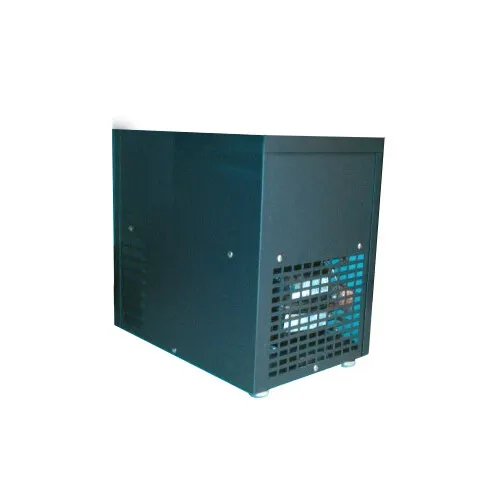
How to Choose the Right Industrial Water Chiller
- Match application, load, and environment: Start with accurate heat load calculations for your specific process.
- Calculate operational costs and the payback period: Consider operational costs and assess the potential payback period for higher-efficiency equipment.
- Consider service and parts availability: Choose manufacturers with established service networks in your region and reasonable parts availability.
- Plan for future expansion: Prefer modular systems that allow capacity additions at lower costs without replacing entire units.
Industrial Water Chillers vs. Other Cooling Solutions
Industrial water chillers differ from other cooling solutions because they are designed for precise, controlled process cooling rather than general heat rejection or space conditioning.
Unlike cooling towers, DX systems, or packaged HVAC units, chillers deliver stable, low-temperature water that can be distributed reliably to critical equipment. When production depends on tight temperature control, concentrated heat loads, or cooling below standard HVAC limits, a dedicated industrial water chiller provides the consistency and reliability that alternative systems cannot match.
Chillers vs. Cooling Towers
Cooling towers are heat rejection devices, not chillers. They cool condenser water through evaporation, but can’t provide the low temperatures or precise control that process cooling requires. Cooling towers complement water-cooled chillers; they don’t replace them.
Chillers vs. Direct Expansion Systems
Direct expansion (DX) systems circulate refrigerant directly to cooling coils at the point of use. Chillers provide centralized, stable cooling that can be distributed wherever needed.
Chillers vs. Packaged HVAC Units
Packaged rooftop units cool air, not water. They’re designed for space cooling with much broader temperature tolerances than process cooling requires.
When is a Dedicated Chiller the Right Choice?
- When you need a consistent water temperature within tight tolerances,
- When you have significant heat loads concentrated in specific equipment,
- When process reliability directly impacts production,
- When you need temperatures below what standard cooling methods provide,
a dedicated industrial water chiller is the right solution.

Industrial Water Chillers FAQs
What temperature do industrial water chillers maintain?
Most industrial water chillers maintain process water between 40°F and 60°F (4.44°C and 15.55°C). With glycol, chillers can achieve temperatures from -20°F to -40°F (-28.88°C to -40°C) for specialized low-temperature processes.
How long do industrial water chillers last?
Industrial water chillers typically last 15 to 25 years with proper maintenance and regular cleaning. Equipment lifespan is affected by maintenance quality, operating hours, and load-cycling frequency.
Are industrial water chillers energy efficient?
Relatively yes. Water-cooled chillers typically operate at 0.5-0.7 kW/ton under good conditions. Air-cooled units run 0.8 to 1.2+ kW per ton, depending on ambient temperature. Variable-speed compressors, advanced controls, and proper sizing improve real-world efficiency compared with older fixed-speed, oversized equipment.
Do industrial chillers require glycol?
For the standard unit, no. But if you need temperatures below 32°F (0°C) or if there’s any risk of freezing during shutdowns, then the chiller system requires glycol.
Conclusion: When an Industrial Water Chiller Is the Right Investment
Choosing the right industrial water chiller is a strategic investment that directly impacts production stability, energy consumption, and long-term operating costs. The most important takeaway is that chillers must be selected based on actual process requirements. Accurate heat-load calculations, proper flow rates, and realistic temperature differentials are essential to ensure reliable performance without oversizing or unnecessary energy waste.
Air-cooled, water-cooled, and evaporative systems differ in terms of installation complexity, water use, efficiency, and climate conditions. Likewise, selecting the appropriate compressor technology, scroll for smaller loads, screw for mid-range applications, or centrifugal for large-scale facilities, ensures the system operates efficiently across both peak and part-load conditions.
Energy efficiency extends beyond nameplate ratings. Metrics such as COP, EER, and especially IPLV provide a more accurate picture of real-world operating costs. At the same time, variable-speed drives, modern controls, and heat-recovery options can significantly reduce lifetime energy costs. Water quality management, filtration, and glycol maintenance are equally critical, as poor water conditions can quickly erode efficiency, reliability, and equipment lifespan.
The total cost of ownership matters more than the upfront price alone. Installation complexity, maintenance requirements, regulatory compliance, service availability, and future expansion capability all influence the long-term value of an industrial chiller system. When precise temperature control, uptime, and process reliability are non-negotiable, an appropriately sized and well-maintained industrial water chiller is not just the right solution, but it’s a necessary one.

