

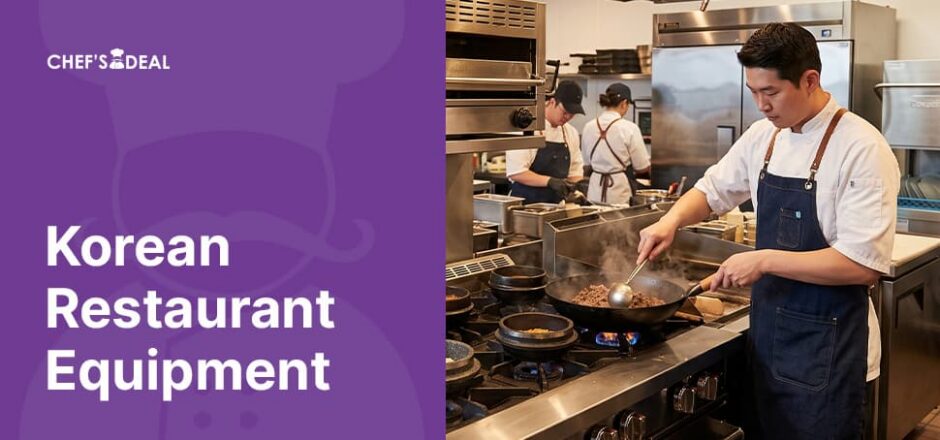
A Korean BBQ buildout runs $125,000 to $425,000 in equipment alone, and the grill table and ventilation system typically account for $75,000 to $250,000 of that before any other kitchen equipment is purchased. Menu format changes this picture significantly: a Korean fried chicken concept runs $40,000 to $150,000 since it skips ventilation infrastructure entirely, and a fast-casual bibimbap restaurant can open for $20,000 to $65,000 for the same reason.
Every format built around tableside grilling adds certification, ventilation, and layout requirements that fried chicken and bibimbap concepts never touch, and verifying a grill’s NSF, UL, or ETL certification against its exact model number is the step most likely to delay or fail a final inspection when skipped.
TL;DR
- Menu type decides your equipment list first. Korean BBQ needs a grill + ventilation; bibimbap needs a rice cooker + stone bowls; fried chicken needs fryers + a breading station. Full BBQ is the only format that requires certified ventilation.
- Ventilation is the single biggest cost driver. Budget $75,000–$250,000 for the grill-table and exhaust system alone in a 30-seat BBQ buildout, more than the rest of the kitchen combined.
- Verify certification before you order, not after. NSF/UL/ETL listings should be checked against the exact model number in NSF’s and UL’s public databases; a mismatch can fail your final inspection.
- Format changes the budget dramatically. A full BBQ buildout runs $150,000–$400,000; Korean fried chicken runs $40,000–$150,000; a fast-casual bibimbap concept can open for $20,000–$65,000 since it skips ventilation entirely.
- No industry benchmark currently ranks Korean BBQ grill brands. FE&S’s Best in Class study hasn’t been published since 2017, and ENERGY STAR sunset its commercial foodservice award in 2025, so certification, service network, and parts availability matter more than brand-name reputation right now.
Equipment Needed by Menu Type
A Korean BBQ concept needs a grill and certified ventilation; a bibimbap restaurant needs neither and spends that budget on rice cookers and stone bowls instead. Identify the concept that matches your menu first, and then review the complete equipment checklist for the remaining supporting equipment.
| Menu Concept | Core Equipment | Note |
| Korean BBQ | Tabletop or freestanding grill, ventilation hood or downdraft system, heat-resistant dining tables | See the Korean BBQ Restaurant Equipment Checklist |
| Bibimbap / Rice-Bowl Concept | Commercial rice cooker, stone bowls (dolsot), rice warmers | See Rice Cookers, Stone Bowls & Traditional Cookware |
| Korean Fried Chicken | Fryers, breading station, oil filtration system | See Essential Equipment for a Korean Fried Chicken Restaurant |
| Soup / Jjigae-Focused | Stock pots, ttukbaegi stone pots | See Rice Cookers, Stone Bowls & Traditional Cookware |
| Full-Service / Multi-Concept | Combination of grill, rice cooker, fryer, and stock pot equipment | Review each section based on the menu items served |
Korean BBQ Restaurant Equipment Checklist
A Korean BBQ kitchen needs seven equipment categories to open: tabletop grills and ventilation, cooking surfaces, tableside tools, banchan serviceware, kitchen prep equipment, refrigeration, and a POS system. Each category expands on the specific units a Korean BBQ kitchen and dining room need to open for service.
- Grills and ventilation: Place tabletop grills for customer-facing tables or freestanding charbroilers for back-of-house cooking, paired with a compliant exhaust system.
- Cooking surfaces: Match grill tops, pan tops, or mesh grates to the cuts of meat and vegetables on the menu.
- Tableside tools: Use heat-resistant tongs, NSF-certified kitchen shears, chopsticks, and spoons for service and banchan.
- Banchan serviceware: Stock multi-compartment dishes, prep tables, and airtight storage containers for Korean side dishes.
- Kitchen prep equipment: Furnish the kitchen with food processors, cutting stations, meat slicers, and marinating containers for bulk meat and vegetable prep.
- Refrigeration: Install reach-in and undercounter refrigerators, walk-in coolers, and freezer storage for marinated meats and banchan ingredients.
- POS system: Select a point-of-sale system that supports tableside ordering, course pacing, and per-table grill-time tracking.
Choosing the Right Commercial Grill: Built-In vs. Freestanding
Built-in tabletop grills put the cooking at the guest’s table; freestanding grills and charbroilers keep it in the kitchen. The choice comes down to whether tableside cooking is part of the concept. Built-in tabletop grills create the traditional Korean BBQ experience by letting guests cook at the table. Freestanding grills and charbroilers support back-of-house production for fast-casual restaurants, food courts, and limited-service concepts.
- Built-in tabletop grills install directly into dining tables and connect to an overhead hood or downdraft ventilation system. They raise the cost per seat but define the Korean BBQ dining experience guests expect.
- Freestanding grills and charbroilers operate under a central Type I exhaust hood in the kitchen. They simplify ventilation design, reduce installation costs, and increase production speed for restaurants that serve grilled meat without tableside cooking.
- The heat source affects both formats. Gas grills provide fast temperature recovery and precise flame control. Electric grills simplify installation. Charcoal grills deliver traditional smoky flavor but require greater ventilation capacity, ash management, and fire-code compliance.
A Quick Tip from Chef’s Deal: Plan your dining room layout before selecting built-in grills. Retrofitting tables and ventilation later costs significantly more than designing the grill system during the initial buildout.
Cooking Surfaces: Grill Top vs. Pan Top vs. Mesh Grate
Grill top, pan top, and mesh grate are the three cooking surfaces used in Korean BBQ, and each one is built for a different cut of meat. Matching the surface to the menu protects the meat’s texture and controls how quickly tables turn during service.
| Cooking Surface | Best For | Main Advantage |
| Grill Top | Large cuts of meat and searing (galbi, bulgogi, thick-cut pork belly) | Provides strong searing and even heat distribution |
| Pan Top | Quick heat transfer for vegetables and small cuts (bean sprouts, kimchi, egg) | Prevents small foods from falling through the grill |
| Mesh Grate | Ribs and thinly sliced meat exposed directly to open flame | Creates faster browning and smoky flavor through direct flame exposure |
A Quick Tip from Chef’s Deal: Keep interchangeable grill tops, pan tops, and mesh grates available if your menu includes different meats and vegetables. Swapping cooking surfaces improves cooking performance without installing additional grills.
Tableside Tools: Tongs, Kitchen Shears & Chopsticks
Tableside tools for Korean BBQ service include heat-resistant stainless tongs, NSF-certified kitchen shears, and chopsticks and spoons for rice. Servers and guests rely on these tools throughout the meal, so tool quality directly affects both food safety and the pace of service.
- Tongs: Dedicated heat-resistant stainless tongs assigned separately for raw meat and cooked meat help prevent cross-contamination at the table.
- Kitchen shears: NSF-certified shears cut meat and remove bones tableside once the meat finishes cooking on the grill.
- Chopsticks and spoons: Stainless or reusable chopsticks and spoons serve banchan and rice throughout the meal.
A Quick Tip from Chef’s Deal: Choose NSF-certified stainless shears and dry them fully before storage to extend the working life of tableside tools that see heavy daily use. Carbon-steel blades rust quickly when they sit wet between services.
Kitchen Equipment Needed for Banchan Preparation
Kitchen equipment needed for banchan preparation includes prep tables, multi-compartment banchan dishes, airtight storage containers, and a food processor for bulk mincing. Banchan service depends on rapid, repeatable prep work behind the scenes, since most Korean restaurants refill several small dishes per table throughout a meal.
- Prep tables: Dedicated stainless-steel prep tables support the daily volume of chopping, portioning, and plating required by banchan service.
- Multi-compartment dishes: Melamine or stainless banchan dishes with 2 to 6 compartments organize small portions for efficient tableside refills.
- Airtight storage containers: Sealed containers prevent strong-smelling items like kimchi and fermented pastes from transferring odor throughout walk-in coolers.
- Food processors: A commercial food processor speeds up bulk mincing of garlic and ginger, a daily task that consumes significant prep-line labor when done by hand.
A Quick Tip from Chef’s Deal: Prep banchan in larger batches before service and store each item in labeled airtight containers. Organized prep stations speed refills and reduce labor during busy meal periods.
Rice Cookers, Stone Bowls & Traditional Cookware
Rice cookers, stone bowls, and traditional cookware round out the equipment list for menus built around bibimbap, jjigae, and soondubu. Commercial-capacity rice cookers, dolsot stone bowls, and ttukbaegi stone pots each serve a specific dish format and require handling equipment that keeps kitchen staff and servers safe.
- Commercial rice cookers: Rice cookers sized for commercial-capacity batches keep rice production consistent through service without requiring constant stovetop attention.
- Dolsot stone bowls: Stone bowls hold and finish bibimbap, crisping the rice against the bowl’s interior surface as the dish reaches the table.
- Ttukbaegi stone pots: Stone pots hold jjigae and soondubu at serving temperature far longer than metal cookware, keeping soups hot throughout the meal.
A Quick Tip from Chef’s Deal: Handle stone cookware with caution: dolsot and ttukbaegi retain extreme heat well after leaving the stove. Heat-resistant mats, gloves, trivets, and serving pads protect staff and guests during tableside service.

Essential Equipment for a Korean Fried Chicken Restaurant
Essential equipment for a Korean fried chicken restaurant includes fryers, a breading station, an oil filtration system, and holding cabinets. Korean fried chicken’s double-fry method and sauce-forward finishing steps demand equipment that a standard American fried chicken kitchen does not always require.
- Fryers: Dual-basket fryers support the double-fry technique that gives Korean fried chicken its characteristic crisp exterior.
- Breading station: A dedicated breading station with separate dry and wet stages keeps coating consistent across high-order volumes.
- Oil filtration system: Built-in or portable oil filtration extends fry oil life and protects flavor consistency across a busy service.
- Holding cabinets: Holding cabinets keep fried chicken crisp and at a safe serving temperature during sauce application and packaging.
A Quick Tip from Chef’s Deal: Separate grilling and frying stations whenever possible. Dedicated cooking zones reduce cross-traffic, improve workflow, and help maintain consistent food quality during busy service.

Commercial vs. At-Home Korean BBQ Equipment
Commercial and at-home Korean BBQ equipment differ in grill type, ventilation, installation, compliance, tool quality, and cost. A home Korean BBQ setup uses portable equipment built for occasional use; a commercial kitchen requires continuous-duty equipment built to code.
| Factor | Commercial Setup | At-Home Setup |
| Grill Type | Continuous-duty tabletop or downdraft grill | Portable butane or electric tabletop grill |
| Ventilation | Type I hood or certified downdraft exhaust system | Residential range hood or other manufacturer-approved household ventilation |
| Installation | Professional installation by a licensed contractor | Plug-in or free-standing setup |
| Compliance | NFPA 96, local fire code, and health department approval | No commercial code requirements |
| Tool Quality | NSF-certified, heat-resistant, continuous-duty tools | Standard consumer-grade tools |
| Cost | Higher upfront investment, built for daily volume | Lower cost, built for occasional use |
A Quick Tip from Chef’s Deal: Avoid mixing residential and commercial equipment in a restaurant. Commercial kitchens require code-compliant appliances, ventilation, and NSF-certified tools that withstand continuous daily operation.
Ventilation & Grill Type Basics
The basic ventilation requirement is that any grill that produces grease-laden vapor needs a compliant exhaust path. This core rule applies to all commercial kitchens, not specific to Korean cuisine. Consult a licensed mechanical contractor and the local Authority Having Jurisdiction (AHJ) to decide whether a downdraft or an overhead hood fits your space.
Do You Need a Ventilation Hood for a Korean BBQ Grill?
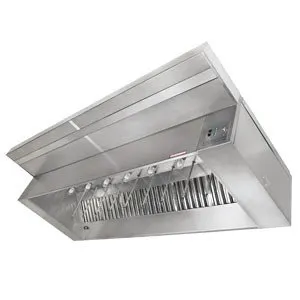
A Korean BBQ grill needs a ventilation hood in nearly every commercial setup, unless the table uses a certified downdraft grill that exhausts smoke and grease vapor through the table itself. Grease-producing cooking equipment falls under NFPA 96 as a Type I application, which generally requires a Type I hood system. Confirm exact requirements with the local fire marshal or AHJ before finalizing equipment orders.
Downdraft vs. Overhead Hood: Which Fits Your Space
Downdraft vs. overhead hood selection depends on ceiling clearance, dining room layout, and whether the space is a new build or a retrofit. Downdraft grills pull smoke and grease vapor down through the table itself; overhead hoods capture rising heat and smoke through ductwork mounted above the cooking surface.
| Factor | Downdraft System | Overhead Hood |
| How It Works | Exhausts smoke and grease down through the grill table into floor or wall ducting | Captures rising heat and smoke through ductwork mounted above the grill |
| Best For | Tighter dining rooms and spaces with limited ceiling clearance | New builds with sufficient ceiling height and duct routing |
| Retrofit Difficulty | Higher; requires floor or subfloor duct routing at each table | Lower in spaces with existing rooftop or exterior duct access |
Choosing Grill Types & Verifying Real Suppliers
Choosing grill types and verifying real suppliers protects a restaurant’s opening timeline and its health and fire inspections. Buyers researching Korean BBQ grills consistently look for a way to confirm that a supplier’s equipment actually carries the certification it claims, since a downdraft grill without a valid NSF or UL listing can delay or fail a final inspection.
How to Verify NSF/UL Certification Before Buying a Korean BBQ Grill
Verifying NSF/UL certification before buying a Korean BBQ grill means checking the manufacturer’s listing directly rather than relying on a certification mark shown in a product photo. NSF International and UL Solutions both maintain free, searchable public databases that confirm whether a specific model actually holds an active certification.
- Search NSF’s Certified Product listings: NSF.org hosts a public database of certified equipment; search by manufacturer or product type to confirm a tabletop or downdraft grill model appears as an active listing.
- Search UL Product iQ: UL Solutions’ Product iQ database lets buyers search by company name, model number, or category code (CCN) to confirm UL or ETL certification status.
- Match the listing to the exact model: Confirm the certified model number matches the exact grill configuration you are purchasing; manufacturers sometimes sell both certified and uncertified variants of a similar-looking unit.
- Ask for documentation in writing: Request a copy of the certification listing or file number from the supplier before placing a deposit on a custom or made-to-order grill table.
Commercial Korean BBQ Grill Suppliers Comparison
Commercial Korean BBQ grill suppliers vary in capacity, certification scope, warranty terms, lead time, and bulk-order minimums. Compare all 5 factors, not just price. Request these from any Korean BBQ grill manufacturer or table-system supplier before committing to an order.
| Comparison Factor | What to Request From the Supplier |
| Capacity | Confirmed BTU or wattage output per burner and per table configuration |
| Certification | Active NSF, UL, or ETL listing verified against the exact model number |
| Warranty Terms | Written coverage period for parts, labor, and the downdraft blower motor |
| Lead Time | Confirmed production and freight timeline in writing, especially for custom table builds |
| Bulk-Order Minimums | Minimum order quantity and pricing tiers for multi-table or multi-location openings |
Some manufacturers that build certified downdraft or ventilated tabletop grill systems for Korean BBQ service include RoasterTech, Samsung BBQ Grills, and JC Enterprises.
| Supplier | Certification | Warranty | Published Pricing |
| RoasterTech (Roaster Tech Inc., Los Angeles, CA) | States it built the first UL-certified downdraft BBQ table in the US | Not published on-site; confirm directly with the manufacturer | 4-seat table: $4,150; 6-seat table: $4,350; 8-seat table (2 units): $8,300 (complete unit price; excludes duct, fire system, exhaust fan, shipping, and installation) |
| Samsung BBQ Grills (J&S Proline, Inc., Los Angeles, CA) | States its grill systems carry NSF/UL certification | 1 year on roasters and grills | Not published; quote-based |
| JC Enterprises (Gardena, CA) | Hoods carry UL Type I certification; grills carry Intertek ETL certification | 12 months on parts and workmanship, subject to proper installation and code-compliant use | Full hood and grill systems are quote-based |
This is not an exhaustive list of every Korean BBQ grill manufacturer; it profiles suppliers whose certification and warranty claims could be independently confirmed on their own websites. Re-verify certification status against the exact model number using the NSF and UL Product iQ steps covered above.
Other Korean BBQ Equipment Manufacturers Worth Knowing
CENHOT, HPOTT, Shinpo, and Saycook show up regularly in Korean BBQ equipment sourcing. Their scope, origin, and certification status vary, so verify each independently before ordering.
- CENHOT manufactures in China and sells a broad catalog of hot pot and Korean BBQ equipment: gas, electric, and charcoal Korean BBQ grills, smokeless purification systems, and custom tables.
- HPOTT also manufactures in China and has built Korean BBQ, Japanese BBQ, and hot pot tables, with heavy customization on tabletop material, color, and built-in smokeless purification.
- Shinpo Co., Ltd. is a Japanese manufacturer that engineers smokeless roasters for Korean BBQ tabletop service, and the company maintains a documented US service network.
- Saycook manufactures gas up-draft and down-draft Korean BBQ roasters sold through Los Angeles-based Korean BBQ equipment suppliers, alongside compatible table stands and retractable exhaust hood accessories.
Cost Comparison of Different Grill Types
Cost comparison of different grill types shows meaningful differences in unit cost, installation cost, and operating cost across gas, charcoal, and electric Korean BBQ grills. Gas grills generally fall in the middle of the range, charcoal setups add ventilation and fuel-handling costs, and electric grills usually carry the lowest installation cost where gas service is unavailable.
| Grill Type | Relative Unit Cost | Installation Cost | Operating Cost |
| Gas | Moderate | Requires a certified gas line connection and hood or downdraft tie-in | Moderate; scales with burner run time |
| Charcoal | Moderate to high | Highest; typically needs additional ventilation capacity for solid-fuel cooking | Higher; recurring charcoal purchase and more frequent grease-duct cleaning |
| Electric | Lower to moderate | Lowest in kitchens with adequate electrical service and no gas line required | Lower to moderate; depends on local electricity rates |
Note: These are general planning ranges rather than fixed prices, since grill-table cost depends heavily on table size, seating capacity, and custom configuration. Request a formal quote from the supplier for an exact figure before budgeting a specific dollar amount.
Recommended Equipment Brands by Category
Brand recommendations by category help operators shortcut the research process across grills, ventilation, rice cookers, prep equipment, and refrigeration. This table combines Foodservice Equipment & Supplies (FE&S) magazine’s last published “Best in Class” results (2017) with brands that recur across multiple independent buying guides and testing outlets published in 2025 and 2026.
| Equipment Category | Recommended Brands | Why |
| Grills & Ventilation | Vulcan, CaptiveAire, Halton, Accurex | Vulcan and CaptiveAire led FE&S’s 2017 Charbroilers and Ventilation Systems categories; CaptiveAire, Halton, and Accurex recur across current independent ventilation buying guides. |
| Prep Equipment | Robot Coupe, Hobart, Vollrath, Waring | Robot Coupe, Vollrath, and Hobart led FE&S’s 2017 processor, chopper, and mixer categories; all 4 brands recur across current independent food-processor buying guides. |
| Commercial Rice Cookers | Cuckoo, Zojirushi, Town Food Service | No FE&S or industry ranking exists for this category; Zojirushi tops America’s Test Kitchen’s independent testing; Cuckoo and Town’s Rice Master recur in commercial buying guides for high-volume Asian restaurant use. |
| Refrigeration | True Manufacturing, Traulsen, Hoshizaki, Thermo-Kool | True and Thermo-Kool led FE&S’s 2017 refrigeration categories; True, Traulsen; Hoshizaki repeatedly appears in current independent commercial refrigeration buying guides. |
Treat these recommendations as a starting shortlist and confirm certification, warranty terms, and service availability directly with each manufacturer before purchasing. Chef’s Deal carries equipment from 400-plus manufacturers. Know what to evaluate in each category rather than looking for a single winner, since brand strength varies by exact model and region.
Which Korean BBQ Grill & Ventilation Brands are Actually Reliable?
No current, well-known industry benchmark ranks grill or ventilation brands for the Korean BBQ category.
- FE&S’s Best in Class Study, the longest-running reliability survey in commercial foodservice equipment, last published results in 2017 and hasn’t resumed since.
- The EPA’s ENERGY STAR Partner of the Year award, another benchmark some manufacturers cite, was also sunset for commercial foodservice equipment starting in 2025.
Prioritize NSF, UL, or ETL certification, manufacturer support, installation quality, replacement-part availability, and service coverage when comparing grill and ventilation manufacturers.
| Evaluation Factor | What to Check Before Buying |
| Certification | Verify applicable NSF, UL, or ETL listings for the specific equipment model |
| Ventilation Compatibility | Confirm that the grill and exhaust system work together as specified by the manufacturer |
| Installation Support | Check whether the manufacturer provides layout guidance, technical documentation, and startup support. |
| Parts Availability | Confirm access to replacement burners, heating elements, filters, controls, and other wear parts |
| Service Network | Identify qualified technicians in the restaurant’s geographic area before purchase. |
| Operator References | Ask comparable Korean BBQ restaurants about long-term performance and service experience. |
Korean BBQ grill reliability also depends heavily on installation. A properly specified downdraft system with correct duct routing, makeup air, grease management, and regular maintenance often performs better than a higher-priced system with poor installation or inadequate service support.
A Quick Tip from Chef’s Deal: Cross-reference any brand against its NSF/UL/ETL listing until an independent study specifically covers Korean BBQ downdraft grills. Request references from at least two Korean BBQ operators, and confirm parts and service availability directly with the manufacturer before purchasing.
Startup Costs, Budgeting & Financing
Startup costs, budgeting, and financing for a Korean restaurant cover 3 questions: the full equipment buildout cost, how a fried-chicken format differs, and how to finance the grill and ventilation system, the largest capital item unique to this concept.
Cost Breakdown for Opening a Korean Restaurant
Cost breakdown for opening a Korean restaurant separates into equipment line items. The grill and ventilation system carries the highest weight. A reasonable planning range for a mid-size, full-tableside-grill concept is roughly $125,000 to $425,000 in equipment costs; the grill-table and ventilation system alone commonly account for $75,000 to $250,000 of that total.
This range covers kitchen and dining room equipment only; it excludes leasehold improvements, construction, permitting, rent deposits, and working capital, which add substantially more to a full buildout budget.
| Line Item | Typical Range | Note |
| Grill Tables & Ventilation (Downdraft or Hood)* | $75,000 – $250,000+ | Scales directly with grill-table count; includes table units, hood or downdraft duct, fire suppression, exhaust fan, and installation |
| Cooking Equipment (Ranges, Fryers, Rice Cookers) | $15,000 – $40,000 | Depends on menu breadth beyond tableside grilling |
| Refrigeration (Reach-Ins, Walk-Ins, Freezers) | $15,000 – $60,000 | Marinated-meat storage volume runs higher than in most cuisines |
| Banchan Serviceware & Tableside Tools | $3,000 – $10,000 | Recurring replacement cost due to daily wear |
| Furniture (Heat-Resistant Seating & Additional Tables) | $15,000 – $50,000 | Grill-table structure is priced under Grill Tables & Ventilation above; this line covers chairs, stools, and any non-grill tables |
| POS System | $2,000 – $15,000 | Higher-tier systems support per-table grill-time and course tracking |
*Most manufacturers offer a custom quote for grill table installation rather than a fixed published price; confirm hood, duct, fire-suppression, and labor costs directly with the manufacturer or installer before finalizing a budget.
Average Startup Costs for a Korean Fried Chicken Restaurant
Average startup costs for a Korean fried chicken restaurant run between $40,000 and $150,000. This range is lower than a full Korean BBQ buildout because the format skips grill-table ventilation infrastructure. A fried-chicken-focused concept concentrates capital in fryers, breading stations, oil filtration, and holding cabinets rather than per-table exhaust systems, the biggest cost driver for a Korean BBQ concept.
Published franchise figures show the full buildout picture (construction, equipment, inventory, and opening costs combined, not equipment alone): SFC Seoul Fried Chicken, a US-founded Korean-style chain, reports $150,000 to $420,000 for a 900- to 2,400-sq-ft (83.612 m2 to 222.967 m2) format. C chicken concept’s all-inclusive cost is almost the same as a Korean BBQ restaurant’s equipment-only investment.
Financing Options for Korean BBQ Grill & Ventilation Equipment
Financing options for Korean BBQ grill and ventilation equipment include equipment leasing, Small Business Administration (SBA) loans, and vendor financing. These options matter most for the grill-table and hood system because it represents the largest single capital outlay in the buildout.
- Equipment leasing spreads the grill-table and ventilation system’s cost across monthly payments rather than one upfront purchase, preserving cash for the rest of the buildout.
- SBA loans offer longer repayment terms suited to major infrastructure investments like a ventilation system.
- Vendor financing, such as terms up to 84 months through Chef’s Deal, lets operators equip grill tables, ventilation, and the rest of the kitchen without exhausting opening-day capital reserves.
Equipment Packages by Restaurant Concept & Size
Equipment packages vary by restaurant concept and seat count. The 3 packages below outline equipment categories and general price bands for common Korean restaurant formats. Treat each as a directional planning checklist and confirm exact SKUs and pricing with a Chef’s Deal equipment specialist before finalizing an order.
Equipment Package for a 30-Seat Korean BBQ Restaurant
An equipment package for a 30-seat Korean BBQ restaurant typically runs $150,000 to $400,000 in total equipment cost. This format sits at the higher end of Korean restaurant startup budgets because grill-table ventilation infrastructure scales directly with seat count.
- Grills: Built-in or freestanding grills sized to cover 30 seats anchor the package and drive most of its cost.
- Ventilation: A downdraft or overhead ventilation system matches the grill configuration and represents the single largest line item.
- Tables and seating: Heat-resistant tables and seating are built around the grill placement and required clearance.
- Cooking surfaces: Grill tops, pan tops, or mesh grates should match the menu’s cuts of meat and vegetables.
- Tableside tools: Tongs, shears, and chopsticks are sized for full seating turnover across the dining room.
- Banchan serviceware: Prep equipment and serviceware support consistent side-dish service throughout the meal.
- Refrigeration: Reach-in and walk-in units are necessary for marinated-meat and banchan ingredient storage.
- POS system: A point-of-sale system supports tableside ordering and course pacing.
Equipment Package for a Korean Fried Chicken Restaurant
An equipment package for a Korean fried chicken restaurant typically runs $40,000 to $150,000 in total equipment cost, well below the Korean BBQ package.
- Fryers: Dual-basket fryers handle double-fry service volumes during peak hours.
- Breading station: A dedicated breading station keeps dry and wet stages separate for consistent coating.
- Oil filtration: A filtration system extends fry oil life across a busy service.
- Holding cabinets: Holding cabinets keep fried chicken crisp during sauce application and packaging.
- Prep tables: Prep tables support sauce preparation and order packaging.
- Refrigeration: Refrigeration stores raw chicken and sauce ingredients at safe temperatures.
- POS system: A point-of-sale system is built for high-volume counter or delivery-forward service.
Equipment Package for a Fast-Casual Bibimbap Restaurant
An equipment package for a fast-casual bibimbap restaurant typically runs $20,000 to $65,000 in total equipment cost. This package represents the lowest-capex entry point among the 3 formats, since it requires no grill or ventilation upgrade. This range is a directional estimate built from the category costs, not a published industry figure.
- Rice cookers: Commercial-capacity rice cookers are sized for daily rice volume across the menu.
- Stone bowls: Dolsot stone bowls and heat-safe handling mats support tableside bibimbap service.
- Prep equipment: Prep equipment handles vegetables, proteins, and sauces for daily assembly.
- Banchan serviceware: Serviceware supports consistent side-dish service across the counter.
- Refrigeration: Smaller-footprint refrigeration suits a counter-service layout without a full walk-in.
- POS system: A point-of-sale system is built for fast-casual order flow.
New vs. Used Equipment: What’s Actually Worth Buying Used
New vs. used equipment decisions for a Korean BBQ buildout hinge on warranty and certification risk versus upfront savings, particularly on the grill and downdraft system. A used prep table or refrigeration unit carries relatively low risk; a used downdraft grill carries meaningfully higher risk if its certification status or gas components can’t be verified.
Pros and Cons of New vs. Used Korean BBQ Equipment
Pros and cons of new vs. used Korean BBQ equipment center on warranty coverage, certification confidence, and total cost. New equipment carries a full manufacturer warranty and a verifiable NSF/UL listing; used equipment saves money upfront but shifts inspection and certification risk onto the buyer.
| Equipment Type | Pros | Cons |
| New | Full manufacturer warranty, verifiable and current NSF/UL certification, and predictable maintenance costs in the early years of operation. | Higher upfront capital requirement, particularly on grill tables and downdraft ventilation systems. |
| Used | Lower upfront cost, which helps new operators preserve capital for buildout and opening expenses. | Uncertain remaining lifespan on downdraft blower motors and gas components, and certification tags that may no longer match current code if the unit was modified or relocated. |
A Quick Tip from Chef’s Deal: Have a qualified technician inspect the grill, blower motor, gas or electrical components, and ventilation system before buying used Korean BBQ equipment. Verify that the equipment’s certification and installation can meet current local code requirements before committing to the purchase.
Used Korean BBQ Grill Options: What to Inspect
Used Korean BBQ grill options require a specific inspection checklist before purchase, since a downdraft system hides most of its wear inside gas lines and blower components. Inspect these 4 areas before buying any used grill table:
- Burner condition: Check burners for even flame distribution and signs of corrosion or clogging that reduce heat output.
- Downdraft fan function: Run the downdraft fan and confirm it pulls smoke and grease vapor consistently without excessive noise or vibration.
- Gas valve certification tags: Confirm gas valves and control components still carry legible certification tags, since removed or illegible tags can fail a final inspection.
- Hood compatibility: Verify that a used grill table’s exhaust connection matches the ventilation system already installed or planned for the space.
Where to Buy Commercial Korean Kitchen Equipment Online
Operators can buy commercial Korean kitchen equipment online through 3 reliable channels: manufacturer-direct ordering, authorized dealers such as Chef’s Deal, and reputable used-equipment marketplaces. Confirm the seller’s return policy, request the NSF/UL certification documentation, and verify freight and lead-time commitments in writing before ordering any Korean BBQ grill or banchan serviceware sight-unseen.
Korean BBQ Table & Floor Layout Essentials
Korean BBQ table and floor layout essentials focus on table spacing for grill clearance & ventilation coverage, and small-footprint grill placement. The right layout balances guest safety, effective exhaust coverage, and efficient use of limited dining and service space.
Table Spacing & Ventilation Coverage for Grill Seating
Table spacing and ventilation coverage for grill seating determine both guest comfort and fire-code compliance. Each grill table needs enough clearance from neighboring tables to keep smoke, heat, and open flame away from adjacent diners; each hood or downdraft point needs coverage sized to the grill beneath it, not just the table’s footprint.
- Clearance between grill tables: Maintain generous aisle and table spacing around every grill-equipped table to support server movement and guest safety around an active heat source.
- Hood or downdraft coverage per table: Size each exhaust point to the grill surface itself, confirmed against the manufacturer’s specification, not estimated from the table’s outer dimensions.
- Furniture material: Use heat-resistant table surfaces and finishes near the grill to prevent scorching and to meet fire-code material requirements in some jurisdictions.
A Quick Tip from Chef’s Deal: Confirm exact table spacing and clearance requirements with the local fire marshal or building department, since minimum distances vary by jurisdiction and by whether the grill uses gas, charcoal, or electric heat.
Fitting Grill Tables into a Small Footprint (10–30 Seats)
Fitting grill tables into a small footprint of 10 to 30 seats requires compact downdraft grill options, efficient table configurations, and vertical storage for banchan serviceware. A tight floor plan can make large overhead hood runs more difficult to accommodate, which pushes smaller Korean BBQ concepts toward compact, table-integrated downdraft systems.
- Compact downdraft grills: Table-integrated downdraft units avoid the ceiling clearance and duct routing that a large overhead hood requires.
- Table configuration: Mix 2-top and 4-top grill tables to balance seating flexibility against the fixed footprint each grill table occupies.
- Vertical storage: Wall-mounted or vertical shelving for banchan dishes and serviceware conserves floor space in a small kitchen without slowing tableside refill speed.
A Quick Tip from Chef’s Deal: Plan the grill table layout around your ventilation and service paths first, then use 2-top and 4-top tables to maximize seating flexibility without overcrowding the dining area.
Scaling Korean BBQ Equipment Across Multiple Locations
Scaling Korean BBQ equipment across multiple locations depends on standardizing the BBQ system across every site, then evaluating the return that grill-table investment actually produces. Standardized equipment simplifies purchasing, training, maintenance, and service. ROI analysis helps operators determine whether the added investment is justified.
Standardizing Grill, Hood & Banchan Equipment Across Sites
Standardizing grill, hood, and banchan equipment across sites simplifies parts sourcing, staff training, and repair response time as a Korean BBQ concept opens additional locations.
- Single-vendor sourcing: Standardizing on one grill and ventilation manufacturer across locations simplifies warranty tracking and parts ordering.
- Spec-sheet consistency: Matching grill and hood specifications across sites shortens staff training time when employees transfer between locations.
- Volume discounts: Multi-location operators can negotiate volume pricing on grill tables and banchan serviceware when ordering across several openings at once.
- Staged delivery: Coordinating staged delivery across multiple openings keeps lead times predictable when scaling a bulk grill-table order.
ROI Analysis: What Korean BBQ Grill Investments Actually Return
ROI analysis for Korean BBQ grill investments centers on cost-per-cover economics and table-turn speed, since a grill table changes both the cost and the pace of a dining room. The framework below uses illustrative figures to show how the calculation works; actual return depends on menu pricing, table count, and local labor & utility costs.
- Cost per cover: Divide total grill-table and ventilation investment by the number of covers served monthly to estimate the equipment cost embedded in each guest check.
- Table turns per night: A grill table often seats guests for a longer average visit than a standard table, since cooking happens tableside; weigh that slower turn rate against the higher average check a Korean BBQ meal typically commands.
- 5-year maintenance vs. throughput gain: Compare the grill and ventilation system’s 5-year maintenance cost, covered in the maintenance section, against the additional covers and check average the grill format supports over the same period.
Example: A 30-seat Korean BBQ buildout with a grill-table and ventilation investment of $120,000 serves 3,000 covers per month. The restaurant generates roughly $6,750 in monthly profit at an illustrative average check of $45 and a 5% net profit margin (a commonly cited full-service restaurant benchmark). It recovers the $120,000 equipment investment in approximately 18 months at that pace.
Treat this as an illustrative framework rather than a guaranteed return, since actual ROI depends on menu pricing, table turns, sales volume, labor, utilities, maintenance, and local operating costs.
Converting an Existing Restaurant into Korean BBQ
Converting an existing restaurant into Korean BBQ concentrates on the infrastructure decisions unique to this concept: ventilation capacity, gas or electrical service to each table, and floor plan retrofit.
How to Convert an Existing Restaurant to Korean BBQ
Converting an existing restaurant to Korean BBQ follows a specific sequence: assess existing ventilation capacity, confirm gas or electrical line and panel capacity for grill tables, retrofit the dining room layout, and secure updated permitting before service begins.
- Assess ventilation capacity: Confirm whether the existing hood system can support grill-table exhaust loads, or whether the space needs new downdraft infrastructure; see Ventilation & Grill Type Basics above for the underlying requirements.
- Confirm gas/electrical line and panel capacity: Verify that the existing gas line or electrical panel can support the additional draw from multiple grill tables before ordering equipment.
- Retrofit layout: Reconfigure the dining room around new table spacing and exhaust coverage requirements rather than keeping the previous floor plan.
- Update permitting: Secure updated building, fire, and health department permits before installation, since adding grill tables and ventilation infrastructure typically requires new sign-off even in a previously permitted dining room.
Common Challenges & Cost-Effective Remodel Priorities
Common challenges in a Korean BBQ conversion include ventilation retrofit cost and existing floor plan constraints, the 2 biggest obstacles when converting an existing space. A phased remodel approach that prioritizes grill and hood infrastructure first keeps the conversion budget focused on the systems that gate the restaurant’s ability to open at all.
- Ventilation retrofit cost: Adding hood or downdraft capacity to a space that wasn’t built for grease-producing cooking equipment is the single largest conversion expense.
- Floor plan constraints: Existing table layouts, structural columns, and ceiling height rarely align with the clearance a grill-table dining room requires, forcing a full layout redesign in many conversions.
- Phased remodel priority: Prioritize grill and hood infrastructure first, since permitting and installation lead times on ventilation systems run longer than furniture or serviceware orders.
Korean BBQ Grill Maintenance & Troubleshooting
Korean BBQ grill maintenance and troubleshooting consist of 4 structured processes: a preventive maintenance schedule, downdraft cleaning steps, common troubleshooting scenarios, and a parts-replacement guide specific to Korean BBQ grill and ventilation equipment.
Maintenance Schedule for Korean BBQ Grills & Ventilation
A maintenance schedule for Korean BBQ grills and ventilation follows a daily, weekly, monthly, and quarterly cadence, framed as a preventive plan rather than a reactive one. Always use the manufacturer’s maintenance schedule as the primary reference, then adapt the frequency to operating hours, cooking volume, and local code requirements.
| Frequency | Task |
| Daily | Wipe down grill surfaces, empty grease trays, and visually check burner flame consistency |
| Weekly | Deep-clean grill tops, pan tops, and mesh grates; inspect downdraft intake for grease buildup |
| Monthly | Inspect and clean downdraft fan components; check gas connections and electrical wiring for wear |
| Quarterly | Schedule professional inspection of the full exhaust system and grease-duct cleaning per the applicable NFPA 96 schedule |
A Quick Tip from Chef’s Deal: Stay ahead of this schedule to optimize grill performance during high-volume service, since a grease-clogged downdraft intake or an uneven burner flame both slow cook times and shorten the equipment’s usable life.
How to Clean a Built-In Downdraft Grill
Cleaning a built-in downdraft grill follows a specific sequence, since grease and food residue collect both on the visible cooking surface and inside the downdraft intake beneath it.
- Power down and allow the grill to cool completely before beginning any cleaning step.
- Remove and clean the cooking surface (grill top, pan top, or mesh grate) with a degreasing solution rated safe for stainless steel and food-contact surfaces.
- Clear the downdraft intake grate of food debris and grease buildup, since blocked intakes reduce exhaust performance immediately.
- Empty and clean the grease collection tray beneath the downdraft intake.
- Wipe down the surrounding table surface and reassemble the unit before service resumes.
A Quick Tip from Chef’s Deal: Use only cleaning solutions rated safe for both stainless steel and grease-trap components; harsh solvents not rated for food-contact surfaces can damage the grill’s finish and void the manufacturer’s warranty.
Troubleshooting Korean BBQ Grill Issues & Mid-Service Breakdowns
Troubleshooting Korean BBQ grill issues starts with identifying the cause behind the 4 most common problems: ignition failure, uneven heat, downdraft fan noise, and gas smell.
- Ignition failure: Check the igniter and gas supply connection first; a worn igniter is the most common cause and is typically an inexpensive, fast replacement.
- Uneven heat: Inspect burner ports for clogging or corrosion, since uneven flame distribution across the cooking surface usually traces back to a partially blocked burner.
- Downdraft fan noise: Unusual fan noise typically signals debris buildup or a worn fan bearing; shut the unit down and inspect before continuing service.
- Gas smell: Treat any gas smell as an immediate safety issue. Shut off the gas supply, evacuate the area if the smell is strong, and contact a licensed technician before resuming use.
A Quick Tip from Chef’s Deal: Follow these steps if a grill or hood fails mid-service: Move affected tables to available seating, shut down the malfunctioning unit safely, and keep a backup service plan, such as a reduced kitchen-cooked menu, ready so the dining room can continue serving guests while repairs are arranged.
Korean BBQ Grill Parts: Replacement Guide & Where to Source Them
Korean BBQ grill parts that most often need replacement include igniters, burners, downdraft fans, and grates. Identify the right part using the model number on the unit’s certification tag. Matching the exact model number prevents ordering an incompatible part, particularly on downdraft fan assemblies, which vary by manufacturer.
- Igniters: Daily ignition cycles make igniters one of the most frequently replaced parts; they are typically a fast, low-cost replacement.
- Burners: Burners with persistent corrosion or clogging that cleaning no longer resolves need replacement.
- Downdraft fans: Fan motor and blade replacement addresses persistent noise or reduced exhaust performance that cleaning does not fix.
- Grates: Grill tops, pan tops, and mesh grates wear out from direct heat exposure and need periodic replacement to maintain even cooking.
A Quick Tip from Chef’s Deal: Evaluate the pros and cons of OEM and third-party replacement parts. OEM parts carry the strongest fit and certification confidence but often have longer lead times; third-party parts can shorten lead time and lower cost but require careful verification against the exact model number before ordering.
Korean Restaurant Equipment FAQs
What permits do I need for a Korean restaurant?
A Korean restaurant typically needs a health department permit, a building and fire permit, a hood or ventilation permit if the kitchen uses grease-producing equipment, and a liquor license if the concept serves alcohol.
What are the must-have banchan items for a Korean restaurant menu?
Most Korean restaurant menus include kimchi, seasoned bean sprouts (kongnamul), spinach namul, pickled radish (danmuji), and a potato or fish cake side as core banchan staples.
Do I need restaurant insurance specifically for Korean BBQ service?
Yes, you need specific insurance for Korean BBQ service, though there isn’t a separate policy planned exclusively as Korean BBQ insurance. Open-flame or high-heat tableside cooking raises liability considerations beyond standard restaurant coverage; confirm with an insurance provider that the policy accounts for tableside grill risk.
Do Korean BBQ restaurants always need a ventilation hood?
Yes, unless the restaurant uses a certified downdraft grill system at each table.
Can I use an outdoor gas grill inside my restaurant?
No. Outdoor-rated grills aren’t built or certified for indoor use and pose a carbon monoxide risk in an enclosed dining room.
Can I use butane burners in a commercial kitchen?
Butane burners are portable, but they burn through fuel quickly and aren’t ideal for sustained, high-volume commercial service. Confirm with the local fire marshal or AHJ before using butane equipment indoors.
Conclusion
A Korean BBQ restaurant equipment checklist covers far more ground than a standard restaurant buildout. Tableside grilling adds ventilation, certification, and layout requirements that most cuisines never touch. A well-planned equipment package balances safety, workflow, reliability, and long-term operating costs rather than simply choosing the most expensive equipment available.
- Choose the grill and ventilation system first: Determine the grill format and exhaust configuration before finalizing the dining room layout, utility requirements, installation plan, and permitting.
- Build the equipment package around the menu: Select cooking surfaces, tableside tools, banchan prep equipment, rice production, refrigeration, and POS capabilities based on the dishes and service model.
- Standardize equipment when expanding: Use consistent specifications, parts, and service networks across multiple locations to simplify training, purchasing, maintenance, and repairs.
- Verify equipment before purchasing: Confirm certification, installation requirements, warranty coverage, parts availability, service support, and local code compliance before placing an order.
- Evaluate new and used equipment carefully: Save money on suitable used equipment where inspection risk is manageable, but apply greater scrutiny to grill tables, downdraft systems, and other critical infrastructure.
- Plan for long-term operating costs: Compare maintenance, service, utilities, replacement parts, and expected equipment life alongside the initial purchase price when building the budget.

