

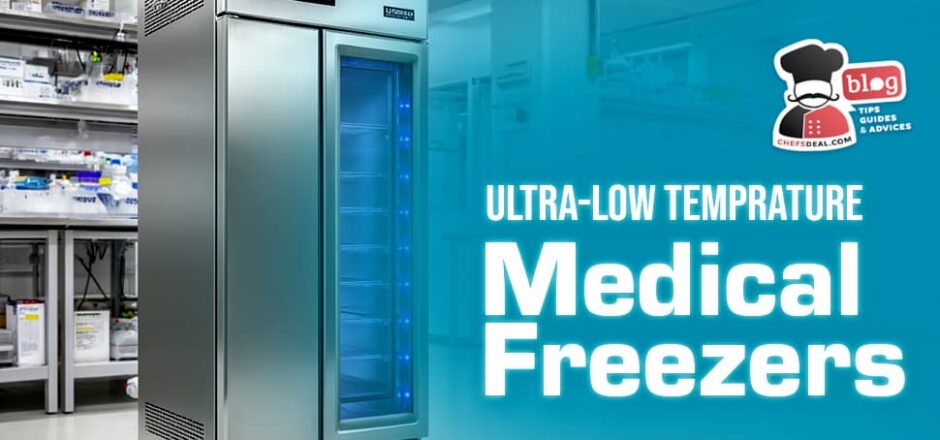
Ultra-low-temperature medical freezers store critical biological materials, samples, vaccines, medicines, and reagents that require very low temperatures down to -123°F (-86°C) and the utmost temperature consistency. An unexpected variation can damage vaccine effectiveness, spoil specimens, make expensive pharmaceuticals ineffective, or even destroy people’s dreams. This is where ultra-low temperature medical freezers become vital for laboratories, hospitals, and research facilities.
What is an Ultra-Low Temperature Medical Freezer?
Ultra-low-temperature medical freezers (ULT freezers or deep freezers) are specialized commercial refrigeration units designed to maintain extremely cold temperatures, typically ranging from -40°F to -123°F (-40°C to -86°C).
They feature special refrigeration systems with cascade compressors, which gradually reduce temperature through repeated cycles and multi-layer insulated chambers. Ultra-low medical freezers feature enhanced insulation systems to ensure maximum chill preservation and maintenance. Advanced alarm systems, data loggers, and power backup systems also provide secure storage.
What is Stored in an Ultra-Low Temperature Freezer?
ULT freezers are used to store valuable temperature-sensitive materials in modern medicine and research:
- Biological Samples: Plasma, RNA, DNA, tissue samples, and biopsy specimens can be stored at -20°C for short-term applications but require 80°C storage conditions for long-term safety up to 5 years, as explained in the PMC’s article titled “The procurement, storage, and quality assurance of frozen blood and tissue biospecimens in pathology, biorepository, and biobank settings”.
- mRNA Vaccines: These vaccines, including COVID-19 vaccines, require -130°F and -76°F (-90°C and -60°C) for safe storage until the expiration date, as shown by the CDC.
- Long-term Storage of Reagents and Enzymes: These labile research materials can be stored at temperatures ranging from -4 to -112°F (-20 to -80 °C) to ensure long-term stability, as explained by Apollo Scientific Co.
- Experimental Drugs and Trial-stage Biologics: Pharmaceuticals require stable, low-temperature conditions to prevent degradation and loss of activity. Hence, they need to be stored -4 to -112°F (-20 to -80 °C) according to the article by Christos Kypraiou and Theodoros Varzakas.
- Cell Lines and Microbial Cultures: Living specimens and biologic cultures provide higher protein extraction for ongoing research projects, as stated in “Novel perspective on a conventional technique: Impact of ultra-low temperature on bacterial viability and protein extraction”.

Who Needs a ULT Medical Freezer?
Biomedical and genetic labs, pharmaceutical producers, and hospitals, as well as the vaccine distributors and the IVF clinics, rely on ultra-low temperature storage for their daily operations:
- Biomedical Research Laboratories: Universities and private research facilities with biomedical research labs that study genetics, immunology, and drug development use ULT medical freezers.
- Biobanks and Genetic Repositories: Facilities that store extensive collections of biological specimens for future research or medical applications and treatments require ultra-low medical freezers for the safe storage of valuable specimens.
- Pharmaceutical Manufacturers: Pharma companies use ULT freezers to preserve the medicines, vaccines, and drugs developed, tested, and stored at temperature-sensitive conditions.
- Hospitals with Oncology/Transplant Departments: Hospitals and medical centers need ULT medical freezers for cancer treatments and organ preservation.
- Vaccine Distribution Facilities: Cold chain logistics centers require ULT freezers for transport, storage, and management of vaccine inventory.
- IVF & Fertility Clinics: Reproductive health centers store embryos, sperm, and egg samples in the ULT freezers until they are used for the treatment.
Key Features of Ultra-Low Temperature Freezers
Modern ULT freezers come equipped with sophisticated features designed for reliability and user convenience:
- Temperature Range: Ultra-low temperature freezers typically operate between -40 °C and -122.8°F (-40°C and -86°C), with a ±1.8°F (±1 °C) accuracy range.
- Cascade Compressor Systems: To ensure rapid cooling (-112°F/-80°C in under 5 hours) and efficient performance (up to 33% less energy consumption), ULT freezers feature cascade compressor systems with enhanced lubrication.
- Microprocessor Digital Controls: These medical freezers feature precise temperature management, microprocessor controls, digital temperature displays, setpoint security, and performance monitoring systems.
- High-density Insulation: Multi-layer foam and vacuum panels minimize energy loss while increasing energy efficiency.
- Alarm Systems and Data Logging: Visual and audible alarms to notify the operator of unexpected problems, and continuous temperature recording for later reference and control.
- Remote Monitoring via IoT or Wi-Fi: Real-time status updates and alerts sent to mobile devices and remote computers.
- Battery Backup or CO₂/LN₂ Emergency Systems: Temporary power solutions to maintain safe conditions during outages.
- Interior Configurations: Stainless-steel interior construction, adjustable shelving, drawer systems, and sample organization solutions to maximize energy efficiency and storage.

Types of ULT Freezers: Upright vs. Chest
There are primarily two types of ULT freezers: upright and chest freezers, each offering varying benefits and capacities.
| Feature | Upright ULT Freezers | Chest ULT Freezers |
| Floor Space | Compact footprint, fits against walls | Requires more floor space |
| Sample Access | Easy front-loading with drawer systems | Top-loading, requires reaching into unit |
| Organization | Better sample organization with shelves/drawers | Limited organization options |
| Energy Efficiency | Higher energy consumption due to door opening | More energy-efficient, cold air retention |
| Sample Capacity | Lower capacity per cubic foot | Higher storage density |
| Temperature Recovery | Slower temperature recovery after opening | Faster temperature recovery |
| Price Range | Generally more expensive | Typically less expensive |
| Best For | Frequent access, organized storage needs | Long-term storage, maximum capacity |
Compliance and Storage Standards of Ultra-Low Temperature Medical Freezers
ULT medical freezers are used in medical and research laboratories that need to meet stringent regulatory requirements for safely handling vaccines, pharmaceuticals, biological samples, or clinical samples.
WHO PQS Standards for Ultra-low Vaccine Storage
WHO PQS standards define the requirements for ultra-low freezers used for vaccine storage, including temperature uniformity, energy supply, cool-down time, corrosion resistance, electrical safety, markings, alarm systems, and documentation protocols.
Good Laboratory Practice (GLP) Requirements
The US Food and Drug Administration outlines the framework for well-controlled, reliable studies and research through its Good Laboratory Practice (GLP) requirements. As explained by the OECD, this set of rules includes proper temperature monitoring, maintenance of calibration records, and documentation of sample traceability for mutagenicity, toxicity, and physical-chemical testing.
GMP (Good Manufacturing Practices) for Pharma
Both the FDA and the WHO outline Good Manufacturing Practices (GMP) for pharmaceutical companies, which require the use of ultra-low freezers to store sensitive samples and drugs during production and testing for certification purposes.
OSHA and CDC Recommendations for Safety and Data Tracking
Ultra-low freezers require careful handling and operation; therefore, OSHA and CDC recommendations are crucial for ensuring the safety of laboratory personnel and maintaining public health standards.
Temp Logging: Paper Chart vs. Digital vs. Cloud
To ensure compliance with state regulations for maintaining temperature data, ultra-low temperature freezers are available with temperature data logging features, such as digital data loggers with USB downloads or cloud-based monitoring systems that provide real-time alerts and automated reporting.
Maintenance Tips for Ultra-Low Medical Freezers
You can extend the service life and maintain the efficient and effective operation of your ultra-low temperature freezer with a proper maintenance schedule that includes:
- Regular quarterly temperature calibration with certified thermometers and document results
- Cleaning filters and compressor vents monthly to remove dust buildup
- Gasket seals and door closing checks to inspect door seals for cracks and ensure proper closure
- Daily temperature data logging via manual checks, digital systems, or cloud-based platforms with continuous documentation
- Backup storage and established protocols for emergency sample transfer
Top Brands of ULT Freezers in The Market
Top brands in the ultra-low temperature freezers known for reliability and performance in the market are:
- Thermo Scientific: Thermo Scientific offers high-quality ULT freezers, including the TSX and TDE series, which can reach temperatures as low as -86°C (-122.8°F) and accommodate up to 700 2-inch boxes.
- PHCbi (Panasonic Biomedical): PHCbi (Panasonic Biomedical) offers a comprehensive range of ultra-low freezers, providing safe storage at temperatures as low as -122.8°F (-86°C), as well as cryogenic freezers for secure sample storage at -238°F (-150°C), with a large capacity of up to 672 two-inch boxes.
- Eppendorf: Eppendorf specializes in laboratory equipment, including the CryoCube series, which provides a capacity of up to 576 boxes at -122.8°F (-86°C).
- Helmer Scientific: Helmer Scientific manufactures the i-Series with a -86 °C temperature level and a 528-box capacity. Its portable ULT freezers facilitate transfers with 72 standard 2-inch boxes at -86°C (-122.8°F).
- Accucold by Summit: AccuCold by Summit offers cost-effective solutions for smaller facilities, with the LAB series providing compact sizes, including -85°C (-121°F) temperature and 4.8 cu. ft. (136 L).
- Koolmore: Koolmore medical freezers offer 4 cubic feet of storage for up to 9,000 2ml vials.
- Migali: Migali is a trusted manufacturer of ultra-low temperature (ULT) medical freezers engineered for precision, reliability, and regulatory compliance. Designed for hospitals, laboratories, and research facilities, Migali ULT freezers offer deep-freezing capabilities down to -86°C, ensuring the safe storage of vaccines, biological samples, and sensitive pharmaceuticals.
With compact undercounter designs, energy-efficient operation, and robust digital control systems, Migali models like the EVO-U18-ULT and EVO-28-ULT combine performance with space-saving functionality. All units are backed by Migali’s Lowest Price Guarantee and financing options, making them an accessible solution for critical cold storage needs in demanding healthcare environments.

What’s the difference between a ULT freezer and a lab freezer?
The difference between the ULT freezers and standard lab freezers is the operating temperature. Lab freezers typically operate at -4°F to -40°F (-20°C to -40°C), while ULT freezers operate at -40°F to -123°F (-40°C to -86°C).
How cold does an ultra-low freezer get?
ULT freezers typically operate between -40°C and -86°C (-40°F to -123°F).
How long can vaccines stay in a ULT freezer?
mRNA COVID-19 vaccines can be stored for up to 6 months at -94°F (-70°C), whereas other vaccines have varying storage times, depending on the manufacturer’s specifications.
What backup options exist for ULT freezer failure?
Backup options include battery systems (4-8 hours), CO₂ backup cooling (24-72 hours), liquid nitrogen backup systems (several days), and emergency sample transfer to backup facilities.
How much energy does a ULT freezer use?
Energy consumption varies by size and efficiency, typically ranging from 15 to 25 kWh per day for standard models.
Conclusion
Ultra-low temperature medical freezers play a vital role in modern healthcare, biotechnology, and research by safeguarding temperature-sensitive materials with unmatched precision. From preserving life-saving vaccines to maintaining the integrity of experimental drugs and biological samples, these units ensure reliability, compliance, and continuity in critical operations.
Choosing the right ULT freezer means evaluating storage needs, regulatory requirements, and long-term reliability. Investing in trusted brands and following best maintenance practices guarantees consistent performance and peace of mind in the most demanding environments.
Shop Commercial ULT Freezers at Chef’s Deal
Chef’s Deal offers a comprehensive selection of medical freezers from reliable brands, trusted by hospitals, universities, and biotech firms worldwide. Our experienced sales team provides expert guidance to help you select the right ULT freezer for your specific needs, whether you’re storing vaccines, biological samples, or pharmaceutical products.
Contact Chef’s Deal today to discuss your ultra-low temperature storage requirements and discover how our certified ULT freezers can protect your most valuable materials while meeting all regulatory standards.

