

Vaccine refrigerators and blood bank refrigerators share medical-grade construction, precise temperature control, and audible/visual alarms. They preserve sensitive medical products, prevent waste, and simplify maintenance while ensuring compliance with audits. However, vaccine and blood bank refrigerators differ in set points, monitoring details, insulation, and documentation.
Blood bank units incur higher lifecycle costs due to the need for heavier insulation and continuous temperature monitoring, whereas vaccine units maintain uniform temperature zones of 2°C to 8°C (36°F to 46°F). Selecting the correct unit reduces inventory loss, avoids compliance issues, and protects patient safety. Evaluate the products you store, cost & maintenance considerations, and regulatory mandates before purchase.
What is a Vaccine Refrigerator?
A vaccine refrigerator functions as a medical-grade appliance that meets CDC and WHO guidelines for storing vaccines, biologics, and temperature-sensitive medications.
The unit preserves potency by operating within a stable temperature range of 2°C to 8°C (36°F to 46°F). Clinics, pharmacies, mobile immunization units, and hospital outpatient departments commonly operate these refrigerators to support immunization programs and protect inventory.
Key Features of Vaccine Refrigerators:
- Uniform temperature distribution maintains consistent product temperatures across shelves, protecting vaccine potency and reducing spoilage.
- Microprocessor-based temperature control delivers precise set-point management and rapid recovery after door openings, optimizing internal stability.
- Audible and visual alarms immediately alert staff to temperature fluctuations, power failures, and door openings, enabling rapid corrective action.

What is a Blood Bank Refrigerator?
A blood bank refrigerator serves as a unit that complies with AABB, FDA, and CDC standards for storing whole blood and blood components. The unit maintains a tighter temperature band of 1°C to 6°C (34°F to 43°F), with 39°F (4°C) commonly set as the operational point. Hospitals, trauma centers, certified blood banks, and research laboratories rely on these units to keep transfusion-ready inventory safe and traceable.
Key Features of Blood Bank Refrigerators:
- Chart recorders or digital printers provide continuous, tamper-evident temperature records required for audits and traceability.
- Continuous electronic logging captures temperature data with satisfactory resolution and archives records for regulatory review and investigations.
- Heavy-duty construction features stainless steel interiors and reinforced insulation, extending hold-over times and withstanding frequent access and cleaning.

What are The Key Differences Between Vaccine and Blood Bank Refrigerators?
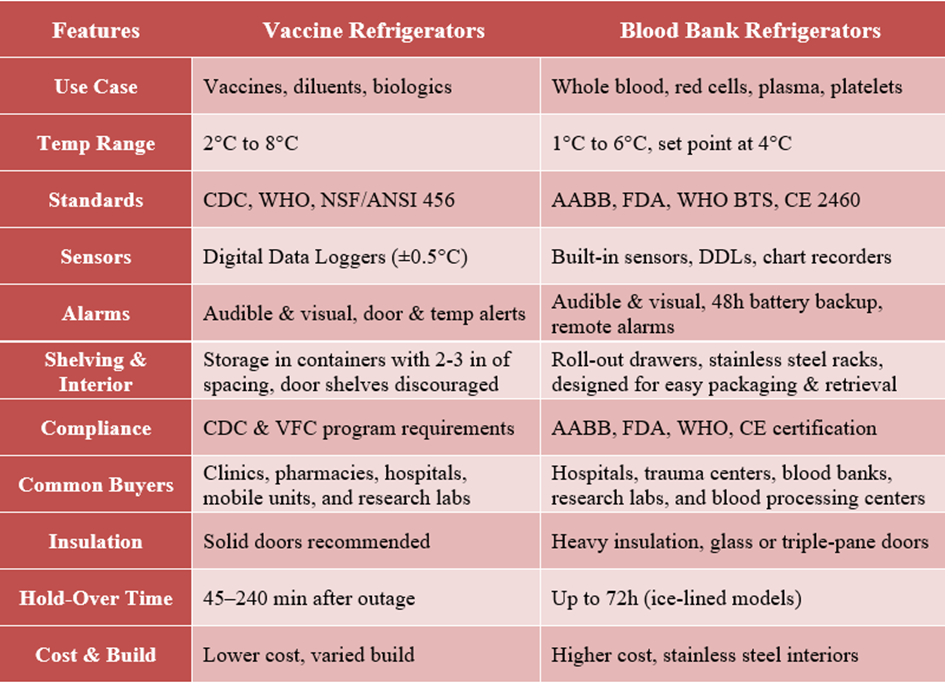
The key differences between vaccine and blood bank refrigerators lie in their design, compliance, and construction features. Vaccine refrigerators store vaccines, diluents, and biologics, following CDC and WHO guidelines, while blood bank refrigerators preserve whole blood and components, adhering to stricter AABB and FDA compliance standards.
Which One Do You Need? Matching Equipment to Facility Type
Matching equipment to your facility type depends on the healthcare setting’s primary function, storage needs, and regulatory obligations. Vaccine refrigerators serve facilities handling immunizations and temperature-sensitive pharmaceuticals; blood bank refrigerators are essential for those managing whole blood and blood components. The correct choice ensures compliance, product integrity, patient safety, and uninterrupted workflows.
Choose a vaccine refrigerator if you are a medical facility that stores vaccines, biologics, or medications. Vaccine fridges feature unique components, including microprocessor temperature control, alarms, and digital data loggers, which ensure compliance with CDC and WHO guidelines. Their design ensures vaccine potency, avoids waste, and prevents patient safety risks.
- A Clinic or Pharmacy Administering Immunizations: Clinics and pharmacies administer routine and seasonal vaccines daily. CDC guidelines recommend the use of purpose-built pharmaceutical-grade refrigerators for these facilities. Many of these facilities also participate in the Vaccines for Children (VFC) program, requiring strict adherence to monitoring and reporting standards.
- A Mobile Vaccination Unit: Outreach programs and mobile clinics rely on portable vaccine refrigerators or freezers to transport and store vaccines safely during off-site immunization campaigns. These units maintain stable temperatures for up to 8 hours, supporting immunization drives in remote or underserved areas. DDLs with buffered probes are essential during transport to keep vaccines within the recommended temperature range.
- A General Practice Storing Temperature-Sensitive Meds: General practices often store a mix of biologics and prescription medications that require refrigeration between 2°C (36°F) and 8°C (46°F). Using a dedicated vaccine refrigerator helps prevent contamination and temperature fluctuations.
- An Outpatient Care Facility, Specialty Pharmacy, Retail Pharmacy, or Physician’s Office: These facilities regularly store and dispense vaccines or temperature-sensitive pharmaceutical products. Therefore, they need purpose-built medical refrigerators to comply with regulations and preserve patient trust.
- A Research Laboratory Handling Vaccine-Related Materials: Research labs involved in vaccine development or testing require stable, precisely controlled environments for storing sensitive samples and biologics. Vaccine refrigerators provide the uniform temperature distribution necessary to maintain sample integrity, support accurate analysis, and ensure reliable outcomes in vaccine research.
Choose a blood bank refrigerator if you are a medical facility that stores whole blood, plasma, platelets, or red cells within the narrow 1°C (34°F) to 6°C (43°F) range. These units adhere to AABB, FDA, and WHO standards and feature advanced monitoring systems, chart recorders or loggers, and alarms.
- A Hospital with Transfusion Services: Hospitals with active transfusion services rely on blood bank refrigerators to safely store whole blood and components for immediate use in surgeries, emergency care, and critical treatments. These units maintain blood integrity within the strict 4°C (39°F) set point, thereby reducing the risks of bacterial growth or hemolysis.
- A Trauma Center or ER: Emergency departments and trauma centers require ready access to viable blood at all times to address urgent and life-threatening situations. Blood bank refrigerators provide rapid availability of whole blood, plasma, and platelets, with robust hold-over capabilities. They are critical for emergency transfusions where blood cannot be left unrefrigerated for more than 30 minutes.
- A Lab Processing Blood Samples: Laboratories handle blood components, cellular therapies, or immunohematology references. They need specialized blood bank refrigerators to maintain strict temperature control throughout the testing and processing cycle. The chart recorders in these units ensure traceability for audits and regulatory compliance.
- A Blood Bank or Blood Processing Center: Blood banks and processing centers manage extensive inventories of whole blood and components. They depend on high-capacity refrigerators abiding by rigorous AABB and FDA standards to preserve blood integrity during storage and distribution.
- A Regional or Central Blood Bank: Regional facilities often serve as distribution hubs for smaller hospitals and healthcare centers. Advanced refrigerators with extended hold-over times and reliable backup systems are must-haves. Ice-lined or solar-powered models provide uninterrupted access to safe, viable blood supplies in areas with unstable electricity.
Not sure which one fits? Contact our experts for guidance.
Compliance Considerations for Vaccine and Blood Bank Refrigerators
Compliance considerations for vaccine and blood bank refrigerators involve meeting the requirements of leading regulatory bodies such as the CDC, WHO, FDA, and AABB. These guidelines regulate the storage and handling of vaccines and blood components. Continuous monitoring and documentation further support quality assurance and accountability.
- CDC Vaccine Storage & Handling Toolkit is the primary regulatory source that provides comprehensive, annually updated recommendations to prevent vaccine storage errors. It mandates the use of purpose-built or pharmaceutical-grade units and prohibits the use of dormitory-style or bar-style refrigerator/freezer combos. DDLs with buffered probes, calibration, and routine audits are central to compliance.
- WHO Performance, Quality and Safety (PQS) requirements for vaccine units certify vaccine refrigerators and related cold chain equipment for global immunization programs. Devices undergo technical evaluation, laboratory testing, and often field trials before approval. PQS prequalification ensures that governments and UN agencies receive equipment that meets minimum safety, reliability, and temperature-control standards.
- FDA Blood Product Storage Requirements regulate all aspects of blood collection, testing, and storage to ensure the safety, potency, and quality of blood products. Compliance also requires adherence to current Good Manufacturing Practices, robust documentation, facility registration, and periodic inspections to maintain licensure and oversight.
- AABB Standards for Blood Refrigeration establish international benchmarks for blood refrigeration. These standards govern both equipment design and operational practices, including extendable shelving systems for organized storage, precise monitoring, and robust alarms. Compliance confirms that blood products remain viable for transfusion and supports accreditation for facilities engaged in blood banking and transfusion medicine.
- Temperature Monitoring Logs and Alarms are critical for uninterrupted compliance with these regulations and product safety. Vaccine units must use DDLs for daily checks and long-term archiving. Blood refrigerators require continuous logging with chart recorders or digital systems. Alarms alert staff to excursions, power failures, or door openings.
Cost & Maintenance Considerations for Vaccine and Blood Bank Refrigerators
Cost and maintenance considerations are decisive in selecting medical refrigeration equipment. Vaccine refrigerators are generally more affordable and less complex, ranging from $500 to $6000. CDC does not prohibit the use of a “household-grade unit,” but this practice risks vaccine potency. Therefore, you need a special, “purpose-built” or “pharmaceutical-grade” fridge explicitly designed for storage of biologics, including vaccines (CDC Vaccine Storage and Handling Toolkit).
Blood bank refrigerators are significantly more expensive due to advanced temperature-control technology, robust construction, and stricter regulatory compliance requirements, such as Migali EVOX-U1RG-BB 24″ Glass Door Medical Refrigerator, which costs $5,231.28, or Migali EVOX-2RG-BB 55″, which costs $13652.
Their advanced tech, such as continuous logging and 48-hour alarm backups, adds to their complexity and value. Aim to strike a balance between higher upfront and operational costs against the non-negotiable need for safe blood storage.
The risks of product spoilage, compliance violations, and reputational damage outweigh ROI in medical refrigerators. This makes routine maintenance equally vital for both types of refrigerators. Cleaning condenser coils, inspecting seals, calibrating sensors, testing alarms, and similar preventive maintenance extend equipment life and contribute to ROI.

FAQs: Vaccine vs. Blood Refrigerators
FAQs about vaccine vs. blood bank refrigerators address common concerns healthcare professionals have about using the right unit for vaccines and blood components. Answers to these questions further help medical facilities select the most suitable unit to preserve the pharma cold chain integrity.
Can I store vaccines in a blood bank refrigerator?
Yes, you can store vaccines in a blood bank refrigerator, but this is not the ideal or recommended practice. The 4°C (39°F) set point in blood refrigerators prioritizes blood stability, which can risk vaccine freezing. CDC strongly recommends using a unit specifically designed for vaccine storage.
What happens if vaccine temperatures fluctuate?
If vaccine temperatures fluctuate, potency is lost and cannot be restored, causing serious consequences:
– Ineffective vaccines require revaccination.
– The risk of inadequate immune responses in patients increases.
– Freezing damage, especially for vaccines containing adjuvants.
– Spoiled vaccines lead to safety concerns, wasted inventory, financial loss, and reduced patient trust.
Are there combo refrigerators for blood and vaccines?
Yes, there may be medical refrigerators marketed for storing both vaccines and blood samples; however, regulatory guidelines strongly recommend separate, specialized units.
How are blood refrigerators calibrated?
Blood refrigerators are calibrated by comparing the unit’s internal temperature readings against a pre-calibrated, NIST-traceable thermometer or data logger to confirm accuracy. A trained engineer or calibration specialist typically performs this process, either on-site or by recalibrating external devices such as data loggers through the manufacturer.
What type of refrigerator is needed for vaccines?
Vaccines require purpose-built or pharmaceutical-grade refrigerators. These units feature unique design elements to optimize vaccine storage.
– Their microprocessor-based monitoring system, equipped with digital sensors, maintains strict, precise temperature control between 2°C and 8°C (36°F and 46°F).
– They house a fan-forced air circulation for uniform cooling.
– Alarms and data loggers detect and record excursions.
– Their design and construction ensure compliance with CDC, VFC, and NSF/ANSI 456 standards.
Can I store vaccines in the residential refrigerator?
Yes, you can store vaccines in the residential refrigerator. CDC suggests that “household-grade units are also an acceptable option for vaccine storage,” but under limited conditions. Temperature instability, the lack of alarms or monitoring devices, rapid warming during power outages, and an increased risk of freezing during transport put vaccine efficacy at risk.
Which refrigerators should not be used to store vaccines?
The following refrigerators should never be used to store vaccines:
– Dormitory-style or bar-style units
– Combination refrigerator-freezers with a single compressor
– Household freezer compartments
– Food or beverage refrigerators, or any unit storing vaccines with food
– Soft-sided coolers for transport.
– Units using alcohol thermometers, chart recorders, or infrared sensors instead of digital data loggers.
Conclusion
Vaccine and blood bank refrigerators are both medical-grade units designed to preserve temperature-sensitive healthcare products, but their applications differ. Vaccine refrigerators are ideal for clinics, pharmacies, and mobile units that manage immunizations and biologics. Blood bank refrigerators are crucial for hospitals, trauma centers, and labs that handle blood components. Choosing the right unit ensures compliance and protects patient safety.
Shop Certified Medical Refrigerators from Chef’s Deal
Chef’s Deal offers a comprehensive line of vaccine and blood storage units from trusted brands, such as Accucold and Migali, all of which meet the standards of the CDC, WHO, FDA, and AABB. The experienced team members offer expert consultation to clinics, labs, and hospitals on medical refrigeration, space optimization, code compliance, and staff training. You can also refer to our medical refrigeration buying guide before purchasing a unit. Benefit from quick shipping on select models, financing options, and extended warranties.

