
Professional food allergen management is a mandatory safety standard that protects guests from life-threatening anaphylaxis and shields businesses from devastating legal liability. Implementing robust kitchen protocols, including color-coded equipment, staff training, and rigorous cross-contact prevention, is essential for regulatory compliance and brand trust. These critical steps maintain a safe, transparent, and loyal environment in any modern commercial kitchen.
Executive Summary of Allergen Protocols
- Safety First: Learn why the 9 major allergens require strict prevention beyond standard sanitization.
- Operational Excellence: Discover how dedicated tools and SOPs eliminate cross-contact during prep.
- Risk Mitigation: Understand the high costs of non-compliance, from health violations to civil litigation.
- Business Growth: See how transparent allergen labeling builds loyalty and increases profit margins.
Why Food Allergen Management is a Critical Safety Responsibility?
Food allergen management is a critical safety responsibility because uncontrolled allergen exposure can cause severe allergic reactions, including anaphylaxis, hospitalization, and death. In foodservice operations, even trace cross-contact from improper storage, handling, or temperature control can trigger life-threatening incidents, making strict allergen separation, labeling, and refrigeration practices essential for regulatory compliance and public health protection.
Food Allergy Research & Education (FARE) reports that around 33 million Americans live with food allergies, resulting annually in approximately 3.4 million ER visits. Around150-200 individuals die annually due to allergic reactions to food (FDA).
Restaurants account for a significant share of these incidents. The CDC noted that foodservice settings are responsible for nearly 50% of fatal food allergy reactions. Even trace exposure can trigger severe reactions, as food allergies involve an immune response to specific proteins the body identifies as threats. Cooking, freezing, or reheating does not neutralize allergens.
Effective food allergen management protects guests, staff, and business reputation by reducing legal, regulatory, and operational risks. A single preventable reaction can lead to litigation, health department enforcement, and lasting brand damage. Operators that implement documented allergen controls earn trust, repeat business, and loyalty from allergy-affected diners who actively seek reliable, transparent establishments.
What are Food Allergens?
A food allergen is a harmless food protein that triggers an abnormal immune system response in susceptible individuals. More than 160 foods can cause allergic reactions, but the FDA has identified 9 major allergens. The immune system misidentifies the protein as harmful, triggering immune responses that cause symptoms. Allergic responses can escalate rapidly and require strict avoidance.
What are The Most Common Food Allergens in the USA?
The most common food allergens in the USA are milk, eggs, wheat, soy, peanuts, tree nuts, fish, shellfish, and sesame, which account for over 90% of food allergies (FDA). These allergens are especially dangerous because they are widespread in commercial kitchens and strongly associated with severe anaphylaxis, a life-threatening condition that can restrict breathing, drop blood pressure, and become fatal within minutes.

Allergic Reactions vs. Food Intolerance
Allergic reactions differ from food intolerance in both cause and risk level. Food allergies involve the immune system and can trigger life-threatening symptoms upon microscopic exposure. Intolerances involve the digestive system and cause discomfort. Intolerance procedures are insufficient for allergy safety because trace residues that are harmless to guests with food intolerances may be fatal to individuals with allergies.
How Food Allergen Exposure Happens in Commercial Kitchens?
Food allergen exposure in commercial kitchens happens through unintentional cross-contact during storage, preparation, and service. These risks escalate when equipment, ingredients, and communication systems fail to isolate allergens consistently across the operation.
Cross-Contact During Preparation
Cross-contact during preparation occurs when allergenic proteins transfer through shared surfaces, utensils, gloves, or cooking media, as defined by the FDA Food Code. Using the same knife, cutting board, or fryer oil can spread allergens, even if the items appear clean. Allergen proteins remain active even after visible residue disappears.
Think of a food allergen in your kitchen like invisible wet blue paint. If a chef touches a “peanut” bucket (the blue paint) and then touches a “nut-free” sandwich, that sandwich now has blue paint spots. Using the same knife spreads the paint further. Removing the risk requires complete scrubbing and sanitation, not a quick wipe.
Storage and Labeling Errors
Storage and labeling errors occur when ingredients are stored in unsealed containers, above allergen-free foods, or in poorly segregated areas. FDA recall data consistently show that missing, incorrect, or outdated labels are a leading cause of allergen-related recalls. Decanting ingredients into secondary containers without full allergen identification further increases the risk of accidental exposure.
Think of improper allergen storage like placing an open bottle of dye on a top shelf above clean uniforms. Small leaks or vibrations eventually stain everything below the bottle, even if it never tips over. Allergen proteins spread silently through storage areas without sealed containers and clear labels.
Communication Breakdowns
Communication breakdowns occur when allergen information is lost between front-of-house and kitchen teams. Studies show that 53.9% of allergy cases in US restaurants happened after guests already informed staff of their allergy (Food Control). This highlights the risk of verbal-only communication, assumptions, or incomplete knowledge of the recipe. Written tickets, verified ingredient data, and confirmation protocols are essential controls.
Think of allergen communication breakdown like removing a warning label from an electrical panel. The system still functions, but the people working around it lack the information needed to stay safe. The risk becomes visible only when an emergency occurs because allergy details do not travel from the guest to the kitchen.
What is the Role of Allergen Management in Food Safety?
The role of allergen management in food safety is to prevent life-threatening immune reactions by eliminating unintended allergen exposure throughout food preparation and service. Allergen management addresses risks that cooking, freezing, or reheating may not fully neutralize, and therefore requires procedural prevention.
Preventing Cross-Contact, Not Just Cross-Contamination
Cross-contact and cross-contamination describe different risks. Sanitizing, cooking, or reheating helps kill bacteria, preventing cross-contamination. “Clean” is not always safe in allergen control. Surfaces that appear visually or microbiologically clean may still contain allergenic protein residues that can trigger reactions. Allergen control requires physical removal of proteins that sanitizers or cooking cannot destroy.
Protecting Vulnerable Guests
Vulnerable guests include children, elderly individuals, and people with severe or multiple allergies. According to the Asthma and Allergy Foundation of America (AAFA), roughly 100 million Americans live with some form of allergy, and about one-third have a diagnosed food allergy. Children account for approximately 8%, and adults aged 75 and older account for about 4.5% of food-allergic individuals (FARE).
- Children: More than 40% of children with food allergies have experienced a severe allergic reaction such as anaphylaxis (FARE).
- Teenagers and young adults: Although severe reactions can occur at any age, teenagers and young adults face the highest risk of fatal food-induced anaphylaxis, often linked to increased risk-taking behaviors and delayed epinephrine use (FARE).
- Asthma overlap: Children with food allergies are 2–4 times more likely to develop asthma: 30–40% of children with food allergies also have asthma (CDC). Having both conditions places them at the highest risk for severe or fatal anaphylaxis.
- Elderly individuals: Seniors experience the highest mortality rates once anaphylaxis occurs, due to age-related immune changes and reduced physiological reserve (AAFA).
- People with severe or multiple allergies: Individuals with allergic conditions are significantly more likely to develop food allergies. NIH data indicate that approximately 33% of people with severe eczema develop a food allergy. FARE further notes that having one food allergy carries roughly a 40% chance of developing a second.
These figures demonstrate that allergen exposure is a predictable, high-risk food safety issue affecting large and medically vulnerable populations. Foodservice operators have both legal and ethical responsibilities to protect guests from preventable harm and to manage associated liability. Designing a compliant, systematic allergen management program is a core requirement of professional food safety operations.
Food Allergen Management and Regulatory Compliance
Food allergen management supports regulatory compliance by ensuring accurate disclosure, staff awareness, and procedural controls that protect public health. FDA-enforced agencies regulate allergen labeling practices to minimize medical emergencies, recalls, and litigation.
Allergen Labeling Requirements
The FDA monitors allergen labeling requirements in the US through the FALCPA and FASTER acts. These laws require clear identification of the source of any of the 9 major allergens on packaged foods, either in the ingredients list or in a separate “Contains” statement.
FALCPA labeling requirements do not apply to made-to-order restaurant meals, but dining facilities are responsible for menu transparency. Many local jurisdictions require foodservice operations to provide menu notices that prompt guests to disclose allergies, enabling staff to activate safety protocols for allergic diners.
Health Codes and Allergen Awareness
State and local health departments enforce allergen awareness by adopting the FDA Food Code. Inspectors assess allergen procedures to verify that establishments prevent cross-contact and that the Person in Charge (PIC) can demonstrate knowledge of allergens and symptoms of allergic reactions. Many states require formal allergen training, with certificates maintained on-site for inspection and renewed at defined intervals.
What are The Key Components of an Effective Food Allergen Management Program?
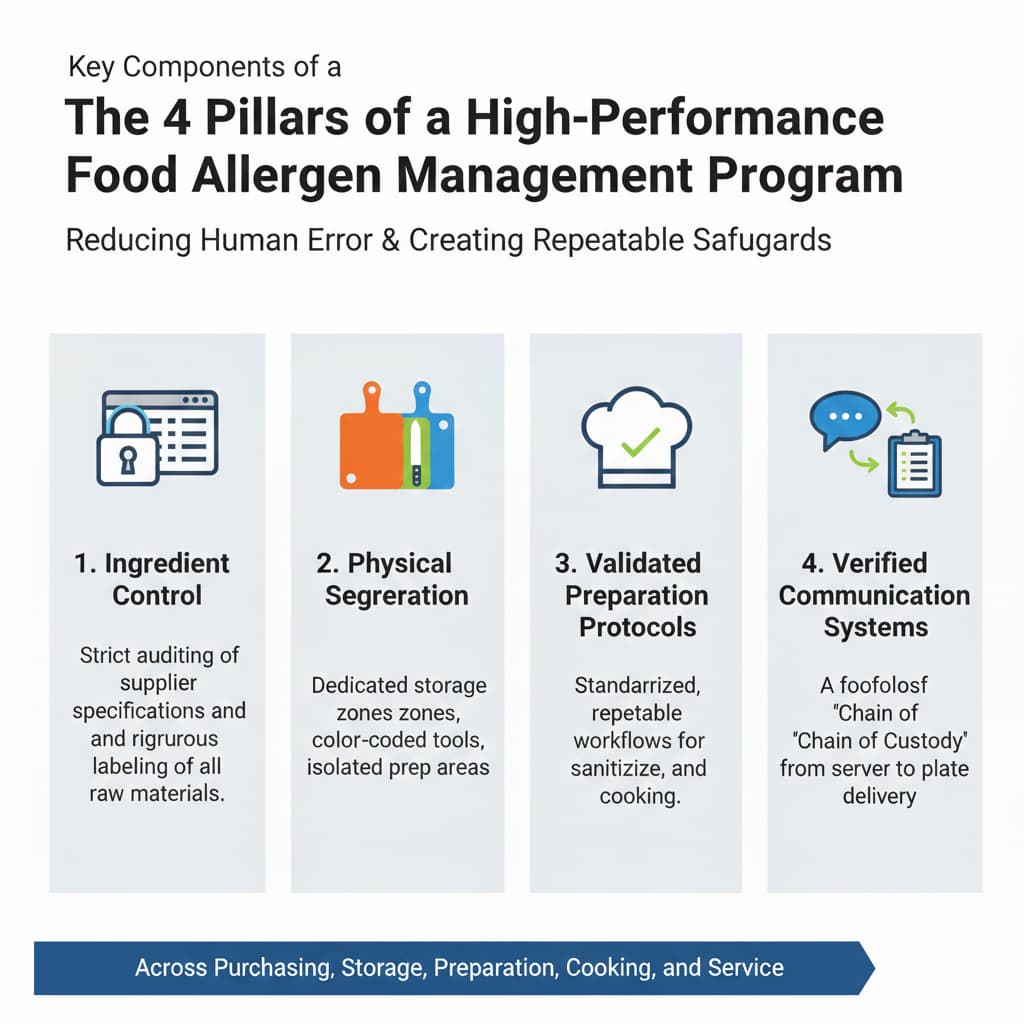
The key components of an effective food allergen management program include ingredient control, segregation, preparation protocols, and verified communication systems. Together, these elements reduce human error and create repeatable safeguards across purchasing, storage, preparation, cooking, and service.
1. Ingredient Control and Supplier Transparency
Ingredient control begins with accurate information. Operators should maintain verified ingredient lists by keeping a master allergen matrix that catalogs all ingredients and the major allergens they contain. Even minor ingredient substitutions or formulation modifications can introduce new allergen risks. Systems must be in place to manage recipe changes by closely tracking supplier notifications.
2. Storage and Segregation
Storage controls prevent accidental exposure before food reaches prep areas. Create dedicated allergen-free zones by storing allergenic ingredients separately when possible, or by storing them below allergen-free items to prevent spills and drips. Use color-coded containers and shelving. Visual identification systems reduce handling errors during busy shifts and inventory rotation.
3. Preparation and Cooking Procedures
Preparation and cooking protocols are the primary defense against cross-contact. Dedicated utensils, cutting boards, and fryers are critical because shared fryer oil can transfer allergenic proteins. Utilizing separate equipment when possible is a simple but effective measure against cross-contact. When this is not possible, apply proper cleaning between tasks: wash shared equipment with soap and water to remove allergen proteins.
4. Service and Order Handling
Service and order handling procedures must be standardized and precise. Do not rely on verbal communication: communicate allergen-related requests via order tagging and alerts in POS systems, and through written tickets. Ensure a final verification before serving: distinct plates, labels, and the manager’s double-checks confirm allergen-safe meals reach the correct guest without error.
Staff Training and Allergen Awareness
Staff training is the most important control in food allergen management because human decision-making, not equipment, determines whether safety protocols are followed. Equipment cannot fix communication failures when staff members miss, misunderstand, or assume information about allergies. Consistent training ensures uniform responses across shifts, roles, and locations, ensuring all employees apply allergen procedures correctly every time.
High staff turnover and variable scheduling in the foodservice industry require ongoing training to maintain safety standards. Consistency across shifts helps build a culture of food safety. A lack of standardized training leaves allergen safety to individual judgment, increasing risk. Ongoing education updates the information that experienced staff and new hires need to know, establishing a shared knowledge base.
What Staff Must Know
Informed employees are the primary barrier to accidental allergen exposure for guests. Every team member must be able to identify the 9 major food allergens, recognize hidden allergens in ingredients and recipes, and understand how allergens can transfer through shared equipment, surfaces, and cooking media.
Staff must know how to respond to allergy requests and emergencies. They must treat every allergy disclosure as a medical issue, not a preference, and know when to escalate questions to a manager or chef rather than guessing. They must also recognize the signs of an allergic reaction and follow emergency procedures immediately.
What is The Role of Documentation and Standard Operating Procedures (SOPs)?
The role of documentation and SOPs in food allergen management is to convert safety expectations into repeatable, verifiable actions that reduce reliance on memory or assumptions. Written allergen protocols provide step-by-step guidance for handling allergy requests, preparing meals safely, and cleaning equipment, which reduces guesswork during peak service hours when errors are most likely.
SOPs establish accountability and regulatory compliance. Training logs confirm that staff have received allergen education, while incident reports create traceability when reactions occur. Consistent recordkeeping allows operators to identify breakdowns, demonstrate due diligence to inspectors, and continuously improve allergen controls.
What are Common Allergen Management Mistakes That Increase Risk?
Common allergen management mistakes that increase risk include misunderstandings about exposure thresholds, overreliance on cleaning, and inconsistent staff practices. These failures often occur despite good intentions and are a leading cause of preventable allergic reactions in foodservice settings.
- Assuming Small Amounts are Safe: This is a dangerous assumption because trace exposure can trigger severe or fatal anaphylaxis. There is no universally safe threshold for most food allergens, and microscopic residues left on utensils, gloves, or surfaces can be enough to cause a medical emergency.
- Overconfidence in Cleaning Alone: Remember that “clean” is not always safe in allergen control. Standard sanitation focuses on killing bacteria rather than removing allergenic proteins. Visibly clean or sanitized surfaces may still retain protein residues.
- Inconsistent Practices across Staff: When training is uneven or informal, procedures differ between employees. Shift-to-shift variations undermine allergen controls, increasing the likelihood that allergens are handled safely on one shift and dangerously on another.
Food Allergen Management in Different Foodservice Environments
Food allergen management varies across foodservice environments because menu design, ingredient density, and production scale directly affect exposure risk. Each setting requires tailored controls to address its most common failure points and maintain consistent safety standards.
- Restaurants and Cafés: These environments face high menu complexity and customization challenges. Making dozens of dishes for different appetites in tight spaces with shared utensils during peak service requires thorough sanitation between tasks to avoid cross-contact. Not relying solely on verbal communication among staff minimizes errors.
- Bakeries and Dessert Operations: High-risk allergen density is common in these facilities. Airborne flour, powdered milk, and sticky nut-based ingredients spread easily and are difficult to remove. Strict segregation, dedicated equipment, and enhanced cleaning are essential for allergen control.
- Catering and High-Volume Operations: Scale and time pressure are prevalent in these operations. Large-batch production, rapid turnaround, and ingredient substitutions increase the risk of labeling errors and cross-contact. Standardized documentation, traceability, and communication systems are critical to allergen safety.
The Business Impact of Proper Allergen Management
The business impact of proper allergen management is most visible in cost avoidance and risk reduction. Food allergen incidents lead to lawsuits, emergency medical claims, and recalls. Food Marketing Institute (FMI) reported that the average cost of a single food recall is approximately $10 million. An anaphylaxis-related liability settlement in foodservice can surge the costs, making prevention far less expensive.
Proper allergen management also builds guest trust and long-term loyalty, particularly among households affected by allergies. One allergic guest often determines where an entire group of 3–5 people dines. 75% of consumers are more loyal to brands that provide transparent ingredient and allergen information beyond legal minimums (FMI).
Allergen safety impacts brand reputation through online reviews, social media, and word of mouth. Nearly 25% of restaurant social media reviews mention allergen concerns (Frontiers in Allergy). Negative incidents spread rapidly online, while allergy-safe reputations generate repeat visits. A positive experience at a diner leads to a 92% repeat-visit rate among food-allergic guests, boosting profit margins by up to 24% (Apicbase).
Building a Culture of Allergen Safety
Building a culture of allergen safety requires leadership commitment and continuous improvement. Management sets expectations through training, enforcement, and resource allocation. Allergen control plans become ‘living documents’ by learning from near misses and updating procedures after recipe or supplier changes.
Employees in leadership-driven organizations are more likely to comply with safety procedures. This results in a stronger food safety culture (FSC). The FDA identifies leadership as the “most often cited key component” in its systematic review of FSC. Leaders establish food safety as a core organizational priority and empower employees to embrace the essential behaviors needed for a robust FSC.
FAQ: Food Allergen Management
What is food allergen management?
Food allergen management is a systematic process for identifying allergens in ingredients, controlling cross-contact, training staff, and communicating risks to guests to prevent allergic reactions.
What happens if a restaurant fails to comply with allergen labeling requirements?
A restaurant may face health code violations, fines, civil lawsuits, forced closures, or criminal liability in severe cases involving serious injury or death if it fails to comply with allergen regulations.
How do restaurants prevent allergen cross-contact?
Restaurants prevent allergen cross-contact by using dedicated equipment, enforcing handwashing and glove-change protocols, segregating ingredients, and documenting allergen requests through written or digital order systems.
Who is responsible for allergen safety in foodservice?
Responsibility for allergen safety rests with every employee. Owners, managers, and the designated PIC are legally accountable for training, procedures, and enforcement.
Is cleaning enough to remove allergens?
Cleaning alone is not always enough to remove allergens. Heat and sanitizers do not destroy allergenic proteins. Physicallyscrub surfaces with soap, water, or validated detergents to remove residues effectively.
Conclusion
Food allergen management is a core food safety obligation that protects lives, ensures regulatory compliance, and safeguards business viability. Standard bacteria control practices do not neutralize allergens: even trace exposure can be fatal. Continuous staff training, documentation, segregation, and communication are a must. A correctly executed allergen management program reduces liability, strengthens brand trust, and supports long-term operational stability.
The following checklist of operational dos and don’ts summarizes essential food allergen management best practices to maintain the highest safety standards.
Dos of Food Allergen Management
- Do treat every allergy disclosure as a medical concern requiring strict procedures.
- Do verify ingredients, labels, and recipes whenever an order changes.
- Do train all staff regularly and document allergen-awareness training.
- Do physically clean and scrub equipment to remove allergen residues.
- Do use written or digital systems to flag and verify allergen orders.
Don’ts of Food Allergen Management
- Don’t assume small amounts of allergens are safe for sensitive guests.
- Don’t rely on sanitizers, heat, or visual cleanliness to remove allergens.
- Don’t allow informal or verbal-only communication of allergy requests.
- Don’t store allergenic ingredients above allergen-free foods.
- Don’t treat allergen management as optional or secondary to speed or convenience.
You can also read our article about ‘How Commercial Refrigeration Prevents Food Waste and The Role of Commercial Refrigeration in Preventing Foodborne Illnesses in foodservice businesses for a seamless kitchen operation.

