

Running a commercial kitchen means keeping your refrigeration spotless and systematically arranged. A well-maintained fridge directly impacts your bottom line, food safety ratings, and daily operations. Proper cleaning and structured organization protect food quality, reduce waste, improve efficiency, and ensure compliance.
A short guideline with key takeaways:
- Clean and organize commercial refrigerators daily, weekly, and monthly to maintain food safety and extend equipment life.
- Store food from top to bottom by cooking temperature to prevent cross-contamination.
- Implement FIFO labeling and leave space for proper airflow to maintain stable temperatures.
- Clean condenser coils, gaskets, and vents regularly to reduce energy costs and prevent breakdowns.
- Maintain logs and inspection readiness to avoid health code violations and operational risk.
Why Cleaning and Organization Matter in Commercial Refrigeration?
Cleaning and organization are critical in commercial refrigeration because these units offer longer service life, lower energy consumption, and more efficient operation.
Commercial fridges and freezers operate under more rigorous conditions than residential units, resulting in higher levels of dust, grease, and dirt. They manage larger food and ingredient inventories and are responsible for hundreds of daily procurement openings. Therefore, commercial refrigeration systems require better organization and more frequent cleaning.
The cleaning of commercial refrigeration systems is a critical factor in food safety and public health regulations, as clearly stated in state health codes like the Rules of
Tennessee Department of Agriculture Food.
However, dirty coils reduce cooling performance; clogged air vents cause overworking; and worn gaskets allow ambient air to enter while leaking chilled air, resulting in higher energy bills. Furthermore, this may result in major, costly breakdowns and shorten the service life of your fridge or freezer.
Organizing the cooler and freezer improves efficiency in stock management, food handling, and safety. Well-organized commercial refrigeration equipment enables adherence to FIFO and faster item location. Moreover, it helps you prevent cross-contamination, which occurs when raw meats drip onto ready-to-eat items or when spoiled food is buried behind fresher stock.
Cleaning, temperature fluctuations, and food safety applications are specifically checked by health inspectors to ensure proper food storage conditions, clean surfaces, and food-safe organization. Violations of the regulations result in fines, mandatory closures, or reputational damage that can take months to rebuild.
Commercial Refrigeration Cleaning Frequency: What’s Required?
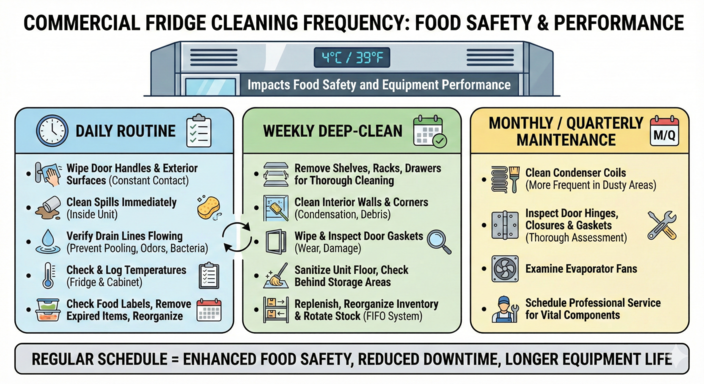
Daily, weekly, and monthly cleaning schedules impact food safety and equipment performance.
Daily cleaning tasks
Daily cleaning tasks should be part of your routine to remove easily accessible dirt and dust and to conduct quick checks for potential issues. Daily commercial cleaning tasks include:
- Wipe down door handles and exterior surfaces that see constant contact.
- Check for and immediately clean any spills inside the unit.
- Verify that drain lines are flowing to prevent water pooling, which causes odors or bacterial growth.
- Check the temperature readings in the fridge and cabinet, and log them to identify any fluctuations that may indicate issues.
- Check food labels, remove expired or compromised items, and reorganize any sections that became cluttered during service.
Weekly deep-clean priorities
Weekly deep-cleaning tasks for commercial fridges require more time and effort to remove dirt and stains and organize stock. So, you should:
- Remove all removable shelves, racks, and drawer inserts for thorough cleaning.
- Clean interior walls, paying close attention to corners where condensation and debris accumulate.
- Wipe door gaskets with appropriate solutions and inspect them for wear or damage.
- Sanitize the unit floor and check that nothing has fallen behind the storage areas.
- Replenish and reorganize your inventory in full,
- Rotate stock, and verify that your FIFO system remains intact.
Monthly and quarterly maintenance routines
Monthly and quarterly maintenance routines are necessary to keep the refrigeration system functioning properly and include:
- Cleaning condenser coils (more frequently in dusty environments),
- Inspecting door hinges and closures, and performing thorough gasket assessments.
- Examining evaporator fans and scheduling professional service for vital components.
How Cleaning Frequency Varies by Food Type and Operation Size?
Cleaning frequency varies by food type and operation size because higher-risk foods and higher-volume kitchens require more frequent sanitation to control contamination and maintain food safety compliance.
- High-risk foods (raw meat, poultry, seafood, dairy): Clean and sanitize daily or after each use.
- Ready-to-eat foods and produce: Clean prep areas and equipment after each task.
- Low-risk dry goods areas: Clean weekly, with spot cleaning as needed.
- Small operations (low volume): Daily cleaning with scheduled weekly deep cleaning.
- Medium-volume operations: Multiple daily cleanings in prep and storage zones.
- High-volume or institutional kitchens: Continuous cleaning during shifts, daily deep cleaning, and frequent equipment sanitation.
Step-by-Step: How to Clean a Commercial Refrigeration Properly
To clean a commercial fridge properly, follow the 5 steps to avoid missing critical areas, minimize downtime, and extend equipment lifespan:
1. Power Down and Prepare Safely
Daily and weekly cleaning normally lasts around 20 minutes, and you can keep the power on. However, monthly cleaning requires more time, so you should unplug the unit to avoid electric shock and save energy while the door is open. Then, all perishables must be moved to another cooler or a temporary insulated bin to ensure safety. If the food’s temperature rises above 41°F (5°C) for more than 2 hours, it must be discarded.
2. Remove and Clean Shelves, Racks, and Pans
Remove shelves, racks, and pans to clean underneath. Use pH-neutral cleaners to prevent corrosion and wear on steel and coated shelves. Do not use scrubbers or abrasive scrubbers, as they can damage the surface and create scratches where bacteria and mold can grow. Instead, use a wet cloth with mild detergent.
3. Clean Interior Surfaces
During commercial fridge cleaning, wipe and sanitize the entire interior, including the corners, back walls, top, and bottom. You can clean these locations with a cloth or sponges, starting from the top and moving to the sides, back walls, and bottom. The spills and old-risk areas must be cleaned daily to prevent bacterial growth and odors.
4. Clean Door Gaskets and Seals
The gasket is the rubber strip that seals the cold air in and keeps the hot air out. A cracked, worn, or dirty gasket allows cold air to escape, causing the compressor to run constantly. You can use a soft cloth and soapy water to clean them weekly. Additionally, visually inspect for cracks and insert a dollar bill into the door; if it slides out easily when the door is closed, your seal is failing and needs to be replaced.
5. Clean Exterior and Vent Areas
The exterior parts are in constant contact with staff and with external dust and contaminants. Therefore, these high-touch areas should be cleaned daily, particularly the handle and doors. Use a microfiber cloth to clean steel surfaces and prevent fingerprints. You must not apply liquids directly to the displays while cleaning.
Most commercial fridges have air-vent channels along the lower front to supply airflow to the condenser coils and ventilation grills. They should be cleaned monthly with a vacuum cleaner or a soft-bristled brush to maintain adequate airflow.
Organizing Commercial Refrigeration for Food Safety
Every stocked item requires a specific location based on contamination risk and temperature requirements. Establishing a labeling and dating system and paying attention to shelf configuration, and a load balance are two other important considerations.
Food Storage Hierarchy (Top to Bottom)
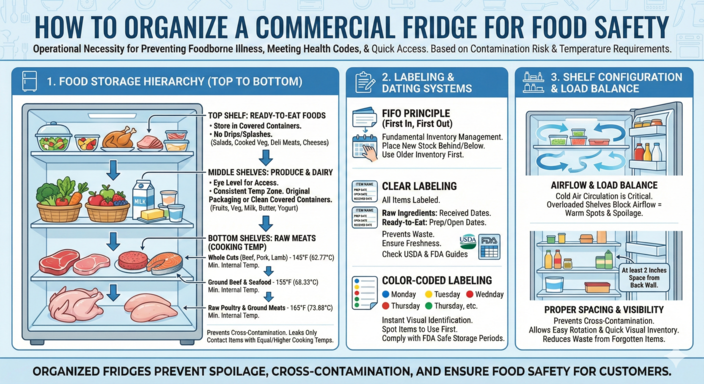
When storing food items, follow a strict hierarchy, starting at the top, with ready-to-eat foods kept farthest from potential contamination from drips, splashes, and contact. This includes prepared salads, cut fruit, cooked vegetables, deli meats, cheeses, and leftovers. These items won’t be cooked further, so protecting them from drips and cross-contact is critical. You must store them in covered containers rather than leaving them uncovered or poorly wrapped.
Produce and dairy should be placed on the middle shelves. Fresh fruits and vegetables are kept at eye level for easy access and rotation. Dairy products like milk, butter, and yogurt maintain their quality best in consistent temperature zones away from the door. You should keep these items in their original packaging when possible or transfer them to clean, covered containers with clear labels.
Raw meats require an organizational order based on their required cooking temperatures. This system prevents higher-risk items from being contaminated by lower-risk items. On the lowest shelf, store raw poultry and ground meats, which require an internal temperature of 165°F (73.88°C) for cooking. The next level up can hold raw ground beef and seafood that require 155°F (68.33°C). Above that, you can place whole cuts of beef, pork, and lamb that require a minimum internal temperature of 145°F (62.77°C).
This arrangement means that even if a package leaks, it only contacts items that require equal or higher cooking temperatures. In addition, all raw meat, fish, and poultry must be stored below ready-to-eat items to prevent cross-contamination.
Labeling and Dating Systems
The FIFO method, which stands for “First In, First Out,” is a fundamental principle of food service inventory management. When new stock arrives, place it behind or below existing items so older inventory gets used first. Therefore, every item needs a clear label showing what it is and when it was prepared, opened, or received.
Raw ingredients should show received dates. This system prevents waste from expired items and ensures customers always receive the freshest possible food. You can check the most common labelling phrases and uses in the USDA Food Safety and Inspection Service’s food product dating guide, and read our blog about ‘How Commercial Refrigeration Prevents Food Waste‘.
To facilitate the operations, many businesses use color-coded labeling. For instance, Monday gets blue labels, Tuesday gets yellow, and so on. Staff can instantly spot which items need to be used first without stopping to read dates. Check the FDA storage chart to ensure food safety by complying with the safe storage periods.
Shelf Configuration and Load Balance
Commercial refrigerators circulate cold air throughout the cabinet to keep things cool and safe. However, overloaded shelves and tightly stacked items block this airflow and create warm spots where food can spoil. Hence, you must leave space between the back wall and stored items, typically at least two inches.
Proper spacing between products serves multiple purposes beyond airflow. It prevents cross-contamination by keeping different food types separate. It allows you to see everything at a glance, making rotation easier and reducing waste from items forgotten at the back.af
Commercial fridge organization is an operational necessity to prevent foodborne illness, meet health code requirements, and locate items quickly. You can read our “The Role of Commercial Refrigeration in Preventing Foodborne Illnesses” blog for more information.
Organizing by Refrigeration Type
Commercial refrigeration is an ecosystem in foodservice establishments, and each one serves a specific purpose, requiring adapted organization strategies:
- Reach-in refrigerators: These commercial fridges are ideal for high-frequency items used for daily preparation and service.
- Keep heavy items on lower shelves for stability and easier access. The door shelves for condiments and frequently accessed items that tolerate minor temperature fluctuations.
- Group similar items together, for instance, dairy in one section, proteins in another, to accelerate finding items during service.
- Walk-in coolers: These large commercial refrigeration units serve as the primary storage area to keep bulk ingredients.
- Create designated zones for different categories with clear floor markings or shelf labels to manage stocks easily.
- Set the stocks at 6 inches high on dunnage racks to ensure airflow and facilitate cleaning.
- Use the area near the door for frequently used items to minimize heat loss.
- Store heavier products on lower shelves, and lighter items on upper shelves.
- Undercounter commercial fridges: These space-saving commercial coolers keep frequently used items within reach, especially when space is limited.
- Use transparent storage containers to maximize visibility.
- Check and rotate inventory daily since these units typically hold 24-48 hours of working ingredients.
- Avoid overfilling, which can block the evaporator and reduce cooling capacity.
- Prep refrigerators: The rail should be filled with the current-day service needs based on your menu’s most popular items.
- Allocate the deeper wells for the high-volume ingredients, and shallow pans are ideal for garnishes and low-volume items.
- Clean the rail thoroughly between shifts, as these units are exposed to ambient air and potential contaminants.
Temperature Zones and Organization Strategy
Commercial refrigerators maintain an average internal temperature, but temperature readings vary across the cabinet. The top areas near the door tend to be slightly warmer, while the bottom rear stays coldest. These patterns help you position temperature-sensitive items in the coldest zones while placing more tolerant products in slightly warmer areas.
The internal organization of your commercial fridge directly affects the temperature consistency. Overloaded shelves create barriers that disrupt the manufacturer-designed circulation path. Cold air can’t reach certain areas, creating pockets that run 5-10 degrees warmer than the thermostat setting, compromising the safety of sensitive foods. Place thermometers at different locations inside the cabinet, such as the top shelf near the door, the middle section, and the bottom shelf at the back, to see the fluctuations.
To prevent overloading and warm spots, carefully organize stock and adjust shelves to accommodate taller items and improve air circulation. Additionally, keep high-risk items away from warm spots and door shelves. Avoid overloading and placing all new stock in a single refrigerator; instead, spread them across multiple units so each compressor can handle the load without overheating.
Common Cleaning and Organization Mistakes to Avoid
The organization and cleaning tasks may be undermined by the commercial refrigeration operators, resulting in errors that should be corrected before they cause serious problems:
- Overpacked shelves to maximize inventory and minimize trips to the walk-in block airflow, create warm spots, and make FIFO rotation nearly impossible.
- Ignoring drain lines can lead to standing water, foul odors, and, eventually, costly water damage.
- Using harsh chemicals seems to create a more sanitized environment, but aggressive cleaners damage refrigerator components and leave scratches that provide a suitable place for residue and bacterial growth.
- Skipping gasket maintenance might save a few minutes during cleaning, but it costs you in energy expenses and eventual gasket replacement. Dirty gaskets prevent proper sealing, letting cold air escape continuously.
What Tools and Supplies are Used for Commercial Fridge Cleaning?
- Approved cleaning agents: Use only pH-neutral, food-safe cleaners; avoid chlorine bleach, ammonia, and abrasive cleansers, which can damage equipment.
- Non-abrasive tools: Use microfiber cloths, soft-bristled nylon brushes, and plastic scrapers to prevent scratches. Prefer color-coded cleaning supplies for raw meat areas, produce sections, and ready-to-eat zones to prevent cross-contamination.
- Digital thermometers and logs: Maintain multiple calibrated thermometers for verifying temperatures at different locations within units.
- Drain brushes and gasket cleaners: Use drain brushes and gasket cleaners to thoroughly clear condensate lines. Gasket cleaners remove debris, while food-grade mineral oil helps maintain gasket flexibility after cleaning.
- Avoiding blocked airflow: Keep the vents open to ensure proper air supply and circulation for optimal refrigeration system performance.
Health Code and Inspection Readiness
Health inspections occur with minimal notice, so your commercial refrigerators must remain inspection-ready at all times.
What inspectors Look for?
State authorities use common practices and categories to check during inspections, as shown in the South Carolina guide on health inspections and violations (South Caroline Department on Aging). What inspectors look for in foodservice and commercial kitchen refrigeration is:
- Cleaning and sanitation
- Food time and temperature controls
- Food storage
- Food preparation
The primary violations that require immediate correction within 5 days are:
- Cooling and storing
- Labelling
- Record keeping
Documentation and Cleaning Logs
Documentation, temperature logs, and cleaning logs provide evidence of your food safety program and may be requested by inspectors. Keep temperature logs, prepare cleaning schedules and checklists, and follow them properly.
How an Organization Reduces Inspection Risks?
Properly organized refrigeration minimizes the food safety and hygiene violations by:
- Reducing temperature fluctuations and overheated spots, which are documented in the temperature logs,
- Retaining the FIFO method to manage stocks and prevent waste,
- Facilitate cleaning and enhance sanitation,
- Accelerating inspections with a clear view and a positive impression.
Proper Spacing Between Products
Proper spacing between products ensures inspectors can see everything clearly during their assessment. Furthermore, it maintains a consistent temperature around the cabinet and helps you pass a temperature test during the inspection.
When Cleaning Reveals Bigger Refrigeration Issues?
Regular cleaning gives you the opportunity to spot problems before they cause complete equipment failure or food loss. For instance, ice buildup in unusual places, particularly around evaporator coils or vents, signals airflow problems, and frost on the back wall or ceiling of the unit suggests the defrost cycle isn’t working properly.
Inconsistent temperatures between thermometer locations indicate airflow blockage or fan problems. Sometimes, simple maintenance such as cleaning coils, replacing worn gaskets, or clearing drains resolves the issue. However, any work involving refrigerant, electrical components, compressors, or complex diagnostics requires qualified commercial refrigeration technicians.
Best Practices to Maintain a Clean and Organized Commercial Fridge Long-Term
To maintain a clean and organized commercial fridge for long-term use, create a habit among your staff by:
- Creating a staff training routine that includes the cleaning procedures, organizational tips, and basics of refrigeration.
- Forming cleaning checklists that eliminate confusion about responsibilities and frequency.
Establishing a regular maintenance schedule with a professional or hiring a technician to deal with the basic maintenance of your equipment if you have many.
How Proper Cleaning Improves Commercial Refrigeration Performance?
Proper cleaning and organization improve commercial refrigeration performance, and pay off the effort and investment through better equipment performance, lower operating costs, and longer service life.
- Lower energy consumption: Clean condenser coils transfer heat efficiently, allowing the refrigeration cycle to complete with less compressor runtime.
- Reduced compressor strain: When refrigeration systems run efficiently, compressors experience less wear from extended runtime and excessive cycling.
- More stable internal temperatures: Consistent temperatures keep food safer and maintain quality better than units that fluctuate.
What is the correct order to organize a fridge in a commercial kitchen?
Commercial fridges are organized from top to bottom by cooking temperature and contamination risk. Top shelves hold ready-to-eat foods such as prepared salads, cooked items, and deli products that won’t be reheated. Middle shelves store produce and dairy products.
Bottom shelves organize raw meats by required cooking temperature: the lowest shelf for poultry and ground meats (165°F (73.88°C)), then seafood and ground beef (155°F (68.33°C)), then whole cuts of beef, pork, and lamb (145°F (62.77°C)). This system prevents higher-risk raw items from dripping onto foods that receive less or no cooking.
How do you properly clean a commercial refrigerator?
Start by removing all items and relocating them to temporary cold storage. Remove shelves, racks, and removable components for washing separately with pH-neutral, food-safe cleaners. Clean interior surfaces from top to bottom using appropriate cleaners and non-abrasive tools, paying extra attention to corners, drains, and areas prone to spills. Clean door gaskets carefully with warm soapy water, checking for wear or damage. Wipe down exterior surfaces, including handles, control panels, and vent areas.
How should a commercial fridge be organized?
Raw proteins on the bottom shelves, ready-to-eat items on the top shelves, with produce and dairy in the middle. Use clear labeling with dates on every item and implement FIFO rotation so older stock gets used before newer inventory. Leave adequate spacing between items to ensure airflow.
How do chefs organize their fridge for efficiency and safety?
Professional chefs organize workflows to meet operational needs while maintaining food safety standards. They position ingredients for their current menu within easy reach and in the sequence they use them during prep and service. Mise en place for the day’s service goes in prep fridges or dedicated sections. They use standardized containers that stack efficiently and label everything clearly with contents and dates.
How often should a commercial fridge be cleaned and reorganized?
Basic cleaning, such as wiping up spills immediately, checking for expired items, and straightening sections that were disrupted during service, should be done daily. Deep cleaning of shelves and interior surfaces should occur weekly. Monthly tasks include thoroughly cleaning condenser coils, inspecting gaskets and seals, and checking drainage systems.

Conclusion
Maintaining clean, organized commercial refrigeration isn’t optional; it’s fundamental to running a safe, efficient, and profitable food service operation. The practices outlined in this guide protect your food quality, prevent health code violations, extend your equipment lifespan, and reduce energy costs. Most importantly, they keep your customers safe from foodborne illness while helping your kitchen staff work faster during service.
Start by implementing consistent cleaning schedules that match your operation’s needs. Train every team member on proper organization principles and hold them accountable through checklists and regular inspections. Invest in the right cleaning tools and supplies so staff can maintain standards without resorting to improvisation. Pay attention to early warning signs of equipment issues identified during cleaning, and address them promptly before minor issues escalate into costly failures.
Your refrigeration represents a major investment and handles your most perishable inventory. Treating it with the care and attention it deserves delivers returns every day through improved food safety, lower operating costs, and smoother kitchen operations. Make proper cleaning and organization non-negotiable parts of your standard operating procedures, and you’ll see the benefits in every aspect of your business.

