


Troubleshooting advice for one Hoshizaki series does not transfer to another, because the difference is not just the shape of the ice. The ice-making mechanism is fundamentally different.
KM-series crescent cubers run on a batch freeze/harvest cycle with valves and a control-board timer.
DCM cubelet dispensers and F-series flakers run continuously, with a rotating auger inside a freezing cylinder and no harvest cycle.
Applying a solution developed for the KM series to an auger-based machine is an operational error, not a minor mismatch, and it will cost you labor and time while you look for a component that doesn’t exist.
TL;DR: Hoshizaki KM vs DCM vs Flaker
- KM series makes ice in batches: Water freezes onto an evaporator plate, then a harvest cycle releases it. Nearly all KM troubleshooting, from dip switches to spray tubes to drain valves to beep codes, is built around that cycle.
- DCM and F series make ice continuously: Ice forms inside a freezing cylinder and a rotating auger pushes it out, with no separate harvest cycle to diagnose and no evaporator plate to inspect.
- KM-specific concepts don’t carry over: Harvest timing, spray tube alignment, and KM freeze-timer settings have no equivalent on an auger machine; the real failure points are auger and bearing wear, gear motor condition, cutter condition, and extrusion consistency.
- Confirm the mechanism before you apply any advice: The model prefix, KM, DCM, or F, is the fastest way to tell which of the two mechanisms you are working on.
Why the Ice-Making Mechanism Matters More Than the Model Name
The mechanism matters more than the model’s name because the model prefix signals a completely different internal mechanism, not a trim variation. But grouping them by “batch cycle” and “continuous auger” highlights potential failure points by specifying their operational features.
Getting these wrong wastes time, which is valuable in foodservice facilities. A technician looking for a harvest-cycle problem on a machine that has no harvest cycle will never find what they are looking for, because there is nothing to find.
The same applies in reverse: an auger bearing wear check is meaningless on a crescent cuber. Every diagnostic step below is organized around mechanism first and model number second, which saves labor hours.
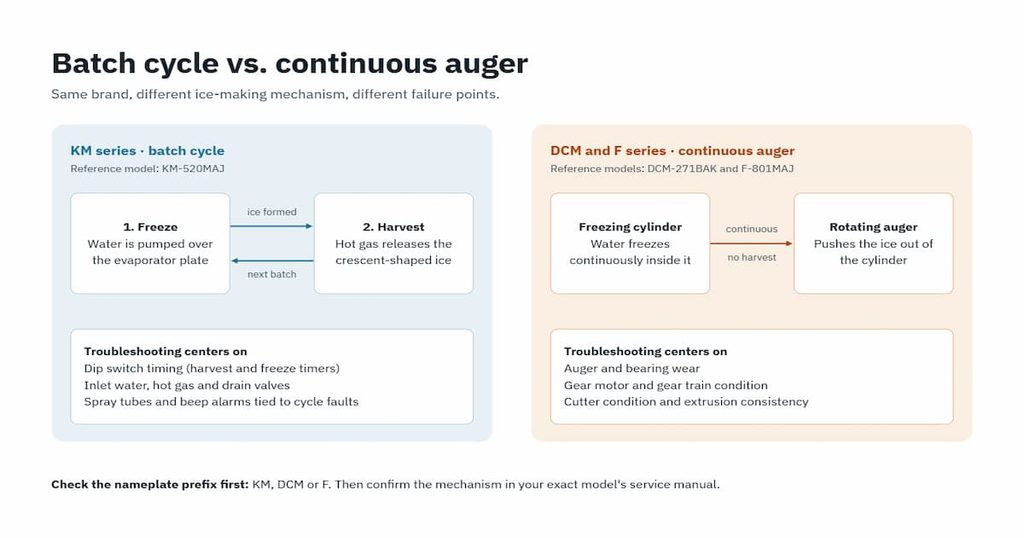
KM Series: Batch Freeze/Harvest Crescent Cubers
The Hoshizaki KM series are crescent cube ice machines, and their ice production relies on a cyclical ice build-up. Water is pumped over an evaporator plate during a freeze cycle, and once the plate reaches temperature, the control board switches to a harvest cycle where hot gas releases the formed crescent-shaped ice. Everything happens in discrete, repeating stages, and each batch of ice has a defined beginning and end.
Therefore, Hoshizaki KM ice maker (like the KM-520MAJ) troubleshooting focuses on three things:
- Cycle timing (the dip switch settings that manage harvest and freeze timers); before changing any of them, read Don’t Touch the Dip Switches: What Happens When Hoshizaki Settings Get Changed article.
- Valves that control water and refrigerant flow during specific phases of the cycle (the inlet water valve, the hot gas valve, and the drain valve); a slow drain valve leak during freeze is covered in The Hoshizaki Dump Valve Failure Nobody Talks About.
- Components like spray tubes, which distribute water across the evaporator plate, and the alignment problem that often follows a cleaning are covered in Ice Machine Jamming After Cleaning? Check Your Spray Tube Alignment First.
- Audible alarms tied to cycle faults, such as the 3-beep freeze-timer lockout walked through in “3 Beeps and No Ice”: A Real Troubleshooting Walkthrough After a Machine Got Moved.
DCM Series: Continuous Auger Cubelet Dispensers
The Hoshizaki DCM series is structurally different from the KM series. Instead of an evaporator plate and a harvest cycle, ice forms continuously as water freezes inside a freezing cylinder, and a rotating stainless-steel auger extrudes the ice. A gear motor and gear train drive the auger, and the ice is delivered to a built-in storage bin rather than dropped from a plate.
Because there is no separate freeze/harvest cycle, Hoshizaki DCM troubleshooting concepts focus on auger and bearing wear, gear motor and gear train condition, cutter condition, and extrusion consistency.
For instance, Hoshizaki’s own service documentation for the DCM-271BAK specifies an upper bearing wear tolerance of 0.02″ (0.51 mm) and advises replacing the lower bearing at the same time as the upper. Conversely, harvest timing and spray tube alignment have no DCM equivalent.
The control scheme differs too. Hoshizaki DCM ice makers like the DCM-271BAK use a separate power switch plus a three-position control switch with ICE, OFF, and DRAIN positions, while the KM series features ON, OFF, and PUMP control switches.
Hoshizaki DCM series also have dip switches, but they govern entirely different functions. On the DCM-271BAK, the S2 dip switches control drain frequency, the continuous dispensing timer, bin control selection, and bin control shutdown delay. However, Hoshizaki KM-520MAJ series S4 switches control freeze timer, harvest pump time, and pump-out frequency. So, a KM dip switch table is not useful for a DCM series ice machine.
Flaker (F) and Other Series: Related but Distinct Auger Mechanisms
The Hoshizaki Flaker series is mechanically closer to the DCM than to the KM. The Hoshizaki Flaker series uses an auger inside a freezing cylinder rather than a plate-and-harvest cycle. Hoshizaki describes the flaker’s greaseless bearing auger construction in its own product copy, and the F-series ice-making assembly is built around the same family of parts: auger, extruding head, upper bearing, mechanical seal, and gear motor.
However, it is not identical to the DCM ice maker mechanism. Hoshizaki flake ice makers like the F-801MAJ have a different auger construction, evaporator positioning, and gear motor location. Therefore, confirm the model series, components, and locations in your service manual before acting.
How to Identify Which Series Your Hoshizaki Ice Machine Is
You can identify your Hoshizaki ice machine series by reading the model prefix off the nameplate, checking the operational pattern, and confirming the series in the service manual:
- Check the nameplate or rating plate: It is usually on an interior panel or the rear of the unit, and the model prefix identifies the series directly. This should be the first place to look. KM means a batch freeze/harvest crescent cuber, DCM means a continuous auger cubelet machine, and F means a continuous auger flaker.
- Watch the physical operating pattern: If the nameplate is illegible or the model number is ambiguous, observe the machine running. A unit that runs a visible batch cycle, water flowing over a plate, then a distinct release of ice, is KM-type. A unit that continuously extrudes and cuts ice with no separate harvest step is DCM- or Flaker-type.
- Confirm against that exact model’s service manual: When you are still unsure, look the model up on hoshizakiamerica.com rather than guessing from general appearance.
This guide focuses on the KM, DCM, and F series. Other series, such as the IM square cubers, run a batch freeze/harvest cycle but use different alarm systems. The Hoshizaki Error Code Reference Guide covers the KM beep codes and the IM on-screen error codes. For AM, C, DKM, or any other series, check that exact model’s service manual.
Quick Reference: Mechanism and Failure-Point Comparison
The table below is a short version of everything above: which mechanism each series uses, what tends to fail, and which current model to use as a reference when pulling specifications.
| Series | Core Mechanism | Typical Failure Points | Reference Model |
| KM (Crescent Cuber) | Batch freeze/harvest plate cycle | Dip switch timing, spray tubes, drain and inlet valves, beep alarms tied to cycle faults | KM-520MAJ |
| DCM (Cubelet) | Continuous auger extrusion in a freezing cylinder | Auger and bearing wear, gear motor and gear train, cutter condition, extrusion consistency | DCM-271BAK |
| F (Flaker) | Continuous auger in a freezing cylinder, related to DCM, not identical | Auger bearing wear, extruding head and cylinder condition, gear motor | F-801MAJ |
A Common Mistake: Applying KM Logic to a Non-KM Machine
The most common mistake is treating a DCM or Flaker as a KM with different ice, and it shows up as a technician hunting for parts and settings the machine was never built with.
For instance, troubleshooting a cubelet dispenser for harvest-cycle problems, looking for spray tubes on a machine that distributes no water across a plate, or hunting for a KM freeze-timer dip switch position is time-consuming and futile.
Checking the model prefix first, KM, DCM, or F, takes seconds and rules out an entire category of wasted effort before you open a panel.
When to Call a Technician
You should call a technician if:
- You are not sure which mechanism the unit uses: Naming can be ambiguous across older and newer model variants, and working on the wrong model risks damage and wastes time.
- A DCM or Flaker shows an auger jam, unusual noise, or inconsistent ice texture: Diagnosing auger, bearing, and gear train issues typically requires disassembly of the ice-making unit, which is not an operator-level task.
The unit’s service manual contradicts anything here: Always follow the exact model’s manual and re-verify the current model status before ordering parts.
FAQs About Hoshizaki KM, DCM, and Flaker Series
What’s the difference between Hoshizaki KM and DCM series machines?
Hoshizaki KM machines make ice in batches on a freeze/harvest cycle, while Hoshizaki DCM machines make ice continuously using a rotating auger inside a freezing cylinder. These are completely different mechanisms, not just different ice shapes.
How do I know which mechanism my Hoshizaki ice machine uses?
Check the model prefix: KM indicates a batch freeze/harvest cuber, DCM indicates a continuous auger cubelet machine, and F indicates a continuous auger flaker. See the “How to Identify Which Series Your Hoshizaki Ice Machine Is” above for the full nameplate and operating-pattern checks.
Do Hoshizaki DCM and Flaker machines have dip switches like KM machines?
Yes, Hoshizaki DCM and Flaker machines have dip switches, but not the same ones. On the DCM-271BAK, the S2 bank controls drain frequency and shutdown delay, and the F-801MAJ family uses its own S1 bank for shutdown delay and drain frequency. Always check the specific model’s manual before changing any switch position, since Hoshizaki flags several as factory-set only.
Can I use KM troubleshooting steps on a DCM or Flaker machine?
No, you cannot use KM troubleshooting steps on a DCM or Flaker machine. Concepts like harvest cycle timing, spray tube alignment, and drain valve leaks during a freeze cycle are specific to the KM’s batch mechanism and have no equivalent on an auger-based DCM or Flaker machine.
Final Thoughts: Mechanism First, Model Name Second
The model prefix on a Hoshizaki nameplate signals a fundamentally different ice-making mechanism, and troubleshooting concepts do not transfer between them. Successful troubleshooting of Hoshizaki ice machines depends on identifying the internal ice-making mechanism, not just the ice shape.
The model prefixes—KM, DCM, and F—designate distinct operational systems that share little diagnostic overlap in cycle-related faults. Applying batch-cycle logic to a continuous-extrusion machine is a costly and futile mistake that leads technicians to search for components, like harvest timers or spray tubes, that simply do not exist on those models.
The KM series relies on a distinct batch freeze-and-harvest cycle, so diagnostics must focus primarily on cycle timers, specific dip switch settings, water valves, and evaporator plate components. In contrast, the DCM and F series operate continuously, utilizing a rotating auger inside a freezing cylinder to extrude cubelets or flaked ice without a harvest phase. Consequently, troubleshooting these auger-driven units centers on mechanical wear, requiring inspections of the gear motor, bearings, cutter condition, and extrusion consistency.
To avoid diagnostic errors, operators and technicians must always verify the machine’s series via the nameplate or physical operating pattern before beginning any repair work. By instantly categorizing the unit as either a batch or continuous system, you eliminate an entire category of wasted diagnostic effort.
When ambiguities arise, or if a continuous auger machine shows signs of internal mechanical wear and jamming, consult the exact model’s service manual or call a certified technician.
Chef’s Deal carries Hoshizaki crescent cubers, cubelet ice machines, and flakers, along with ice storage bins, dispensers, and replacement parts, with competitive pricing, free shipping on qualifying orders, and financing available across the catalog.

