
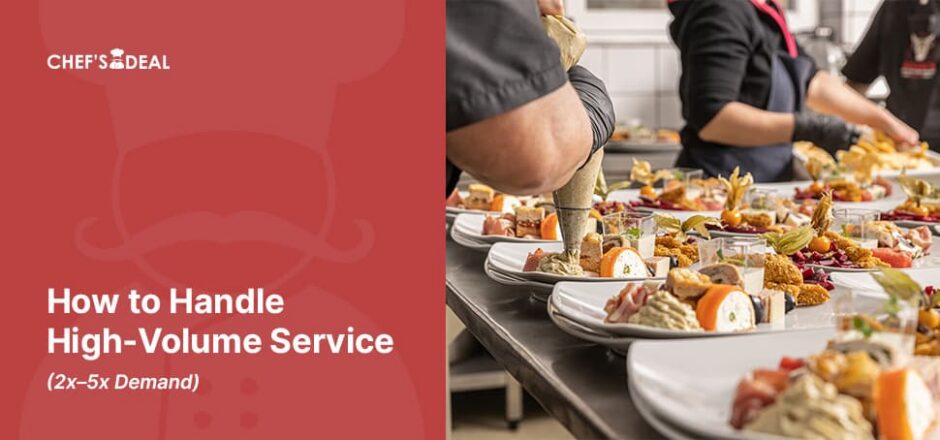


Major sporting events like the FIFA World Cup and the Super Bowl, as well as major festivals, create focus and profitable revenue opportunities for foodservice and beverage-selling businesses. However, this opportunity also presents a challenge in handling high-volume service (2x–5x Demand), since service during a major event requires speed, accuracy, and control. So, there remains a critical possibility of failure as well.
High-volume service does not fail because of bad menus or wrong equipment; it fails because kitchens built for standard throughput are asked to perform at two to five times their normal output without changing how they operate. The margin between a service that runs cleanly under pressure and one that collapses at the first rush comes down to execution decisions made in real time, not preparation decisions made the week before.
The FIFA World Cup 2026, stadium concession operations, and high-demand festival environments all create the same pressure: a sudden, concentrated surge in order volume that exposes every bottleneck in the service flow. The operators who manage that surge successfully are not the ones with the most equipment or the most menu items. They are the ones who simplify, prioritize, and execute with discipline under pressure.
What Happens When Customer Volume Suddenly Doubles or Triples?
Every assumption built into standard service operations becomes a problem when order volume doubles or triples in a short window. The service flow that works at 40 covers per hour does not work at 120 covers per hour. The prep buffer that keeps stations stocked through a normal lunch rush depletes in minutes.
Why High-Volume Service Creates Different Operational Rules?
At standard volume, a kitchen can absorb inefficiencies, a slow ticket, a restocking trip, and a staff member who drifts between tasks, without a visible impact on service speed. At 3x to 5x volume, those same inefficiencies compound, resulting in big service failures.
For example, a 30-second delay at the fryer, unnoticed during normal service, creates a 4-minute backlog during a FIFA World Cup halftime rush, when every order arrives simultaneously. A service staff member was sent to the main cooler to retrieve ingredients, resulting in order losses. Hence, peak service requires a fundamentally different operational model, not just faster execution of the same one.
Throughput Matters More Than Menu Variety During Rushes
During a rush, the metric that determines profitability is throughput, that is, the number of completed orders per hour. A kitchen completing 180 simple transactions per hour at $9 average outperforms one completing 60 complex transactions per hour at $18 average. Every addition to the production sequence that does not directly increase order volume is a burden during peak service.
Small Bottlenecks Become Major Problems at Scale
At standard volume, a bottleneck at a single station slows one ticket. When your traffic reaches 4 times the standard volume, that same bottleneck delays every order moving through the kitchen. A 20-second delay per ticket, at 150 tickets per hour, results in 50 minutes of aggregate lost throughput per service period.
The Most Common Bottlenecks During High-Volume Service
The most common bottlenecks during high-volume service are cooking capacity, prep station, beverage station, and payment & pick-up, which should be identified and eliminated before peak volume arrives.
Cooking Capacity Bottlenecks
Cooking capacity shortage occurs when fryers, griddles, or ovens are at maximum output and incoming volume exceeds their capacity. The practical resolution during a live rush is not to add equipment, since the additional equipment remains idle for a long time after the event season.
The practical solution is to prioritize which item to cook in each cooking unit and to hold some items in batches while the others cook. A griddle running burger patties at maximum capacity should not pause to cook a single item for one ticket; it should batch that item with the next four and release them together.
Prep Station Bottlenecks
The most common prep station failures occur when cooking stations outrun ingredient preparation, when pre-event prep is insufficient, when a menu item requires on-site assembly with multiple components, or when a staff member is pulled from prep to cover another task.
The operational response should immediately assign a dedicated prep role to a staff member during the peak period to replenish the active station’s ingredient supply.
Beverage Station Bottlenecks
Common beverage station tailbacks include throughput problems in event foodservice, ice stocks running out quickly, and tunneling of beverage and food services through the same spot.
Separating beverage pickup from food pickup, dedicating at least one staff member exclusively to ice and beverage management, and pre-chilling product before service all significantly reduce this bottleneck. Read our Beverage Sales Strategy for Sports Events article for further details.

Payment and Pickup Bottlenecks
Payment and pickup bottlenecks still delay the service, causing an obstacle for the people trying to rush for the 2nd half. Designating a clear, labeled payment and pickup area separate from the ordering position, and assigning 2 staff members solely to hand off completed orders and to process orders during peak service, will eliminate most of this congestion.
How High-Performing Kitchens Prioritize Speed During Rush Periods
High-performing kitchens maintain speed during rush periods by simplifying production, reducing menu complexity, and limiting customizations that slow down workflow. Rather than pushing staff to work faster, they focus on maximizing throughput by standardizing orders, prioritizing the most popular menu items, and preventing lower-demand products from disrupting service during peak periods.
Simplify Production During Peak Hours
Temporary production simplification is the fastest and most effective tool available during a rush. When ticket times begin extending beyond target, typically 3 to 5 minutes, in event environments, the first response should be a temporary reduction in production complexity, not an increase in cooking speed.
Removing one high-complexity item from the active menu during the rush reduces the preparation and cooking load at every station, lowers the risk of errors, and frees cooking surfaces for faster items. This is a service-period decision, made and communicated by the kitchen manager the moment ticket times begin to climb.
Focus on Throughput Instead of Customization
Each customization, such as topping substitutions or special preparation requests, disrupts the batch production, requires individual attention, and routes a ticket out of the standard assembly sequence.
During rush periods, high-performing kitchens limit or suspend customization for the peak window. A clearly communicated policy (“standard build only during peak hours”) still addresses customer demand for frequently purchased items while protecting throughput across the entire line.
Protect High-Demand Menu Items First
When production capacity is constrained, protect the items with the highest demand. If fries, hot dogs, and beverages represent 70% of transactions, those three items take priority over everything else in terms of cooking capacity.
Slower-moving items can be temporarily suspended or held for fixed-batch cooking at set times. Keeping the highest-velocity items in constant production ensures that most customers receive their orders quickly, while lower-demand items remain accessible without hindering the preparation of your high-volume items.
Batch Production Strategies That Reduce Wait Times
Batch production helps high-volume kitchens reduce wait times by preparing popular items, such as burgers, fries, hot dogs, and wings, in larger quantities and keeping them in holding equipment.
Batch Cooking vs Cook-to-Order During Rushes
Cook-to-order is appropriate for standard service conditions. Batch cooking is the correct model for high-volume event environments where orders arrive in concentrated waves.
In batch production, a cooking position produces a fixed quantity of a single item, 30 burger patties, two full fryer loads of fries, and releases them to the holding or assembly station simultaneously, while cook-to-order produces several types of items in the same batch in demanded quantities depending on the order.
A kitchen that switches from cook-to-order to batch production during a rush can increase the use of its primary cooking surfaces significantly without changing equipment or staffing.
Which Menu Items Work Best for Batch Production?
The items that work best for batch production are those that maintain safe serving temperatures for 20 to 30 minutes without quality degradation while still offering a high likelihood of revenue.
Hot dogs and sausages held at 140°F (60°C) on a roller grill, burger patties held on a flat-top in a low-heat zone, fries in a warming station, and pre-sauced wings in a food warmer all work well in batch production. Pizza slices held in a display case at serving temperature require no individual production at the point of sale. (Read our The Best Food Ideas to Sell During Major Sports Events article for further menu ideas during events.)
Holding Equipment and Production Timing
Effective batch production depends on holding equipment maintaining safe temperatures between production and service. Hot food must be held at or above 140°F (60°C), and cold food must stay below 41°F (5°C) throughout service.
Production timing should be coordinated so that the next batch is ready before the current holding quantity is depleted, but after the cooking equipment has sufficient capacity to hold the new batch.
How to Organize Kitchen Stations for Maximum Throughput
Maximizing kitchen throughput requires clearly separating prep, cooking, and finishing tasks, minimizing cross-traffic by reducing unnecessary movement, and organizing workflows to prevent staff from interfering with one another. Additionally, keeping frequently used ingredients within easy reach further speeds up service.
Separate Prep, Cooking, and Finishing Tasks
Combining prep, cooking, and finishing at a single station works at low volume and fails at high volume. When one person slices toppings, grills proteins, and assembles the final product simultaneously, it creates a bottleneck.
A single person dedicated to one specific role, such as assembly without touching raw ingredients and cooking the food, can complete final orders two to three times faster than one performing all three functions.
Reduce Cross-Traffic Between Team Members
Cross-traffic, staff moving through each other’s work zones to retrieve ingredients or access shared tools, is a direct throughput cost during peak service. Every unnecessary crossing of a kitchen zone slows two people simultaneously.
Identify the two or three most common crossing points and eliminate them by repositioning a shared container, relocating a tool to the station that uses it most, or designating a one-directional traffic path through the cooking line.
Position High-Use Ingredients Within Reach
Any ingredient that appears in more than 30% of outgoing orders should be within arm’s reach of the station that uses it. During a rush, even 3 to 4 extra feet of travel distance per ticket adds up to minutes of lost output. Reorganizing ingredient placement before or in the first minutes of a rush is one of the highest-impact real-time adjustments a kitchen manager can make.
Staffing Strategies During High-Demand Service
High-demand kitchen staffing depends on assigning clear, specific responsibilities before service, so every team member knows exactly what to work on and where. Avoiding task switching during peak periods is essential, while cross-training key positions provides coverage for high-throughput stations.
Assign Clear Responsibilities Before Service Starts
Every staff member should know their specific task and physical position before the first order arrives. This should be a specific task, not a general role. A printed station map with each person’s name and assigned task, reviewed as a team 15 minutes before service opens, reduces mid-rush confusion more effectively than real-time verbal direction.
Avoid Task Switching During Peak Hours
Task switching is a destructive staffing behavior during high-volume service. When a staff member leaves their assigned position to help with a different task, their station loses production pace, creating a new bottleneck and necessitating an extra staff member. The correct response to a station falling behind is to simplify production at that station and let the batch tempo catch up, rather than pulling a person from elsewhere.
Cross-Train Staff for Critical Stations
Cross-training at least one additional person on every critical station is an execution requirement. When a fryer operator is unavailable, a kitchen without cross-trained backup has two options: remove the item or fall behind on every ticket that includes it.
Cross-training should focus specifically on the two or three highest-throughput stations, the positions where a production gap causes immediate, visible damage to service speed.
How Beverage Operations Affect Overall Service Speed?
Beverage operations directly impact overall service speed, with issues like ice shortages causing immediate stoppages and significant revenue loss during peak periods. Efficient beverage service relies on dedicated roles, a separate beverage service section, proper equipment placement, and pre-chilled inventory.
Why Ice Shortages Create Service Delays?
An empty ice bin during a rush stops beverage orders entirely. Refilling a commercial ice bin during service takes 8 to 12 minutes, during which every beverage transaction requiring ice is delayed.
When you consider that the halftime lasts only 15 minutes during a FIFA World Cup match, this means you lose almost a full-service window. At $3 to $6 per beverage and 60 to 80 beverage orders per halftime, a single 10-minute ice shortage can cost $120 to $360 in direct lost revenue.
Separate Beverage Pickup from Food Pickup
When beverages and food share the same pickup counter, each 15- to 30-second beverage transaction blocks the food handoff. Designating physically separate pickup positions for food and beverages eliminates this collision.
In food truck or stall environments with limited space, a labeled pickup point at the end of the counter is sufficient to direct traffic and reduce congestion.
Reduce Beverage Station Congestion
Beverage station congestion has three consistent causes: one staff member managing both preparation and handoff, a shared pickup area with food, and insufficient pre-chilled product at the point of service.
Assigning one person to beverage preparation and a second to handoff during peak hours, maintaining pre-chilled product in a reach-in adjacent to the service point, and directing customers to a designated pickup area reduces congestion and increases per-hour transaction volume. For event-specific beverage revenue strategies, see Chef’s Deal’s Beverage Sales Strategy for Sports Events.
Managing Customer Expectations During Long Wait Times
Managing customer expectations during long wait times starts with early, clear communication about delays to reduce frustration and maintain transparency in service. Maintaining order accuracy and consistency matters more than speed alone, as customers value correctly fulfilled orders even if they take slightly longer.
Communicate Delays Early
Communicating a delay when it becomes apparent, not after it has already caused a problem, allows customers to make an informed decision and reduces the frustration of an unexplained wait. A visible sign reading “Current wait: approximately 8 minutes” at the order point, or a verbal acknowledgment from the staff member taking the order, converts a potential complaint into a managed expectation.
Maintain Order Accuracy Under Pressure
Order accuracy degrades under high volume when staff prioritize speed over verification. Increasing speed does not mean higher tolerance for wrong food prep. A wrong order delivered quickly is worse than a correct order delivered slightly late. A single-step verification check, reading the order aloud before handing it off, adds 3 to 5 seconds per transaction and prevents the 3- to 5-minute recovery cost of a misfulfilled order.
Why Consistency Matters More Than Speed Alone?
A customer who receives a correctly executed order after a 6-minute wait is more likely to return for a second purchase than one who receives an inconsistent product after a 3-minute wait.
Speed and consistency are sequential priorities. Protect consistency first, then optimize speed within whatever production capacity that consistency requires.
Common Mistakes During High-Volume Service
Common mistakes during high-volume service include expanding the menu, running multiple promotions at once, and failing to enforce clear roles and ignoring production limits.
Expanding the Menu During Peak Hours
Expanding the menu during peak hours introduces new production steps, new coordination requirements, and new possibilities for error across every station. The menu during a rush should be smaller than the standard menu, not larger.
Running Too Many Promotions Simultaneously
Multiple simultaneous promotions create transaction complexity at the payment position and production complexity at the cooking station. During peak service, active promotions should be limited to one, promoted visibly and clearly, and structured to make preparation and processing faster, not slower.
Allowing Staff to Self-Organize During Rushes
When role assignments are not enforced, staff default to the most visible problem rather than the highest-throughput priority. Two people gather at the fryer while the beverage station runs unattended. The kitchen manager’s primary function during peak service is to maintain role assignments to maximize throughput, not to fill in on production tasks.
Ignoring Production Capacity Limits
Continuing to accept orders when ticket times have already exceeded 8 to 10 minutes does not increase revenue. It creates a backlog that takes longer to clear than the peak window lasts, leaving staff managing a recovery period well after the rush has passed. Displaying a temporary wait estimate and restricting the menu are more operationally sound responses than attempting to absorb every new order.
High-Volume Service Checklist
Identify Bottlenecks Before Service
Walk through all the prep, cooking, service, and payment areas to determine the steps most likely to slow down at peak volume before the rush. Adjust ingredient placement or station positioning accordingly.
Simplify Production Where Possible
Remove any menu item that requires more than three production steps or competes for cooking capacity with a higher-volume item.
Confirm Staffing Assignments
Ensure every staff member can state their position and their single assigned task before the first order arrives.
Verify Beverage and Ice Readiness
Ensure ice bins are at least 80% full, pre-chilled product is stocked at the point of service, and one person is assigned exclusively to beverage and ice management.
Review Station Responsibilities
Confirm that prep, cooking, and finishing tasks are assigned to separate positions and that no staff member performs tasks across more than one zone.
Monitor Throughput During Service
One person, the kitchen manager or shift lead, monitors ticket times and makes real-time adjustments to production priority or staffing assignment.

FAQs About High-Volume Service
What is the biggest mistake during high-volume service?
Allowing staff to self-organize during peak periods is the most consistently destructive mistake in high-volume service. Without enforced role assignments, production resources concentrate on visible problems rather than throughput priorities, leaving high-impact stations understaffed and creating bottlenecks that slow service for every customer in the queue.
What causes bottlenecks during busy service periods?
The most common bottlenecks during busy service are cooking capacity limits on primary items, insufficient ingredient prep at the assembly station, ice and beverage depletion, and congestion at a shared pickup counter.
How do restaurants handle sudden demand spikes?
High-performing restaurants handle demand spikes by switching to batch production of primary items, temporarily simplifying the active menu, assigning fixed roles to every staff member, and prioritizing throughput on the highest-volume items.
How can kitchens increase throughput?
Kitchens increase throughput during rushes by switching to batch production, eliminating cross-traffic through station reorganization, assigning dedicated roles to every staff member, protecting high-velocity items from production interruptions, and separating beverage from food operations.
Should menus be simplified during peak demand?
Yes. Reducing the active menu to the three to five highest-volume items eliminates production complexity, frees cooking surfaces, and reduces the cognitive load on every station. The simplification is a service-period decision and can be reversed as soon as volume returns to manageable levels.
Final Thoughts: Turning Demand Spikes into Efficient Service
High-volume service succeeds when operators focus on throughput, protect high-demand items, and eliminate bottlenecks before they spread across the operation.
During major events, kitchens that simplify production, enforce clear roles, and maintain disciplined workflows are better positioned to handle sudden demand spikes without sacrificing service quality.
The goal is not to work faster. The goal is to build a system that continues to perform when demand reaches two, three, or even five times the normal volume.
A single person dedicated to one specific role, such as assembly without handling raw ingredients or cooking, can maintain a faster and more consistent workflow than someone performing all three functions.

