
Event season brings in large crowds, rising demand, and high revenue opportunities for foodservice operators. 2026 promises more opportunities with the FIFA World Cup, Celebrate America 250 festivals, Taste of Chicago, Coachella, and the Indianapolis 500.
To turn this opportunity into profit, you need a well-organized setup to cook, prepare, and serve quickly. So, the operators who capture that revenue aren’t the ones with the biggest kitchens; they’re the ones who prepare well before demand arrives.
Event season preparation follows a clear sequence. It starts with streamlining your menu to fast-prep, high-demand items that can be partially cooked in advance and safely held, then moves into a thorough audit of your equipment.
Because the output figures on a spec sheet and real-world performance under event load are two different numbers. From there, it extends to workflow reorganization, inventory buffers, supplier scheduling, and staff training, each decision building on the one before it.
Every stage of that process carries its own operational weight, from the ice volume required per peak hour to the temperature tolerances your holding equipment must sustain at full capacity.
Organize a well-planned commercial kitchen setup for the event season by following a complete checklist for high-demand periods that outlines specific details, thresholds, and actions across menu optimization, equipment verification, cold storage readiness, beverage planning, inventory preparation, and staffing adjustments.
Getting each one right before demand arrives is what separates a service that runs clean from one that breaks down exactly when the revenue is highest.
Event-Season Execution: Quick-Reference Checklist
| Operational Area | Key Action | Execution Priority |
| Menu | Reduce to 3–5 high-volume items; remove slow-prep and low-frequency dishes | Pre-event |
| Workflow | Separate prep, cooking, and pickup zones; eliminate cross-traffic and shared choke points | Pre-event |
| Batch Prep | Pre-portion proteins, sauces, and toppings; build buffer stock for peak demand | Pre-service |
| Staffing | Assign fixed, single-station roles; avoid multi-tasking during peak service windows | Pre-service |
| Inventory | Stage backup stock for top 3 sellers; monitor depletion in real time during service | During service |
| Beverage & Ice | Pre-fill ice bins; maintain a sufficient ice reserve depending on volume; assign dedicated coverage | Pre-service |
| Equipment | Position high-use equipment (griddles, fryers, hot holding) to match production flow sequence | Pre-event |
| Communication | Use KDS/ticket systems and standardized call-outs; minimize verbal-only coordination | During service |
What Changes During High-Demand Event Periods?
High-demand periods create three primary issues: a sudden increase in order volume, faster service expectations, and greater pressure on the kitchen workflow, all of which require reliable and smart solutions.
Sudden increases in order volume of 2x–5x
Sudden increases in order volume, up to 5 times higher than normal, are the most obvious stressor. But the order volume alone isn’t the only problem. Another problem is the excess load on the equipment rated for standard throughput. Refrigeration equipment struggles to maintain safe temperatures with constant access, and cooking units reach their performance ceiling when staff work at double speed.
Faster Service Expectations from Customers
Sports and music events gather thousands of spectators and audience waiting for faster service. A spectator in a FIFA World Cup match has 15 minutes between the halves, and your average ticket time must be under 5 minutes to ensure efficient service. Otherwise, potential customers will be lost to stands or food trucks next to you.
Higher Pressure on Kitchen Workflow & Equipment
This faster-service requirement places greater pressure on the kitchen workflow and equipment, creating a third stressor. Doors that open and close 300 times per day, rather than 60, accelerate gasket wear in refrigeration systems. Griddles running at maximum output for 6 consecutive hours, rather than 2 hours, experience much higher pressure, which will degrade the components. Every piece of commercial kitchen equipment was designed for normal conditions, but the event season is not a normal condition.
Kitchen Bottlenecks During Peak Hours
Kitchen bottlenecks develop in event-season execution at the station with the lowest production capacity relative to incoming demand. Fryers often become choke points during simultaneous fried-food orders; grills and griddles slow down when proteins, buns, and finishing tasks compete for limited cooking surface space during rush periods.
Assembly stations create bottlenecks when multiple order types require simultaneous access to the same packaging supplies, condiments, or finishing components without dedicated staging for each. Identifying the narrowest point in the production flow before event service begins allows operators to redistribute labor, simplify menus, and increase throughput during periods of compressed demand.
Pre-Event Commercial Kitchen Setup Checklist (Quick Overview)
The high-volume service checklist covers the 8 operational areas that determine whether a kitchen executes well under concentrated demand. Each addresses a distinct failure point that arises during event-season service.
- Simplify the Menu: Limit service to 3–5 core items that cook in under 3 minutes and share overlapping ingredients to reduce prep complexity and ticket delays.
- Increase Prep Volume: Prepare at least 125–150% of projected demand before service begins, including portioned proteins, sauces, toppings, and dry ingredients.
- Assign One Function Per Station: Separate stations into dedicated zones for cold prep, hot cooking, or final assembly to prevent workflow overlap.
- Reduce Staff Movement: Position tools, packaging, ingredients, and utensils within arm’s reach to eliminate unnecessary movement.
- Stage Backup Inventory Nearby: Store backup stock of the top 3-selling items within 10 steps of the production line for rapid replenishment.
- Train Staff for Peak Workflow: Brief staff on event-specific station roles, communication protocols, and simplified menu procedures at least once before service.
- Protect Beverage & Ice Supply: Assign one staff member exclusively to beverage restocking and ice management.
- Match Production to Equipment Cycles: Schedule batch cooking around the slowest equipment to maintain continuous output without creating station backups.
Menu Optimization for High-Volume Service
Optimizing your menu for high-volume service starts with strategic simplification: eliminating complex, multi-step dishes and centering your offering on fast-prep staples like burgers, wings, pizza slices, and fries.
This approach keeps your line moving and your output consistent, while a thoughtfully designed bundle offers to lift the average check by $3–$6 without adding any meaningful complexity to your operation.
Simplify Menu to Increase Speed & Consistency
Simplifying your menu increases speed and consistency in foodservice businesses operating in stadiums, fan zones, and event venues. Identify every item that requires more than 3 preparation steps, needs equipment that can’t run simultaneously, or demands on-site cooking for extended periods. Cut those items for the duration of the event. Fewer menu items with less preparation time enable you to serve more covers and capture more revenue.
Focus on High-Demand, Fast-Prep Items
Focus on high-demand, fast-prep items like burgers, sausages, and pizzas that can be partially prepped in advance using your primary commercial cooking equipment, as explained in detail by Chef’s Deal.
Foods that require a 4-minute cook time but only 30 seconds of assembly are the ideal event menu items. Meat, chicken wings, burgers, pizza slices, and fries can be held at 140°F (60°C) safely for up to 2 hours, giving you a buffer against an instant surge in orders.
Please read our ‘Best Food Ideas to Sell During Major Sports Events‘ article for the high-profit & high-volume.
Bundle Offers to Increase Average Order Value
Bundle offers increase average order value without increasing ticket complexity. A combo menu that pairs your fastest-selling protein, such as a burger or sauce, with a pre-packaged side, like fries, and a fountain beverage adds $3–$6 (USD) to the average check without adding any meaningful cook time.
Equipment Readiness: Capacity & Performance Check
Equipment readiness for high-volume service requires an audit of every piece of equipment in your operation before the event season begins.
Calculate your actual cooking capacity across griddles, fryers, and ovens, accounting for real-world losses under event load, and add. Refrigeration and holding equipment must be verified, maintained, and set to correct temperatures in advance. Your ice production capacity should be tested at peak demand, accounting for the 20–35% output reduction typical in hot-event kitchen environments.
Verify Cooking Equipment Output (Griddles, fryers, ovens)
Verify your cooking equipment output (griddles, fryers, ovens) for your projected volume to ensure equipment readiness before the event season. For example, a commercial griddle with a 100-burger cooking capacity per hour will produce closer to 80-90 burgers per hour under event load due to the loading and unloading time, cleaning and surface preparation, and prep time.
So, calculate the actual cooking capacity and assess how many units are needed to handle the projected sales volume. If that number exceeds what you have, you need to either add equipment or simplify your menu items.
Check Refrigeration & Cold Storage Capacity
Your commercial refrigeration systems must have sufficient capacity to keep you stocked during the season. Commercial refrigerators and freezers must be fully functional to retain safe storage conditions. Walk-in coolers should be set to 38°F (3.33°C) and verified with a calibrated thermometer at least 5 days before your event opens.
Check the door gaskets and the evaporator coil condition, and, more importantly, schedule professional maintenance if your walk-in is more than 8 years old.
Inspect Holding Equipment to Prevent Bottlenecks
Commercial food display and holding equipment streamline foodservice by enabling you to prepare in advance. Food warmers and hot display cases should maintain a consistent temperature of 140°F (60°C) even at full capacity, and cold foods should be kept below 41°F (5°C) to ensure food safety, according to the Minnesota Health Department. To prepare for the event season, such as the FIFA World Cup, all food-holding equipment should be inspected and maintained to ensure reliable operation.
Ensure Ice Production Meets Peak Demand
Ice machine production ratings assume ambient air temperatures of 70°F (21.11°C) and incoming water temperatures of 50°F (10°C). Event kitchens typically operate at an ambient temperature of 80°F–90°F (26.67°C–32.22°C), which reduces production capacity by 20%–35% depending on the machine type. Calculate your daily ice demand, then verify whether your machine’s real-time capacity meets it.
Kitchen Workflow & Station Optimization
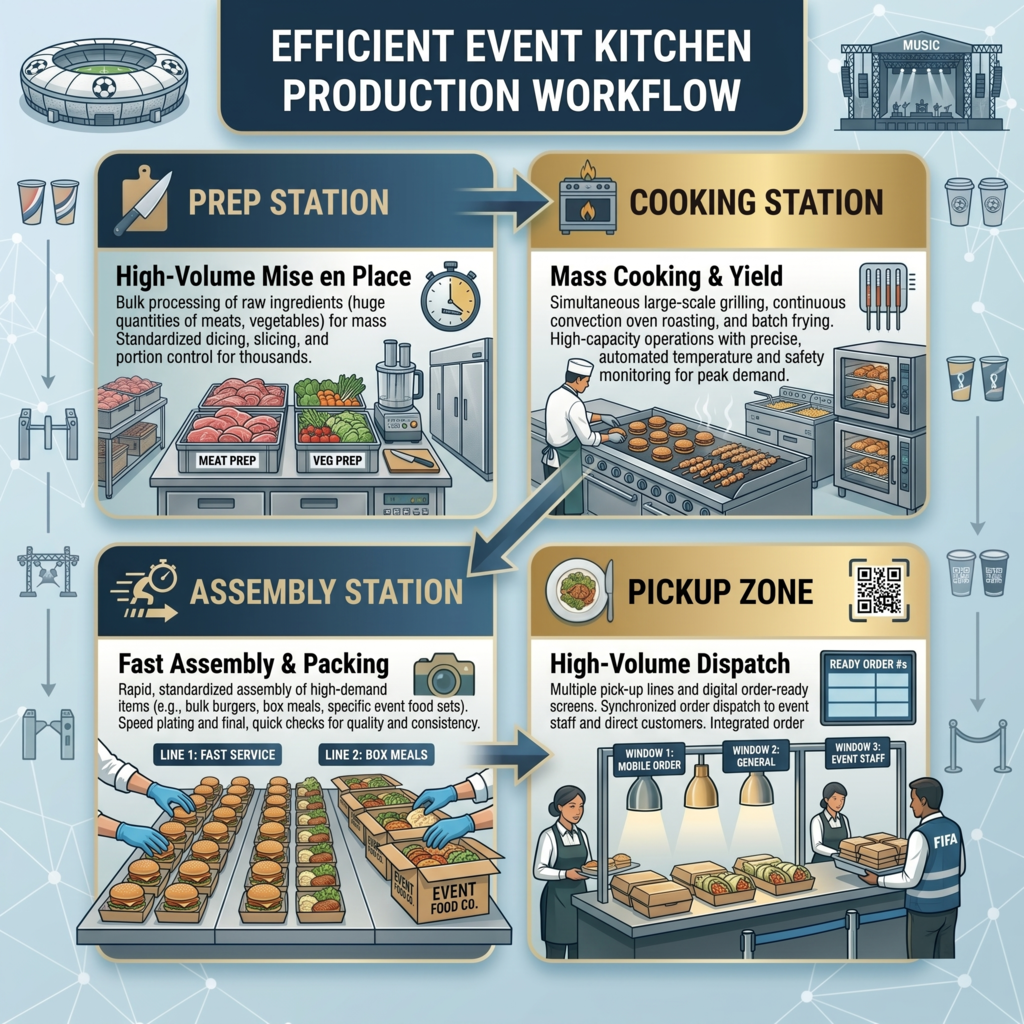
For an optimized kitchen workflow and station, start mapping your current workflow and eliminating unnecessary movement, designating distinct prep, cooking, and pickup zones. Pre-service preparation by portioning sauces, prepping garnishes, and finishing proteins before the rush further minimizes cross-traffic. Aligning your station layout to follow a straight-line sequence from raw ingredients to completed orders keeps the entire operation moving efficiently.
Reorganize Stations for Faster Throughput
Rapidly increasing demand requires a comprehensive organization in your kitchen layout to shorten prep and service time. Hence, map your current layout and identify every step that requires a staff member to move more than 3 feet (0.91 m) from their primary position to complete a task. Condiments, garnishes, plating supplies, and frequently used smallwares must be within arm’s reach of the station executing the final step.
Separate Prep, Cooking, and Pickup Zones
Cross-zone traffic causes ticket errors, staff collisions, and station jams during peak service. So, you should designate separate prep, cooking, and pickup zones to keep workflow organized.
Reduce Cross-Traffic in Busy Hours
Assign all your staff to foodservice during the rush hours, and therefore, you should prepare everything that can be cooked before service opens. Portioned sauces and filled and labeled squeeze bottles, prepared garnishes, and pre-cooked proteins held for final finishing eliminate mid-service trips and reduce cross-traffic.
Please read our ‘Street Food Business Setup for World Cup 2026: Complete Guide for High-Demand Events‘ for details.
Align Workflow with Menu Structure
The kitchen workflow should follow a straight line from raw ingredients to completed orders. Additionally, if your event menu is structured around a primary protein, two side options, and a beverage, your station layout should follow a functional sequence:
Beverage & Ice Planning for Event Demand
Beverage and ice planning demands precise calculation. With an industry-standard 1.5 lb (0.68 kg) of ice per beverage served, a modest 400-cover peak hour can consume nearly 480 lb (217.72 kg) of ice.
High-speed dispensing systems can significantly increase beverage output with no added labor, while assigning a dedicated staff member to monitor and restock ice and beverage supplies at 20-minute intervals during peak hours helps prevent downtime.
Estimate Ice Usage Based on Peak Volume
The event season coincides with the hottest period of the year in the United States. Therefore, you should keep ice bins stocked for cold, refreshing beverage service. The industry standard is 1.5 lb (0.68 kg) of ice per beverage served. At a 400-cover peak hour with 80% beverage attachment, that’s 480 lb (217.72 kg) of ice consumed per peak hour.
Plan to have at least 8 hours of peak-hour demand in storage before your event opens. For a 4-hour event with a peak of 400 covers and 80% beverage orders, a minimum of 1,920 lb (870.91 kg) of ice is required on hand.
Prepare Beverage Stations for Speed
Installing beverage and ice dispensers can produce 40–60 beverages per hour, increasing service speed by up to 3 times compared to station design alone, with no additional labor cost. Using multi-faucet systems and labeling spigots enable faster service and reduced order errors.
Avoid Downtime During Rush Hours
You should assign one staff member to monitor beverage and ice supply levels and execute restocking at 20-minute intervals during peak service to avoid downtime during rush hours. An empty ice bin during a rush takes 8–12 minutes to refill from a machine, during which every beverage order is delayed. That 10-minute gap during peak service can cost 20–40 beverage sales at $3–$6 (USD) each, $60–$240 (USD) in lost revenue.
Inventory & Supply Chain Preparation
Identify your top-selling ingredients, calculate the maximum consumption over the full event duration, and stock at least 20% above that figure to account for waste and unexpected surges. For multi-day events, pre-negotiate mid-event deliveries with your primary suppliers to avoid costly rush charges.
Stock High-Turnover Ingredients in Advance
You should never run out of the most needed ingredients by stocking these items in advance. Hence, you should identify the 5–8 ingredients that appear in your best-selling event menu items and calculate your maximum possible consumption over the event duration. Add a 20% buffer above that number for waste, spillage, and unexpected volume surges.
Adjust Supplier Delivery Frequency
For events longer than 2 days, you should adjust the supplier’s delivery frequency to replenish your ingredient stock. Thus, you should negotiate a mid-event delivery with your primary suppliers before the event begins. A call to your supplier on the matchday or festival time for same-day delivery will cost you more in rush charges.
Plan for Emergency Restocking
You need a plan for emergency restocking if you run out of crucial ingredients during an unexpected surge in orders. So, you should know which items you can source from which store within 2 hours. For events in remote locations, identify the nearest 24-hour broadline distributor and confirm they carry your critical items.
Staffing & Training for Peak Service
Staffing for high-volume event service requires targeted training, clearly defined roles, and deliberate coordination before the season begins. Therefore, run a full-speed simulation at least three days out to expose and eliminate bottlenecks, ensure every team member knows their exact position and responsibilities, and ensure seamless coordination between them.
Train Staff for Speed & Consistency
Your staff needs training in speed and consistency, specifically for the event menu and service flow. A staff member accustomed to your full-standard menu cannot handle a 3-minute ticket time without specific training for that format. Therefore, run a full-speed event simulation at least 3 days before your event opens to identify the slowest step in the sequence and eliminate or accelerate that step before the event.
Assign Clear Roles for Each
Before the event season, you must assign clear roles to each staff member so that every person in your kitchen knows exactly what they will do and where they will stand. You should prepare a printed station map with every staff member’s name at their assigned position and include the specific tasks they are assigned.
Reduce Cross-Traffic Between Staff
Reducing cross-traffic prevents production slowdowns caused by overlapping staff movements during periods of concentrated demand. Organized movement paths and controlled station boundaries improve consistency in throughput across the entire kitchen line.
- Operational Metric: Cross-traffic adds 3–8 seconds per interaction; 30 interruptions per hour remove 2–4 minutes of productive output, equivalent to 2–4 completed orders.
- Movement Rule: Assign directional traffic flow (Prep moves left; finished orders move right).
- Work Envelope: Keep high-frequency tools and ingredients inside each operator’s primary work envelope to reduce lane crossing.
Prepare for Peak Hour Coordination
Shift managers organize the workflow in commercial kitchens, but during the event season, you will need more staff to handle the rush of customers and orders. The hostesses and hosts greet customers, assign tables, and manage reservations to organize the line. Food runners read tickets, call orders, direct servers, and manage the flow of service. You can assign an experienced kitchen staff member to this role during your projected peak period.
Common Mistakes to Avoid During Event Season
An overcomplicated menu slows your line and frustrates guests who prioritize speed. Additionally, the spec sheet ratings and the equipment’s real-world output differ, and both must be evaluated before the event season. Poor work planning creates jams in service flow and requires physical reorganization. Running out of ice or key ingredients is the main reason for the lost revenue.
- Overcomplicating the menu: Overcomplicating the menu with too many ingredients ultimately disappoints customers with slow service, order errors, and inconsistent quality. Guests at events prioritize speed, and a limited menu can be tolerated if the order arrives correctly in 3 minutes.
- Underestimating equipment capacity: Production capacity on the equipment spec sheets reflects the ideal conditions. Therefore, always apply a 15%–20% buffer to account for projected volume when assessing whether your current equipment can meet projected volume.
- Poor workflow planning: It causes jams at the prep station, lengthens ticket times, and slows service speed. The actual solution is a physical station reorganization, moving an ice bin, repositioning a condiment station, or designating a clear pathway between the line and the pickup window.
- Running out of ice or key ingredients: It is an avoidable failure that results in order errors, hot beverages, and profit losses. Therefore, calculate your maximum projected volume, add a 20% buffer, and arrange your supply before your first service days
FAQs About Commercial Kitchen Setup for Event Season
How do restaurants prepare for high-demand events?
Restaurants prepare for high-demand events such as FIFA World Cup matches or festivals by arranging ingredient supplies in advance, creating bundle pricing to increase average order value, inspecting and maintaining equipment readiness, organizing workflow, and assigning roles before the event opens.
What is the most important factor in handling peak service?
The most important factor in handling peak service is to organize the workflow with clear role assignments and to pre-stock ingredients before the event begins.
How can I quickly increase kitchen efficiency?
You can quickly increase kitchen efficiency by reducing your menu to fewer items and ingredients for event service, repositioning every condiment, garnish, and smallware within arm’s reach of the station that uses them, creating an efficient workflow for prep and cooking, to assembly and service.
Do I need new equipment for the event season?
Not necessarily. First, you need to check whether your current equipment can handle your projected volume before the event begins. If your projected demand exceeds what you can prepare, you need additional capacity through rental, supplemental units, or menu reduction to match your existing equipment ceiling. The cheapest option is usually menu reduction, tailoring your menu to your available capacity.
Final Thoughts: Turning Event Demand Into Smooth Operations
Event season promises a profitable period for foodservice professionals and businesses, especially for well-prepared, organized kitchens. A streamlined menu built around fast-prep, high-demand items keeps ticket times under control when order volume doubles.
Equipment audited against real-world output figures, not spec sheet ratings, ensures your cooking, refrigeration, and holding capacity can actually sustain the load. And a kitchen workflow reorganized before service opens, with clearly separated prep, cooking, and pickup zones, eliminates the cross-traffic and station jams that slow everything down at the worst possible moment.
The operational details that separate a clean service from a broken one are measurable. Ice production must account for the 20–35% output reduction that is typical in hot-event kitchens. Holding equipment must sustain 140°F (60°C) at full capacity, not just at rest.
Inventory must be stocked at 20% above the maximum projected volume, with mid-event deliveries pre-negotiated prior to the first service day. Staff must run a full-speed simulation at least three days out, with every team member assigned to a specific position and a specific set of tasks before the event opens.
Preparation is the only variable that operators can fully control before peak demand arrives. The kitchens that turn high-demand events into high-margin operations can do so by reducing complexity, verifying capacity, and stocking properly in advance, using projected demand with buffer zones. Every failure that occurs during an event peak is preventable, and prevention starts well before the event begins.

