

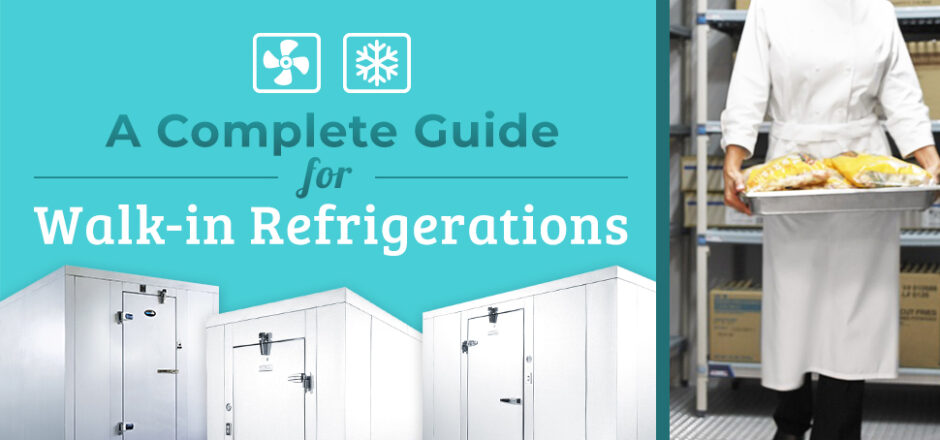
Walk-in refrigeration refers to large-scale refrigerated storage units accessible on foot. These units are designed to store perishable items in large capacities at controlled temperatures.
Commonly used in commercial kitchens, restaurants, supermarkets, and food-processing facilities, these units keep products fresh by maintaining consistent temperatures between approximately 35°F and 41°F (1.7°C to 5°C) for refrigerators or below freezing (around -10°F to 0°F, or -23°C to -18°C) for walk-in freezers.
Walk-in refrigeration units typically feature insulated walls, ceilings, and floors to efficiently maintain temperature and minimize energy usage. They offer ample storage space and easy access, making them ideal for businesses requiring large quantities of food storage.
Why Walk-Ins are Indispensable for Commercial Kitchens?
- Store large quantities of perishable food safely at controlled temperatures.
- Maintain an unbroken cold chain from delivery to preparation.
- Allow staff to walk in, quickly locate products, and maintain workflow.
- Support USDA/FDA regulatory compliance (40°F and below for refrigeration, 0°F for frozen).
- Reduce food waste by preserving freshness longer.
What Temperature Should a Walk-In Cooler and Freezer Be?
A walk-in cooler should be kept between 35°F and 41°F (1.7°C to 5°C), while a walk-in freezer should be maintained between -10°F and 0°F (-23°C to -18°C) to ensure food safety and proper storage.
What is a Walk-in Cooler?
A walk-in cooler is a temperature-controlled storage room that typically operates between 35°F and 45°F (1.7°C to 7.2°C) and keeps perishable food cold but not frozen. Walk-in coolers are ideal for dairy products, fresh produce, beverages, deli items, and florals, any product that requires refrigeration but would be damaged by freezing.
Why 35°F–41°F?
- Prevents bacterial growth (most pathogens multiply rapidly above 40°F).
- Does not cause ice crystal formation that can damage food texture.
- Meets FDA Food Code requirements for cold holding of potentially hazardous foods.
- Aligns with USDA guidance for commercial food storage.
What is a Walk-In Freezer?
A walk-in freezer maintains temperatures between -10°F and 0°F (-23°C to -18°C), keeping food solidly frozen for long-term storage. Walk-in freezers are used for bulk meat, seafood, poultry, frozen vegetables, and ice cream. They require heavier insulation (typically R-32 or higher), insulated flooring to prevent ground frost, and more powerful refrigeration systems than coolers.
Walk-In Freezer Temperature Range by Product
| Product | Optimal Freezer Temp | Storage Duration |
| Beef & Pork | 0°F to -10°F | 4–12 months |
| Poultry | 0°F to -10°F | 9–12 months |
| Seafood | -10°F | 2–6 months |
| Ice Cream & Desserts | 0°F to -5°F | 2–3 months |
| Vegetables (IQF) | 0°F to -10°F | 8–12 months |
Walk-In Freezer Temperature Standards?
- USDA requirement: 0°F for frozen food storage in commercial operations
- FDA Food Code: Frozen foods must be maintained frozen solid
- NSF standards require equipment to maintain a set temperature under maximum load conditions
- Regular temperature monitoring and logging are required for health inspection compliance
How cold is a walk-in freezer? A properly operating commercial walk-in freezer should maintain a temperature between -10°F and 0°F. If you notice temperatures climbing above 0°F, it may signal a possible refrigeration system failure. Inspect door gaskets, defrost cycles, and the condenser immediately.
Walk-In Temperature Comparison Table
| Feature | Walk-in Cooler | Walk-in Freezer |
| Temp. Range | 35°F – 45°F (2°C – 7°C) | -10°F – 0°F (-23°C – -18°C) |
| FDA Standard | ≤ 41°F | ≤ 0°F |
| Ideal For | Produce, dairy, beverages, florals, raw proteins, prepped foods, cold chain compliance | Meat, seafood, ice cream, bulk frozen goods |
| Insulation (R-value) | R-25 standard R-30 recommended | R-32 to R-40 Required for low temps |
| Flooring | Optional insulated floor | Insulated floor required (frost prevention) |
| Sizing Rule of Thumb | 1.5 cu ft per meal/day served | 1.0–1.5 cu ft per meal/day |
| NSF Certification | NSF/ANSI 7 | NSF/ANSI 7 |
| Typical Starting Price | $6,000+ | $8,000+ |
Walk-In Cooler and Freezer Temperature Standards (FDA 2022)
The FDA Food Code 2022 mandates that all Time/Temperature Control for Safety (TCS) foods, including raw meat, cooked foods, dairy, and cut produce, must be held at 41°F (5°C) or below during cold storage. For frozen foods, the USDA requires temperatures at or below 0°F (-18°C). Failure to comply results in failed health inspections, fines, and potential food safety incidents.
| Storage Category | Min Temp (°F) | Max Temp (°F) | Standard | Unit Type |
| Fresh produce & dairy | 33°F | 41°F | FDA Food Code 2022 | Walk-in Cooler |
| Raw meat, poultry, seafood | 33°F | 41°F | FDA Food Code 2022 | Walk-in Refrigerator |
| Bulk frozen food | -10°F | 0°F | USDA / FDA | Walk-in Freezer |
| Ice cream & frozen desserts | -10°F | -5°F | FDA / NFPA | Walk-in Freezer |
| Beverages / Keg beer | 36°F | 50°F | Industry Standard | Walk-in Cooler |
| Floral cold storage | 34°F | 40°F | Industry Standard | Walk-in Cooler |
| ⚠ FDA Food Code 2022, Section 3-501.16: Potentially hazardous foods (time/temperature control for safety) must be held at 41°F or below during cold holding. | ||||
What is The Difference Between a Walk-in Cooler and a Walk-in Freezer?
The main differences between a walk-in cooler and a freezer are their temperature ranges, purposes, structure, and energy consumption.
1. Temperature Range
- Walk-in Cooler: Typically maintains temperatures between 35°F and 45°F (1.7°C to 7.2°C). This range is ideal for keeping perishable foods like vegetables, dairy, meats, and beverages cold but not frozen. It’s suitable for items that need to be readily accessible and stored at a temperature that prevents spoilage without altering their fundamental characteristics.
- Walk-in Freezer: This freezer is designed to keep temperatures between -10°F and 0°F (-23°C to -18°C). This much colder environment is essential for storing items that must be kept frozen, like meat, frozen desserts, and certain prepared foods. The lower temperatures in a walk-in freezer preserve food for extended periods by inhibiting bacterial growth and preventing spoilage.
2. Purpose and Use
- Walk-in Cooler: This cooler is used for items that will be accessed more frequently and don’t require deep freezing. This includes produce, dairy products, and other perishables used daily in restaurants or grocery stores.
- Walk-in Freezer: This freezer is used for long-term storage of items that must remain frozen. This includes bulk meat storage, frozen goods for retail, and items that won’t be used immediately.
3. Structural Differences
- Insulation: Walk-in freezers typically have thicker insulation than coolers to maintain the much lower temperatures.
- Refrigeration System: The freezer systems are more robust and are designed to consistently achieve and maintain lower temperatures.
- Flooring: Walk-in freezers often have insulated floors to prevent ground frost, whereas coolers might not require insulated flooring, depending on their placement and use.
4. Energy Consumption
- Walk-in freezers consume more energy than coolers because maintaining lower temperatures requires more power.
What are The Types of Walk-in Coolers and Freezers?
There are three main types of walk-in units: remote, self-contained, and multiplex. Since freezers and coolers operate similarly, their models are identical, and you can find them in both machines.
1. Self-Contained Walk-in Cooler and Freezers
Self-contained walk-ins are complete packages. As the name suggests, the evaporator and condenser are in a single unit. Self-contained walk-in cooler and freezer units are usually placed outside the buildings, making them outdoor walk-in coolers and freezers.
2. Remote Walk-in Cooler and Freezer
Remote walk-in cooler and freezer units have separate condensers and individually packaged evaporators. These models are quite popular among business owners since they are usually built indoors. Restaurant kitchens generally prefer indoor walk-in coolers.
3. Multiplex Walk-in Coolers and Freezers
Multiplex walk-ins are built indoors. They are called “multiplex” because they have more than one condensing unit and evaporator, unlike other walk-in cooler and freezer units.
Walk-in coolers and freezers are categorized by installation features, such as placement and floor type. Consider these aspects when choosing the best walk-in for your business space.
4. Outdoor Walk-in Coolers and Freezers
Outdoor walk-in coolers and freezers are built outside your building. These units have many advantages: they don’t take up much-needed indoor space, and ventilation is relatively easy since the air can be blown directly out. So, if you have limited space and a separate condenser would cause problems, you should consider an outdoor walk-in unit.
Though outdoor walk-in coolers and freezers have some disadvantages, they require additional security (for weather conditions and theft). Plus, you need to go outside to access your products. While they are minor issues that can be solved, you might not want to spend time or money on outdoor equipment if you are running a big restaurant.
5. Indoor Walk-in Coolers and Freezers
Indoor walk-in coolers and freezers are installed inside your facilities. If you don’t have space issues, indoor units are perfect. There are many advantages to indoor walk-in coolers and freezers. They are easy to clean. You can quickly access your products, and the cost is significantly less since you don’t need additional security precautions. Unfortunately, they might raise your kitchen temperature because their condensers can’t directly blow hot air outside. So this might mean you spend more on AC during the summer.
You can find more information about outdoor and indoor walk-ins in our ‘Outdoor vs. Indoor Walk-in Refrigeration: Which is Right for You?‘ article.
6. Walk-in Coolers and Freezers With and Without Floors
You must consider flooring before making your decision. Walk-in coolers and freezers with floors come with built-in floors and offer specific benefits to your business.
- Since they are insulated, they help you save a lot of energy. A built-in floor is a healthier and more logical option for saving energy, especially if you plan on buying an outdoor unit.
- The level ground will make it easy to carry carts in and out of the unit. When a big shipment comes, you wouldn’t want an uneven floor causing problems while holding the products inside.
- Walk-in coolers and freezers without floors are an option. Companies usually install foam or rubber screeds to maintain insulation with these units. There are various flooring options, and you can choose whichever you like.
There are a couple of different types of walk-in coolers and walk-in freezers that you might want to consider.
7. Custom Walk-in Cooler
The word custom means designed for a specific purpose. You can get custom walk-in coolers and freezers perfectly tailored to your needs and desires. You can decide on almost everything, from size to finish, to create the best unit for your business to thrive.
8. Portable Walk-ins
As the name suggests, portable walk-in coolers and freezers are mobile units. They are mainly used by delivery businesses and restaurants to transport frozen foods and store ice cream during big festivals or events. So, you could benefit from a portable walk-in cooler or freezer if you transport products or run a business that serves at significant social events.
9. Quick Ship Walk-in Coolers and Freezers
Quick-ship units are often overlooked, but manufacturers’ quick-ship programs offer many advantages to customers. Unlike customized models, quick-ship units are built using standardized panels and measurements. They are sent from stock, so their fast arrival is bound to save you a lot of time. Instead of waiting for a custom model, you can order a quick-ship walk-in cooler or freezer and start your business immediately.
10. Walk-in Refrigerators for Homes
Did you know you could get a walk-in unit for your home kitchen? There are now many walk-in coolers for regular kitchens on the market. Their extra storage room and beautiful design appeal to a broad audience. Many people are investing in walk-in units for their homes, opening the door to the future.
What is a Walk-in Cooler and Freezer Combination?
A walk-in cooler and freezer combination is a large, integrated refrigeration unit (one part functions as a cooler, and the other as a freezer) for commercial kitchens, grocery stores, and other food service establishments. This setup is incredibly efficient for businesses requiring substantial storage space for refrigerated and frozen products.
Key Benefits of a Combo Unit
- One set of infrastructure (panels, electrical, plumbing) supports both functions
- Reduces total floor space compared to two standalone units
- Eliminates the need for a second set of condensers and ventilation systems
- Ideal for small-to-medium restaurants, cafes, catering kitchens, and convenience stores
Combo Configuration Options
- Size: Standard sizes starting from 6’×12′ to custom dimensions
- Temperature Zoning: Multiple temperature zones within one unit
- Shelving: Adjustable and heavy-duty shelving tailored to your inventory
- Door Types: Swinging or sliding doors; single or double
- Flooring: Stainless steel, aluminum, or reinforced resin
Walk-in cooler-freezer combos start at around $15,000 for a 6’×12′ unit; larger or custom models can exceed $50,000. Lead times typically range from 2 to 6 weeks. Contact Chef’s Deal for a current price list.
You can find more information about combi walk-ins in our ‘Walk-In Cooler Freezer Combo Guide‘.
How to Size a Walk-In Cooler or Freezer for Your Restaurant
The correct size for your walk-in refrigeration unit depends on your daily meal volume, product turnover rate, and the types of items stored. Undersizing leads to overcrowding and temperature instability; oversizing wastes energy and space.
The 1.5 Cubic Foot Rule
The industry standard sizing formula is 1.5 cubic feet of storage space per meal served per day. For example, a restaurant serving 200 meals per day needs a walk-in cooler with at least 300 cubic feet of usable storage space. Walk-in freezers typically use a ratio of 1.0 to 1.5 cubic feet per meal, depending on how much frozen product you turn over weekly.
Practical Sizing Steps
- Calculate your daily meal count.
- Multiply by 1.5 (cooler) or 1.0–1.5 (freezer) to get the required cubic feet.
- Add 20–25% for shelving, aisles, and expansion buffer.
- Verify the unit’s dimensions fit your available floor space, with a minimum clearance of 2 inches on top and 1 inch on all sides for ventilation.
- Confirm your building’s electrical supply: plan for approximately 5 HP for a cooler and 1 HP per 100 cubic feet for a freezer.
Standard Walk-In Sizes Available
| Footprint | Approx. Volume | Best For | Est. Meal Capacity |
| 6′ × 6′ | ~180 cu ft | Cafes, small bars | ~120 meals/day |
| 6′ × 8′ | ~240 cu ft | Small restaurants | ~160 meals/day |
| 8′ × 10′ | ~400 cu ft | Mid-size restaurants | ~267 meals/day |
| 10′ × 12′ | ~600 cu ft | Full-service restaurants | ~400 meals/day |
| Custom | Varies | Large operations, hotels, catering | Customized |
Thermal Load Considerations
Beyond physical dimensions, the unit’s BTUH (British Thermal Units per Hour) rating must match your space’s thermal load. Thermal load accounts for heat entering through the walls, door openings, product load, and lighting. Undersizing the refrigeration system leads to temperature instability, equipment strain, and premature failure.
Featured Walk-in Brands
Many brands offer a range of walk-in freezer and cooler models for different budgets. You can find the right one for your business in seconds, thanks to the various options on the market.
- American Panel
- AmeriKooler
- Arctic Industries
- Dade
- Kolpak
- Master-Bilt
- Mr.Winter
- Nor-Lake
- Bally
- Imperial Brown
- US Cooler
What are The Walk-in Coolers and Freezers’ Main Parts and Accessories?
A commercial walk-in refrigeration system consists of three core components that work together to maintain precise temperatures: the condensing unit, the evaporator coil, and the compressor. Insulation, doors, latches, gaskets, and hinges, exterior ramps, and door curtains are important components of walk-ins.
Condensing Unit
The condensing unit (the condenser) is the heat-rejection component of the refrigeration system. It releases the heat absorbed from inside the walk-in to the outside air. Condensing units are available in two configurations: self-contained (mounted on top of or beside the walk-in) and remote (installed outdoors or away from the unit). Remote condensers are preferred for walk-in freezers because they eliminate heat and noise from the kitchen, which is critical for maintaining ambient kitchen temperatures and staff comfort. For outdoor installation, a rain roof and weatherproofing are required.
Evaporator Coil
The evaporator coil is located inside the walk-in unit and absorbs heat from the stored food and air, cooling the interior. Evaporator coils require regular defrosting, either via automatic defrost cycles or manual defrosting, to prevent ice buildup that reduces efficiency and airflow. Models with automatic defrost are strongly recommended for freezers to minimize downtime and reduce the manual labor of manual defrost.
Compressor Types
The compressor circulates the refrigerant through the system. The three types used in commercial walk-in refrigeration are scroll, screw, and piston (reciprocating) compressors. Scroll compressors are the most common in walk-in coolers due to their fewer moving parts, quieter operation, and greater energy efficiency. For low-temperature freezer applications, scroll compressors rated for low-temperature refrigerants such as R-448A or R-449A (lower-global-warming-potential alternatives to R-404A) are the industry-preferred choice.
Insulation
Insulation is the most critical passive component of a walk-in system. The industry-standard R-value for walk-in coolers is R-25, though R-30 is recommended for energy savings; better insulation reduces the compressor workload and lowers utility bills. Walk-in freezers require R-32 to R-40, depending on the target temperature. The most common insulation material is polyurethane foam, injected between metal panels. Freezer floors must also be insulated (at least 4 inches of polystyrene is recommended by the South Carolina Department of Agriculture) to prevent ground frost heaving.
Doors
Doors are probably the most critical aspect of commercial walk-in coolers and freezers. They seal out cold air and ensure your unit works efficiently. You have several options: slide doors, swing doors, and long glass doors.
Latches, Gaskets, and Hinges
Since doors are used repeatedly throughout the day, you must ensure they are not damaged. Latches, gaskets, and hinges can wear out over time and stop sealing your unit, which is why they should be high-quality in the first place. You should clean and inspect them regularly.
Exterior Ramps
If you have a walk-in cooler or freezer without a floor, you will need an exterior ramp to carry your products in and out of the unit.
Door Curtains
Door curtains are accessories that help maintain a stable temperature. Plus, you can customize their size according to your walk-in cooler and freezer measurements.
Health, Safety & OSHA Compliance for Walk-In Refrigeration
Walk-in refrigeration units in commercial settings are subject to OSHA regulations, FDA Food Code requirements, NSF standards, and USDA guidelines. Non-compliance can result in fines, forced closures, and reputational damage.
Critical Compliance Requirements
| Standard | Requirement | Application |
| FDA Food Code | Cold food ≤40°F at all times | All commercial kitchens |
| USDA | Refrigerated ≤40°F; Frozen at 0°F | Food processing & restaurants |
| OSHA | Interior safety release, emergency lighting, non-slip floors | Staff safety compliance |
| NSF | Design & sanitation standards for equipment | Equipment certification |
OSHA Walk-In Safety Requirements
- Interior safety release mechanisms (latches) on all walk-in doors are mandatory for freezers
- Emergency lighting for power outage visibility and safe evacuation
- Non-slip flooring and adequate drainage inside the unit
- Ceiling plugs to prevent cord-related tripping hazards
- Temperature monitoring alarms to alert personnel to malfunctions
- Staff training on proper operation, emergency exit procedures, and cold injury prevention
Walk-In Food Storage Best Practices (USDA/FDA Guidance)
- Store raw meats on the lowest shelves, below ready-to-eat foods, to prevent cross-contamination from dripping liquids
- Place dairy and beverages on upper-middle shelves, away from the door
- Follow FIFO (First In, First Out) rotation for all perishable inventory
- Never store non-food items (cleaning chemicals) inside a food walk-in
- Monitor and log temperatures at least twice daily for compliance records
Energy Efficiency: Operating Costs and Best Practices
Walk-in freezers consume significantly more energy than coolers; maintaining -10°F requires far more compressor work than maintaining 38°F. While ENERGY STAR certification is not yet available for walk-in units, several design and operational choices significantly reduce energy consumption and operating costs.
- Walk-in cooler-freezer combos: Combination units cost 10–15% less to purchase than two separate units and share a single condensing system, reducing installation complexity and energy consumption.Organizing Tips for Walk-in Freezers and Coolers
- High-quality insulation: R-30 or higher insulation reduces heat transfer and compressor runtime. The payback period on upgraded insulation is typically 2–3 years in energy savings.
- LED lighting with motion sensors: LED lighting generates significantly less heat inside the unit than fluorescent fixtures, reducing the cooling load. Motion-activated sensors prevent lights from running unnecessarily.
- Door gaskets and strip curtains: Door gasket integrity is the single most common source of energy waste in walk-in units. Inspect gaskets monthly for tears, compression loss, or gaps. PVC strip curtains on high-traffic doors reduce cold air loss by up to 40%.
- Automatic defrost scheduling: Schedule defrost cycles during off-peak hours (late night / early morning) to minimize temperature fluctuations during service.
- Scroll compressors and modern refrigerants: Units using scroll compressors with R-448A or R-449A refrigerants provide better energy efficiency and significantly lower global warming potential than older R-404A systems.
Organising Tips for Walk-in Refrigeration
An organized walk-in is the key to efficiency. With proper organization of your walk-in cooler and freezer, you can extend the shelf life of your products and save time, energy, and money. Here are some tips to help you increase the benefits of your units.
- Use the first-in, first-out method. FIFO is a widely used method for ensuring that products bought first are used first, preventing waste.
- Label your products and shelves. Labeling will help you determine what is in the packages (some products look alike), when they were bought, and where certain products are within your walk-in. You can even use color codes to classify your ingredients.
- Make sure that your bottom shelves are 6 inches above the ground. Leaving a certain amount of space between your products and the floor will decrease the possibility of contamination.
- Store your meat on the bottom shelves. Meat might drip, and you wouldn’t want to contaminate your other products, as it could cause food poisoning and lead to health code violations.
- Don’t overstuff your walk-in coolers and freezers. Air must circulate for your unit to work properly, so ensure there is enough space for airflow.
Safety Tips and Warranties for Walk-in Refrigeration
Warranty is a crucial aspect of any purchase, including walk-in coolers and freezers. Make sure to find out about the warranty conditions for the machine you plan to buy. Some companies offer up to a 50-year warranty. After choosing a unit with good warranty conditions, you need to learn about safety. As it is with everything, safety comes first. Below are the tips to help you with your walk-in freezer and walk-in cooler.
- Check your thermometer upon receiving your shipment. Even though companies calibrate thermometers, you need to make sure that they are working accurately. An uncalibrated thermometer could cost you a lot of money and cause you to fail your health inspections.
- Make sure the floor is clean and dry. Spills left uncleaned could potentially cause your employees to slip and injure themselves.
- Have cold-weather clothes nearby for your employees who need to work in the walk-in cooler or the freezer.
- Don’t exceed your shelves’ maximum weight limit. Overstuffing could cause your shelves to break and fall, causing physical and financial damage.
- Make sure safety releases on doors are intact and functioning. In the case of entrapment, people must have access to a safe release. This is a critical point, and negligence regarding safety releases on doors could result in death, so you must check them regularly.
- Keep your unit clean to prevent bacteria and mold from forming on your food and employees.
- Check your products regularly for spoiled ones. Spoiled products can cause mold and lead to health code violations.
- Beware of the odor of your walk-in unit. An unpleasant smell usually indicates spoiled food, bacteria, or spills that have not been cleaned up yet.
Walk-in Refrigeration Maintenance and Repair Tips
Regular preventive maintenance extends the life of your walk-in, ensures food safety compliance, and prevents costly emergency repairs.
Daily:
- Check and log interior temperature (cooler: ≤41°F; freezer: ≤0°F)
- Inspect door gaskets for tears, gaps, or ice buildup
- Verify door closes and seals fully after each use
Weekly:
- Clean the evaporator coils of dust and debris
- Check for ice buildup on coils (a sign of defrost cycle issues)
- Inspect and clean floor drains
- Verify alarm systems and temperature sensors are functioning
Monthly:
- Clean condenser coils thoroughly
- Inspect all panel seams and caulking for gaps or moisture intrusion
- Check all hinges, latches, and safety releases
- Review temperature logs for patterns or anomalies
Annually:
- Schedule a professional refrigerant level check and system tune-up
- Replace door gaskets if worn
- Inspect insulation panels for moisture damage or delamination
- Review energy consumption vs. baseline and consider upgrades if above target
Converting a Walk-in Refrigeration
Converting a walk-in refrigerator offers versatility in its usage. Whether transforming a cooler into a display unit or altering temperature settings, such conversions require careful consideration of the unit’s design and technical specifications. It’s essential to consult professionals to ensure the conversion efficiently meets operational needs and safety standards.
Can You Convert a Walk-in Cooler to a Display Cooler?
Display coolers are in demand more than ever. If you run a store, you surely need a cooler to showcase your beverages. Instead of buying a separate display cooler, you might want to convert your walk-in cooler into one.
Yes, you read that right; turning your commercial walk-in cooler into a display cooler is possible. You need to alter a few features, such as doors and shelves. Still, it is easier than it seems.
To make your products more accessible to your customers, get a long glass door and invest in shelves suited to a display cooler. Pay attention to lighting. A well-lit cooler will appeal to your customers and increase your profits. If you are unsure how to convert your walk-in cooler into a display cooler, contact the relevant companies for professional help. While you might have opinions, a professional will help you narrow them down and execute your plan flawlessly.
Can You Convert a Walk-in Freezer to a Cooler or a Walk-in Cooler to a Freezer?
The difference between the two units might seem very small, and you might think that you can convert one to another by simply changing the temperature. Well, it is not as easy as you might think. Walk-in freezers and coolers, including components such as compressors, are built to work at specific temperatures.
If you set a freezer’s temperature higher, the compressor designed for low temperatures will malfunction. The same will happen for a walk-in cooler compressor, too. It will simply have trouble working at a lower temperature than it was built for.
To convert your unit, you must make many changes, including to the compressors. Buying a brand-new unit perfectly tailored to your business needs makes more sense considering the money and energy required to convert.
Time to Buy a New Walk-in Cooler & Freezer?
The signs to look for!
From the beginning of this article, efficiency is the keyword for walk-in coolers and freezers. When a unit becomes inefficient, it’s time to replace it. To understand whether your walk-in is failing you, pay attention to a few details: doors, sounds, bills, and temperature.
- Even though walk-in unit doors are pretty strong, they are bound to weaken over time. If a door starts to leak air, you will have problems such as icing and unstable temperature.
- If your bills are spiking, there must be a reason. Your walk-in might be trying to compensate for its temperature, using more energy than usual.
- Loud noises are never good signs. While you should call a maintenance service for weird sounds, if your machine is old and the sound is constant, it’s a clear sign you need to replace your unit.
How Much Does a Walk-in Cooler and Freezer Cost?
The cost of walk-in coolers and freezers ranges from $7,000 to $30,000, depending mainly on the unit size. Thanks to the many options on the market, you can find suitable equipment within your budget.
What to Know Before You Buy
Walk-in refrigeration is a major capital investment that requires professional installation. Unlike reach-in equipment, walk-ins must be integrated into your building’s electrical, HVAC, plumbing, and structural systems.
- Professional HVAC technician required: Refrigerant handling, condensing unit commissioning, and system charging must be performed by an EPA Section 608-certified technician.
- Electrical requirements: Plan for approximately 5 HP (208–230V, 1Ph or 3Ph) for a standard walk-in cooler. Larger or freezer units may require 3-phase power.
- Indoor vs. outdoor installation: Indoor units are less expensive but require significant floor space. Outdoor units eliminate heat and noise from the kitchen but require weatherproofing (rain roof, sealed base) and may need additional security features.
- Prefabricated vs. custom: Prefabricated walk-ins (modular panel systems using cam-lock connections) are easier to install, relocate, and reconfigure. Custom-built units are permanent and designed for specific spatial constraints.
- Lead time: Standard prefabricated units typically ship within 2–6 weeks. Custom units may require 8–12 weeks. Plan installation 1–3 days after delivery.
- Brand options at ChefsDeal: American Panel, Amerikooler, Kolpak, Master-Bilt, Mr. Winter, and Norlake, all available at competitive prices with full manufacturer warranties.
FAQs About Walk-in Refrigerators and Freezers
What temperature should a walk-in cooler be?
A walk-in cooler should maintain between 35°F and 41°F (1.7°C–5°C). The FDA requires commercial cold holding of potentially hazardous food at 40°F or below. For maximum food safety, keep your walk-in cooler at 38°F–40°F under normal operating conditions.
What temperature should a walk-in freezer be?
A walk-in freezer should operate between -10°F and 0°F (-23°C to -18°C). The USDA requires commercial frozen food storage at 0°F. Temperatures above 0°F indicate a system malfunction requiring immediate attention.
What is the standard walk-in cooler temperature range for food safety?
The standard walk-in cooler temperature range for food safety is 35°F to 45°F (1.7°C to 7.2°C), with the FDA-mandated cold holding limit of 40°F. The ideal operating temperature is 38°F–40°F to maintain a safety buffer against door openings and product loading that temporarily raise interior temperatures.
What is a walk-in refrigeration unit?
A walk-in refrigeration unit is a large-scale commercial storage room that maintains a controlled temperature for perishable food, beverages, flowers, pharmaceuticals, and other temperature-sensitive products. Unlike standard refrigerators, walk-in units allow personnel to physically enter to access stored items. They are the standard cold storage solution for restaurants, grocery stores, hotels, hospitals, and any high-volume commercial foodservice operation.
How cold are walk-in freezers compared to coolers?
Walk-in freezers are approximately 35°F–55°F colder than walk-in coolers. A cooler targets 35°F–41°F, while a freezer must reach -10°F to 0°F. This greater temperature differential requires thicker insulation, more powerful refrigeration systems, and higher energy input for walk-in freezers.
If the walk-in cooler air temperature is 41°F or above, what should happen?
If a walk-in cooler air temperature reaches 41°F or above, the following steps should be taken immediately: (1) Remove all temperature-sensitive items to alternate cold storage; (2) Log the temperature deviation with timestamps; (3) Contact your refrigeration service technician; (4) Check door seals, condenser operation, and defrost cycles; (5) Report the incident as required by your local health authority. Do not serve or use food that has been held above 40°F for more than 2 hours.
How do I know what size walk-in I need?
For restaurants, the industry rule of thumb is 1.5 cubic feet of walk-in storage per meal served per day. For example, a restaurant serving 200 meals per day needs approximately 300 cubic feet of total cooler and freezer space. Account for delivery frequency (less frequent = more storage needed), menu mix (produce-heavy vs. protein-heavy), and future business growth when sizing your unit.
What is a restaurant walk-in refrigerator?
A restaurant walk-in refrigerator is a commercial walk-in cooler designed to meet the demanding storage requirements of professional kitchens. It provides large-capacity cold storage at 35°F–41°F for daily-use ingredients, including dairy, produce, meats, prepared sauces, and beverages. Restaurant walk-in refrigerators typically incorporate shelving systems, LED lighting, digital temperature controls, and NSF-certified materials to meet food safety standards.
What are the three types of walk-in condensing units?
The three types of walk-in condensing units are: (1) Self-Contained, the condenser and evaporator are integrated in one unit, typically mounted outside the walk-in; (2) Remote — the condenser is located away from the walk-in (roof, exterior wall) connected via refrigerant lines, reducing heat and noise inside; (3) Multiplex — a centralized compressor rack serves multiple refrigeration units simultaneously, used in large supermarkets and distribution centers.
You can read more detailed information about walk-in condensers in our ‘All About Walk-In Condensers‘ blog.
Your Walk-In, Your Food Safety Foundation
A walk-in cooler or freezer is the single most critical cold storage decision your operation will make. Every food safety standard your kitchen is held to, every health inspection your team prepares for, and every dollar of perishable inventory on your shelves depends on one thing: a unit that reliably maintains the right temperature, every shift.
The rules are straightforward. Per the FDA Food Code 2022, Section 3-501.16, walk-in coolers and refrigerators must maintain a temperature of 41°F or below for all TCS foods. Walk-in freezers must hold 0°F or below. Your unit must carry NSF/ANSI 7 certification. Your temperatures must be logged, your corrective actions documented, and your storage positioned correctly from bottom shelf to top.
What separates operators who pass inspections confidently from those who scramble is having the right equipment from the start.
Updated by Jeremy Anderson 19.03.2026


10 comments On Walk-In Refrigeration: The Complete Guide for Restaurant Operators
Pingback: 26 Key Factors When Buying Walk-in Refrigeration ()
Pingback: 3 Main Types of Walk-In Condensers - Chef's Deal ()
Pingback: Walk-in Floor Considerations - Chef's Deal ()
Pingback: The Best Coffee Shop Equipment List in 5 Steps - Chef's Deal ()
Pingback: 4 Categories Of School Kitchen Equipment – Chef's Deal ()
Pingback: Butcher Shop Equipment List: 15 Equipment You Should Have ()
Pingback: Commercial Bar Equipment and Supplies- Chef's Deal ()
Pingback: What To Know About Correctional Facility Kitchen Equipment ()
Pingback: 6 Main Grocery Store Equipment – Chef's Deal ()
Pingback: Choosing Hotel Supplies - Chef's Deal ()